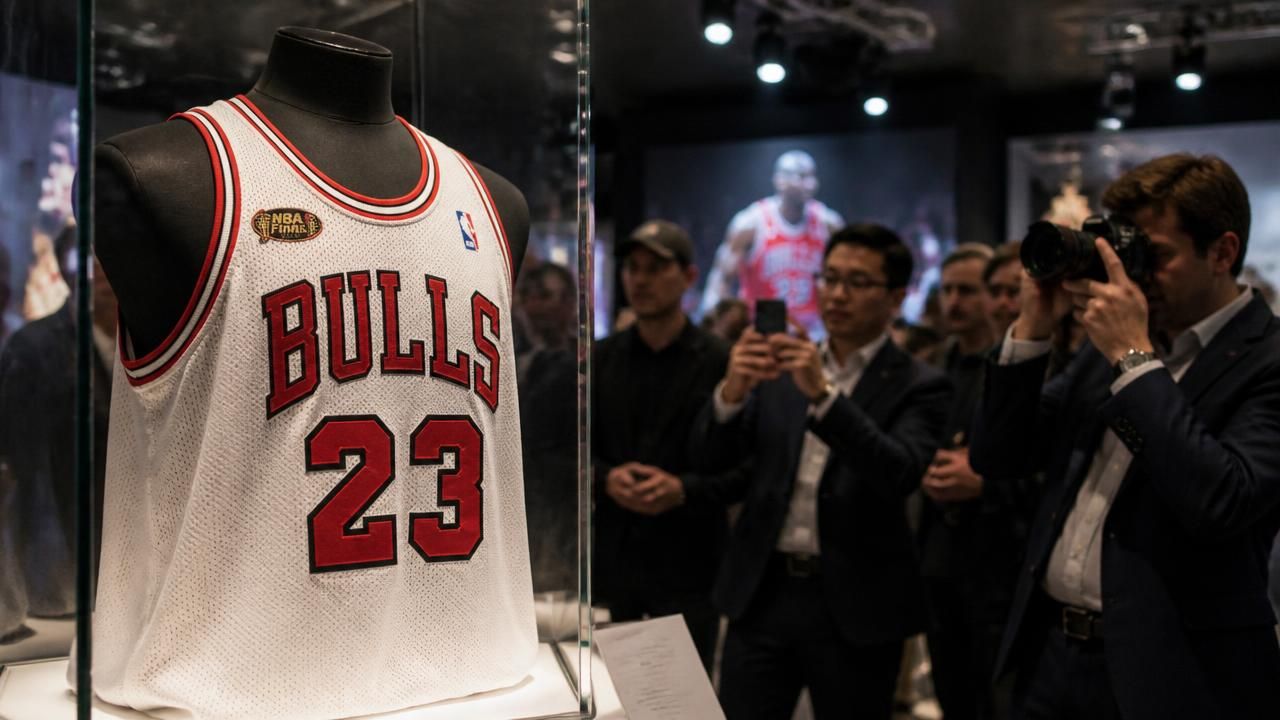
A game-worn Michael Jordan jersey from Game 3 of the 1998 NBA Finals — the championship run immortalized in ESPN's "The Last Dance" — has been consigned to auction with an opening bid of $10 million, a figure that would instantly rank it among the most valuable pieces of sports memorabilia ever sold at public sale.
The lot is being offered by JOOPITER, the digital-first auction house founded by musician and designer Pharrell Williams in 2022. In an interview with Bloomberg Markets, Caitlin Donovan, JOOPITER's global head of sales, framed the offering less as a piece of fan merchandise and more as a maturing asset class.
"Sports memorabilia is one of the fastest-growing parts of the collectibles market," Donovan said, describing game-worn items as an emerging "alternative asset class" attracting collectors and investors who once confined themselves to fine art, watches or classic cars.
The Jersey and the Moment
Jordan wore the jersey on June 7, 1998, when the Chicago Bulls dismantled the Utah Jazz 96-54 at the United Center in Game 3 of the Finals — still the largest margin of victory in NBA Finals history. Jordan scored 24 points that night, and the Bulls went on to close out the series in six games, securing the franchise's sixth championship and the final title of the Jordan era.
That context is central to the valuation. Memorabilia from the 1998 Finals carries a premium because it marks the definitive end of the Bulls dynasty and the subject of the most-watched documentary in ESPN's history, which reintroduced Jordan to a generation of collectors with disposable income.
The Record It Is Chasing
The $10 million opening bid is not arbitrary. In September 2022, Sotheby's sold Jordan's Game 1 jersey from the same 1998 Finals for $10.1 million — the current record for a game-worn basketball jersey and, at the time, a record for any game-worn sports jersey. A 1997 "Flu Game" jersey reportedly crossed the $10 million threshold again in 2023.
Basketball memorabilia, however, still trails the card market. A 1952 Topps Mickey Mantle card fetched $12.6 million in 2022, and a T206 Honus Wagner has traded above $7 million. Sports collectibles overall have been boosted by a broader pandemic-era surge in alternative assets, with auction houses, fractional-ownership platforms and grading companies all competing for a slice of the market.
The $100 Million Claim
The most aggressive framing of the sale came from the New York Post, which reported exclusively that the jersey's owner believes it could fetch as much as $100 million — a figure roughly ten times the current record for a basketball jersey and one that would eclipse virtually every piece of sports memorabilia ever sold.
That claim drew immediate skepticism from market participants who note that opening bids are marketing devices as much as price discovery mechanisms. An auction house can set a high floor to generate headlines and attract bidders, but the final hammer price depends on a far smaller pool of ultra-wealthy buyers than the fine-art market commands. A $100 million result would place the jersey in the same conversation as works by Warhol or Basquiat, a comparison most collectors consider a stretch.
How the Coverage Split
The story, which broke across at least nine outlets, was framed in markedly different ways depending on the audience:
- Bloomberg treated it as a financial-markets story, leading with JOOPITER's sales chief and the growth of memorabilia as an investable category.
- The New York Post led with the eye-catching $100 million figure and the owner's confidence, prioritizing spectacle over market nuance.
- Sports Illustrated and Heavy.com emphasized the potential record for a basketball jersey, keeping the focus on Jordan's legacy.
- Regional and aggregator outlets such as MSN and WGAL framed it as consumer-interest news, with headlines promising a "Last Dance" artifact that "could sell for over $10 million."
That divergence reflects a familiar split in collectibles coverage: business outlets assess the asset class, tabloids chase the headline number, and sports outlets anchor the item in athletic history.
Why It Matters
JOOPITER's involvement is itself notable. Founded by Williams as a digital-native house that dispenses with traditional catalogues in favor of online drops, it has positioned itself at the intersection of culture and commerce — selling objects associated with figures like Williams himself, Nigo and other tastemakers. Landing a Jordan Finals jersey signals the house's ambition to compete with Sotheby's, Christie's and Heritage Auctions for blue-chip consignments.
For the broader market, the auction is a test of whether sports memorabilia can sustain the valuations it reached during the 2020-2022 boom, a period when stimulus-fueled cash and lockdown boredom pushed card and jersey prices to unprecedented highs. Since then, parts of the market have cooled, with some card indices retreating sharply from their peaks.
The result will be watched closely by collectors, consignors and auction houses alike. If the jersey sells near or above its opening bid, it will reinforce the case that game-worn memorabilia from transcendent athletes has become a durable store of value. If it stalls, it may signal that even Michael Jordan — and even the last shot of the last dance — has a price ceiling.
What is not in dispute is the artifact itself: a piece of fabric worn during the final championship run of the most commercially significant basketball player in history, now offered as a financial instrument as much as a relic.