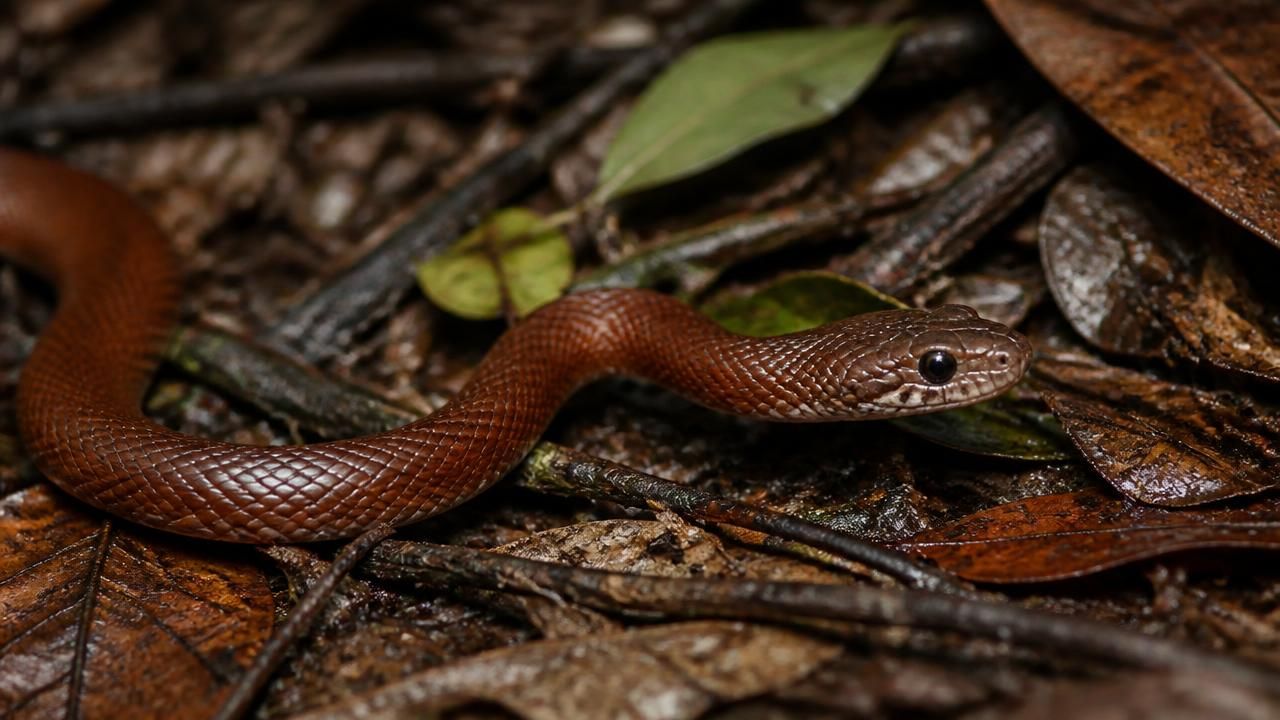
Scientists have identified a new species of snake in New Guinea, and it now bears the name of a rock legend. The reddish-brown groundsnake, formally named Lielaphis slashi, honors Guns N’ Roses guitarist Slash, a longtime reptile enthusiast. The discovery, confirmed through genetic testing and physical analysis, adds a new branch to the tree of life in one of the world’s most biodiverse regions.
The snake is nonvenomous and likely nocturnal, according to researchers. It has been found in the forests of New Guinea, where it may use large rear teeth to catch slippery prey such as lizards and reptile eggs. Its reddish-brown coloration helps it blend into leaf litter and forest floor debris.
A New Species Hidden in Plain Sight
For years, the snake was likely mistaken for a relative. Only after scientists compared its DNA with known species and examined its scales, teeth, and body shape did they confirm it was distinct. The genus Lielaphis was already known, but Lielaphis slashi is new to science. The formal description was published after peer review, marking another entry in the catalog of New Guinea’s fauna.
New Guinea is a hotspot for biodiversity. Its rainforests host countless species of reptiles, amphibians, birds, and insects, many of which remain undocumented. Each new species underscores how much remains unknown—and how quickly habitats are changing.
Why Slash?
Naming a species after a celebrity is not new. Scientists have honored musicians, actors, and writers before, often to draw attention to conservation or because the honoree has a personal connection to the natural world. Slash, whose real name is Saul Hudson, has spoken about his lifelong fascination with reptiles. That passion made him a fitting namesake for a snake that is itself a bit of a rock star in the taxonomic world.
The naming highlights the intersection of science and popular culture, and it may help spark public interest in a group of animals that often receives less attention than charismatic mammals.
The choice also reflects a tradition in taxonomy: species names can honor people, describe physical traits, or mark geographic locations. Lielaphis slashi combines the genus name with Slash’s stage name, ensuring the guitarist’s legacy is tied to the forests of New Guinea.
A Nocturnal Hunter with Specialized Teeth
Details about the snake’s behavior are still emerging, but its anatomy offers clues. The large rear teeth are unusual among its relatives and suggest a diet of hard-to-hold prey. Lizards and reptile eggs are slippery or brittle, and specialized teeth can help a snake grip and crack them. Its nocturnal habits mean it likely hunts under the cover of darkness, using scent and heat detection to navigate the forest floor.
Unlike venomous snakes, Lielaphis slashi poses no danger to humans. Its nonvenomous nature and secretive lifestyle mean it is rarely encountered. That elusiveness may be why it took so long to identify.
Habitat at Risk
The snake’s forest home is under pressure. New Guinea’s rainforests face logging, mining, agricultural expansion, and road building. Climate change adds another layer of stress, altering rainfall patterns and pushing species to adapt or move. For a newly described snake with a narrow range, these threats are especially acute.
Conservationists argue that documenting new species is only the first step. Protecting habitat is essential. Without it, the name Lielaphis slashi could become a memorial rather than a celebration. The discovery therefore serves as both a scientific milestone and a warning.
How Different Outlets Framed the Story
Science Daily focused on the taxonomic details: the genetic testing, the physical differences, and the snake’s likely diet. Other outlets, including Yahoo and MSN, highlighted the celebrity angle and the nocturnal nature of the snake. One MSN headline emphasized that the new snake is unlike its relatives and that its forest home is at risk. Together, these framings show how a single discovery can be told through the lenses of science, pop culture, and conservation.
The story also illustrates the value of genetic testing in modern taxonomy. What once might have been dismissed as a color variant is now recognized as a distinct evolutionary lineage. As DNA sequencing becomes cheaper and more accessible, scientists expect to uncover many more hidden species—especially in tropical forests.
What’s Next
Researchers will continue to study Lielaphis slashi to learn about its range, population size, and ecology. Field surveys in remote New Guinea are difficult and expensive, but they are necessary for effective conservation. Meanwhile, the name Slash may bring attention to the snake and its habitat, a small but valuable benefit of an unusual honor.
For Slash, the recognition is a rare intersection of rock and roll and herpetology. For scientists, it is a reminder that the natural world still holds surprises—and that naming a species is only the beginning of the work to protect it.