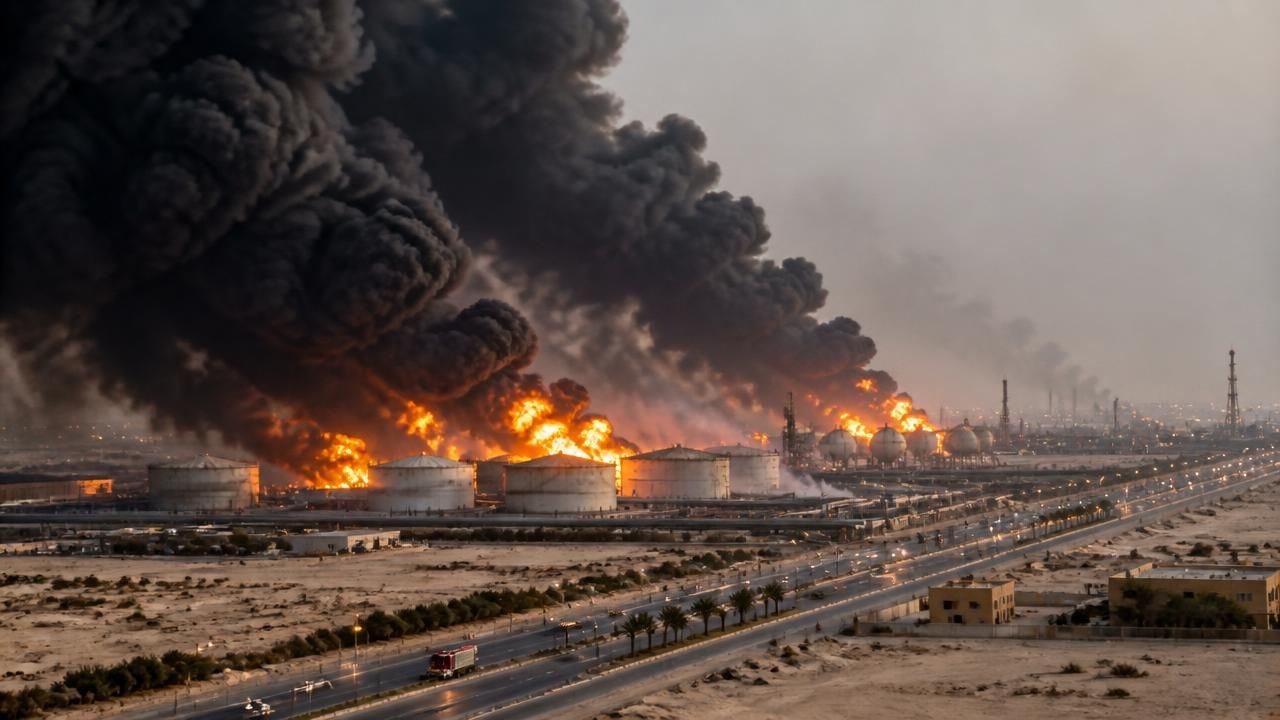
Fires burned at Saudi Arabian energy facilities, at least 73 people were wounded, and global crude prices climbed toward $100 a barrel this week as Yemen's Houthi movement mounted its largest territorial offensive in years — a campaign that has reignited a 12-year civil war, threatened the kingdom's principal oil export route and drawn in governments from Washington to New Delhi.
The scale of the escalation became clearer with each passing day. Houthi forces seized an island in the Red Sea, pushed toward full control of the Bab el-Mandeb chokepoint, and launched missile and drone strikes on Saudi energy infrastructure and, according to the group, on an oil tanker off the Saudi port of Yanbu. Saudi Arabia responded by shutting down its East-West pipeline and issuing mass public alerts, while its warplanes struck a Red Sea port city and airport held by the Houthis.
A week that changed the war's geography
The Houthis' land grab — their most significant in years — extended their reach to a key maritime corridor at the southern mouth of the Red Sea. OilPrice.com described the advance as a bid to gain complete control over the crucial Bab el-Mandeb oil chokepoint, through which a substantial share of Europe- and Asia-bound crude and refined products transit.
Saudi officials confirmed that attacks ignited fires at oil facilities and wounded 73 people, a toll carried by the Associated Press and republished by HuffPost, MSN and Riverbender. Separately, Saudi authorities said debris from an intercepted Houthi drone killed one person. The Houthis, in turn, said Saudi airstrikes left three dead.
"The Houthis' biggest land grab in years reignited Yemen's 12-year civil war and pushed up global fuel prices, extending their reach to a key maritime chokepoint and threatening Saudi Arabia's oil exports." — NPR News
The oil lifeline under strain
At the center of the crisis is Saudi Arabia's East-West pipeline, the 746-mile conduit that carries crude from the eastern fields to Red Sea terminals, allowing Riyadh to bypass the Strait of Hormuz. The Mercury News examined what the pipeline's closure could mean for global oil flows — a question with few comfortable answers. With Hormuz already a perennial flashpoint and Bab el-Mandeb now contested, Saudi Arabia faces the prospect of simultaneous pressure on both of its export outlets.
Market reaction was immediate. Oil prices approached $100 a barrel after the fresh attacks on Saudi energy sites, a threshold that analysts warn could feed directly into global inflation and consumer fuel costs.
One regional expert, quoted by MSN, called the moment the biggest threat ever to Saudi oil production — a characterization that underscores how far the Houthis have moved from a ragtag insurgency to a force capable of striking the world's most important petroleum supply chain.
Diplomacy scrambles as the region braces
Saudi Crown Prince Mohammed bin Salman traveled to Egypt to seek support, according to the Mercury News, a sign that Riyadh is courting Arab allies rather than relying solely on its own military response. Washington's posture remained ambiguous: President Trump said he had no regrets about the Iran war, even as Fox News reported that Iran had pushed the Houthis to capture Yemeni Red Sea ports and attack Saudi Arabia — framing the campaign as a proxy confrontation with Tehran.
India, a major buyer of Saudi crude and a stakeholder in Red Sea shipping, voiced explicit concern. "Houthi strikes on Saudi threaten Bab-el-Mandeb navigation, security," Indian officials said, in statements reported by Business Standard, the Deccan Chronicle and Times Now. For New Delhi, the stakes are twofold: energy security and the safety of the sea lanes that carry a large share of its trade with Europe.
Why the Houthis keep growing stronger
The Boston Herald posed the question that has quietly frustrated a decade of Western and Gulf policy: why Yemen's Houthis have only grown stronger through years of war. The answers are structural. Airstrikes have degraded but never broken the movement's command structure; the group has refined drone and missile tactics at relatively low cost; and its control of northern Yemen's population centers has given it a durable recruiting base.
The current offensive also reflects a shift in Houthi strategy — from harassing shipping to physically seizing ground adjacent to the strait, converting a nuisance into a chokehold.
What to watch next
- Oil prices and spare capacity. Whether crude holds near $100 depends on how quickly Saudi Arabia can restore pipeline flows and reassure buyers.
- The Bab el-Mandeb. Any formal Houthi attempt to close or tax the strait would force a multinational naval response.
- Egypt and the Suez Canal. Reduced Red Sea traffic already threatens Suez revenues; a broader closure would compound Cairo's economic troubles.
- Iran's role. If U.S. intelligence confirms direct Iranian direction of the campaign, the conflict could widen beyond Yemen's borders.
- Humanitarian fallout. Yemen's war has already produced one of the world's worst humanitarian crises; renewed fighting risks another displacement wave.
What began as a localized offensive has rapidly become a test of the global energy system's resilience — and of whether any outside power can still shape events in a country where, after 12 years of war, the Houthis appear to be the ones setting the terms.