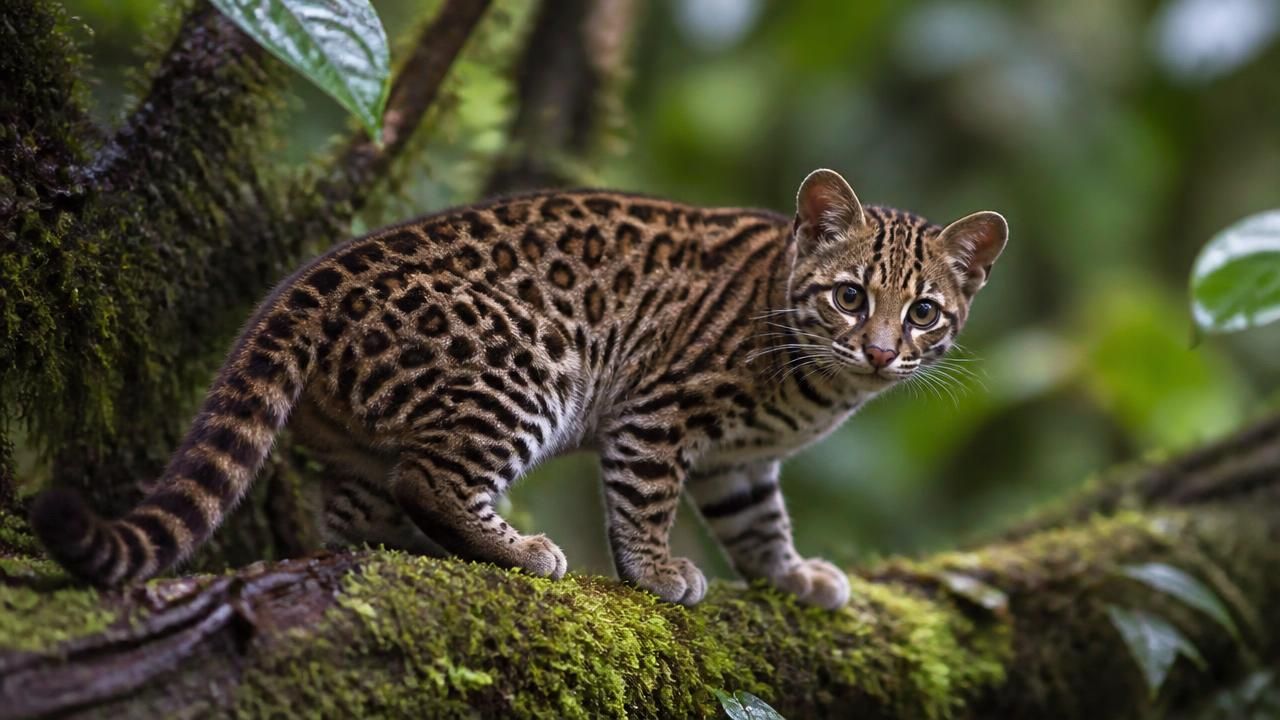
Scientists have identified a previously unknown species of wild cat living in the cloud forests of Bolivia — the first time a new living feline species has been formally named and described in more than a century. The animal, which local communities call the tilcayo, is a miniature predator that measures roughly 18 inches (46cm) in length and weighs about 3 pounds (1.4kg), making it smaller than the average domestic house cat.
The discovery, reported across a wave of international coverage, places the tilcayo in the genus of so-called tiger cats — a group of small spotted felines distributed across much of South America, including the oncilla and the pampas cat. Researchers say the cat was found in Bolivia's Yungas, a mountainous forest region where the canopy is frequently wrapped in cloud and humidity hangs heavy in the air.
A Miniature Leopard Hiding in Plain Sight
With its rosetted, leopard-like coat and diminutive frame, the tilcayo fits the profile of a cryptic forest predator: small enough to escape notice, camouflaged enough to evade cameras, and nocturnal enough to have slipped past decades of survey work. Several outlets seized on that imagery, with one headline describing it as a "mini leopard" and Scientific American billing it as "the first new species of cat discovered in more than a century — it's adorable."
The scientific significance, however, runs deeper than its photogenic qualities. Formally naming and describing a new living felid is an exceptionally rare event. Taxonomists note that the last comparable description of a new living wild cat species dates to the 19th century, when the Andean cat was documented from the high Andes. Since then, new cats have occasionally been proposed as subspecies or reclassified after genetic analysis, but a genuinely new species — described, named and published — had not emerged in over 100 years.
"A diminutive wild cat that inhabits Bolivia's cloud forest has been identified as a previously unknown species, marking the first time a new living feline species has been formally named and described in more than a century," the Guardian reported, noting that the animal is known locally as the tilcayo.
Why the Yungas Rewards — and Punishes — Explorers
The Yungas form a narrow, steep belt of forest running down the eastern flank of the Andes, where warm Amazonian air meets cold mountain currents and condenses into near-permanent mist. The result is one of the most biodiverse — and least surveyed — ecosystems on the continent. Steep gradients, dense undergrowth and persistent fog make systematic wildlife surveys expensive, slow and physically punishing.
That inaccessibility helps explain the century-long gap. It also explains why local knowledge proved decisive. The name tilcayo comes not from a laboratory but from the communities who live alongside the animal and have long recognized it as distinct from its relatives. Scientists working in the region drew on that familiarity to target their fieldwork.
- Size: about 18 inches (46cm) long and roughly 3 pounds (1.4kg)
- Habitat: Bolivia's Yungas cloud forest, a humid, mountainous region
- Group: tiger cats (Leopardus), found across much of South America
- Local name: tilcayo
- Significance: first new living cat species named and described in over a century
How Different Outlets Told the Story
The coverage split into recognizable genres. Specialist science and wildlife outlets — Scientific American, Discover Wildlife — led with the discovery itself and the visual appeal of the animal, foregrounding the photographs and the taxonomy. The Guardian emphasized the formal milestone, the local name and the ecological setting of the Yungas. Regional and international wire-style reports, syndicated widely across MSN and similar aggregators, compressed the story into a single claim: a new cat species, identified for the first time in 100 years.
Indian and Middle Eastern outlets took a more human-interest angle, with the Times of India inviting readers to "Meet Tilcayo" and ynetnews emphasizing that this was the first new living cat species in over a century — a careful qualifier that distinguishes the finding from fossil descriptions. Devdiscourse filed it under Science-Environment, reflecting how such discoveries are increasingly framed as environmental news rather than purely taxonomic curiosities.
What the Discovery Means for Conservation
Newly described species arrive with an immediate practical problem: almost nothing is known about their population size, range or threats. A species that has only just been named cannot yet be assessed for the IUCN Red List, and without baseline data, conservation planning is guesswork. Small, forest-dependent cats are particularly vulnerable to habitat fragmentation, agricultural encroachment and road building — pressures that are intensifying across the Andean slopes.
The tilcayo's discovery also carries a broader scientific message. If a felid — a relatively well-studied, charismatic order of mammals — can remain undescribed for a century in a forest that scientists have visited for generations, the inventory of life in the world's cloud forests is far from complete. Every such finding strengthens the case for protecting the Yungas and similar ecosystems, not only for the species already known to science but for the ones still waiting to be named.
For now, the tilcayo exists in the record as a name, a description and a set of measurements — the beginning, rather than the end, of what researchers will need to learn about it.