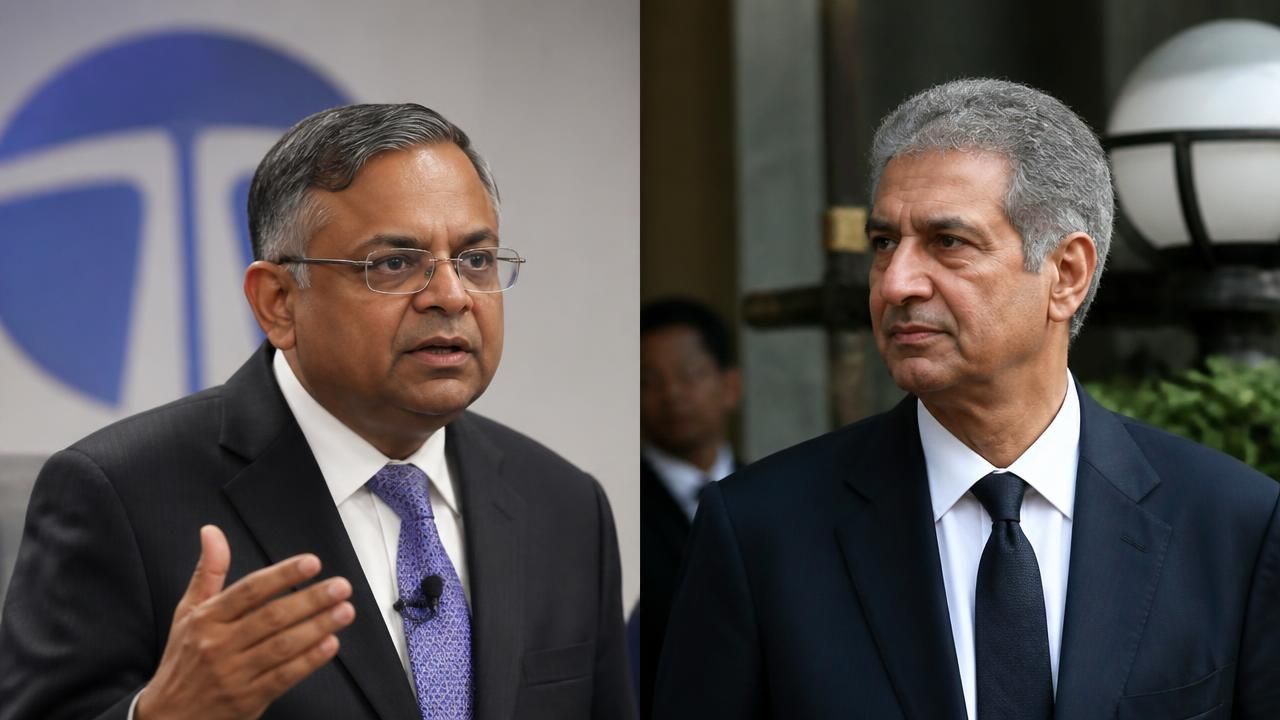
Tata Sons Pvt., the holding company at the apex of India's sprawling Tata Group, has handed chairman N Chandrasekaran a fresh five-year term and declared it will pursue a stock-market listing — decisions that the Tata Trusts, the conglomerate's largest shareholder, have publicly denounced as “illegal” and a “legal nullity.”
The clash, which unfolded inside a single board meeting and spilled into duelling public statements, sets up the most serious governance confrontation at Bombay House since the era of Ratan Tata, and has reopened a long-simmering question about who ultimately controls one of India's oldest and most influential corporate empires.
Bloomberg Markets, the Financial Times and Forbes all framed the outcome as a full-blown showdown: Tata Sons pressing ahead despite the very public opposition of the founding-family patriarch, Noel Tata. Indian outlets, including Mint and India.com, led instead with the raw mechanics of the vote — the board granting the extension, the trusts immediately calling it illegitimate.
What the board decided
According to Tata Sons' own statement, the board resolved to re-appoint Chandrasekaran for another five years and to move toward a listing of the holding company. The Trusts, which hold roughly two-thirds of Tata Sons' equity, responded by rejecting the validity of the proceedings, describing the reappointment vote as a “legal nullity” and insisting that proper process had not been followed. MSN and India.com carried the Trusts' language almost verbatim: the reappointment of N Chandrasekaran as chairman, they said, was “illegal.”
The competing accounts diverge sharply on what actually happened in the room. One strand of coverage — circulated across MSN aggregations — describes Chandrasekaran as having signalled a willingness to step down, with the Trusts responding that they would “respect his decision.” Other reports describe Noel Tata telling the board it was time to “move on” from Chandrasekaran entirely. Yet the board's formal statement granted him another full term. The contradictions reflect a dispute in which both sides are competing to define the record.
The listing flashpoint
The deeper conflict is not personal but structural. Tata Sons is classified by the Reserve Bank of India as an upper-layer non-banking financial company, a designation that carries a listing mandate. Mint reported that Tata Sons is facing an IPO deadline tied to an RBI decision, with the central bank weighing how strictly to enforce it.
Noel Tata has pushed back hard. According to accounts of his position, he argues that listing would fundamentally alter the institution's nature.
“Listing will destroy its character,” Noel Tata is reported to have said, pushing back after the board backed an IPO.
For the Trusts, which fund a vast network of philanthropic endowments, a public listing raises uncomfortable questions: it would bring external shareholders into a vehicle whose purpose has always been to hold and protect the Tata operating companies — from Tata Consultancy Services to Tata Motors and Tata Steel — while channelling dividends into charity. A market listing would also dilute the trusts' grip and subject the holding company to quarterly disclosure and public-market discipline. The board's counter-argument, implied in its decision to proceed, is that regulatory compliance is not optional and that the trusts' objections cannot indefinitely override an RBI mandate.
Succession: who next?
The Trusts have already begun the search for a successor, according to MSN reports, kickstarting a process that undercuts the board's five-year extension. Speculation has centred on a small field of internal candidates, among them:
- Noel Tata — the founding family's patriarch, now firmly at the centre of Tata Group affairs after years on the fringes, and the leading voice against both the reappointment and the listing.
- TV Narendran — the long-serving chief executive of Tata Steel, widely regarded as one of the group's most credible operational leaders.
- Other internal executives who would represent continuity with Chandrasekaran's restructuring agenda.
Mint captured the irony bluntly: after years in the wings, Noel Tata “has taken centrestage, and inherited a leaky chalice.” Whoever succeeds Chandrasekaran inherits not just a conglomerate but a governance fight, an unresolved regulatory deadline and a shareholder relationship that has turned openly adversarial.
A governance flashpoint for India Inc
Reuters framed the crisis as a broader reckoning, noting that the Tata turmoil has “rekindled India Inc's succession debate” — a reminder that many of the country's family-founded conglomerates still rely on informal dynastic authority that sits awkwardly alongside modern board governance. Where the Trusts see a defending of institutional character, the board's defenders see an attempt by a philanthropic shareholder to override fiduciary and regulatory obligations. Where the board sees necessary compliance, the Trusts see an unaccountable management entrenching itself.
Chandrasekaran, who took over in 2017 after the turbulent removal of Cyrus Mistry, has spent his tenure simplifying the group's sprawling portfolio, cutting debt and pushing digital transformation. That legacy now sits in the balance. Analysts caution that a prolonged public fight could unsettle the group's listed companies, complicate capital-raising and invite greater regulatory scrutiny of the Tata Trusts' own governance.
What happens next is unclear. The Trusts could escalate legally, challenging the board's authority in court or through the registrar of companies. The RBI could clarify — or tighten — its listing deadline. And the board could find that pressing ahead with a chairman its majority shareholder considers illegitimate is not sustainable, no matter how the vote was recorded.
What is certain is that the page, as Noel Tata put it, has turned. The Tata Group — a symbol of Indian industrial nationhood for more than a century — is now fighting over what it is: a family trust, or a public company.