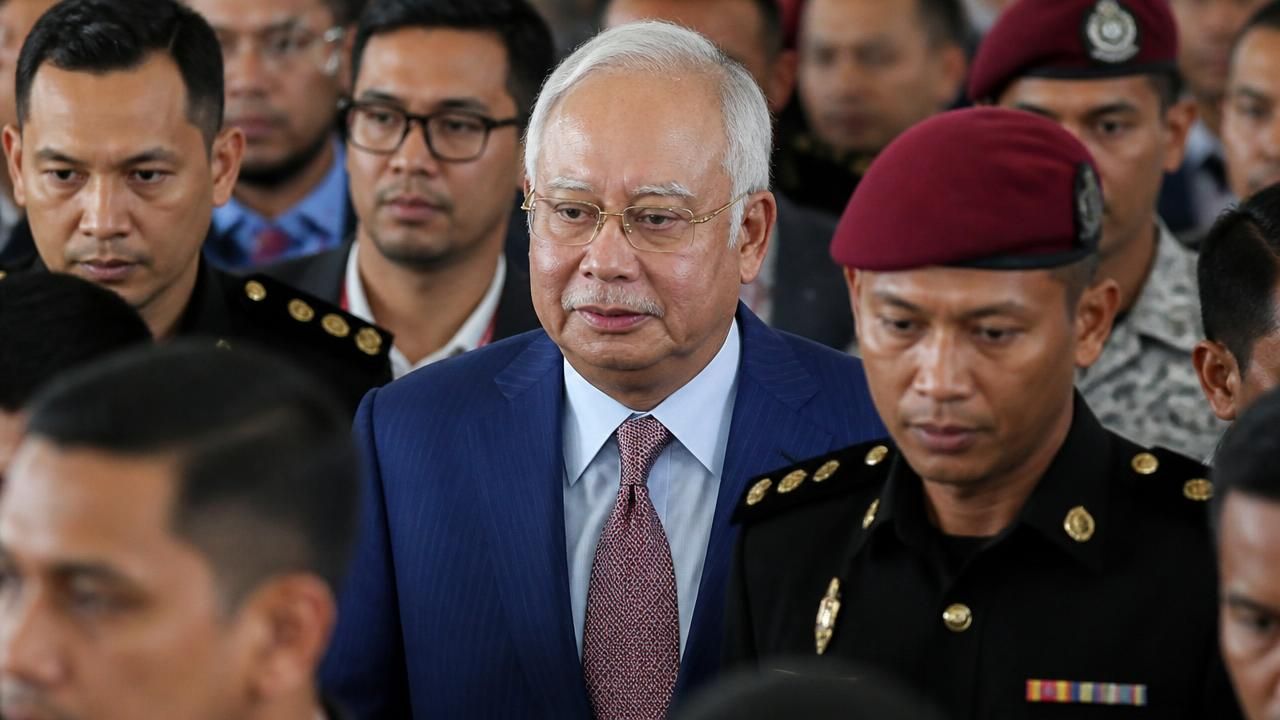
Malaysia's Federal Territories Pardons Board deferred a decision Friday on jailed former prime minister Najib Razak's latest bid for a royal pardon, shelving a politically explosive ruling that could free the man at the center of the multibillion-dollar 1MDB scandal.
The board, chaired by the Malaysian king — the Yang di-Pertuan Agong — had been expected to weigh Najib's application at its Friday sitting, according to people familiar with the matter. Instead the panel held off, with reports attributing the delay to mounting public backlash against the prospect of early release for the country's most prominent convicted graft offender.
A Conviction Rooted in 1MDB
Najib, who served as prime minister from 2009 to 2018, was convicted in July 2022 on seven counts of abuse of power, criminal breach of trust and money laundering linked to SRC International, a former subsidiary of the state fund 1MDB. He was sentenced to 12 years in prison and fined 210 million ringgit. Malaysia's Federal Court upheld the conviction that August, and he began serving his term at Kajang prison.
The case sits atop one of the largest financial scandals in history. Investigators in the United States and Malaysia concluded that roughly $4.5 billion was siphoned from 1MDB — a fund Najib himself launched in 2009 to spur development — through a web of shell companies, luxury art, jewelry, a superyacht and Hollywood productions. The U.S. Department of Justice described the scheme as "kleptocracy at its worst." Goldman Sachs, which underwrote bond deals for the fund, agreed in 2020 to pay more than $3.9 billion in penalties worldwide. Financier Jho Low, accused of orchestrating the theft, remains a fugitive.
The First Pardon and the Second Bid
Najib's application is not his first appeal for royal intervention. A previous pardon petition, filed shortly after his imprisonment, produced a contentious outcome: his 12-year sentence was halved and his fine substantially reduced. That decision was greeted with public dismay by many Malaysians who saw it as clemency granted too easily — a sentiment that has hardened as the former leader has pursued further relief.
The current bid extends that campaign. Supporters frame the applications as an act of mercy for an aging politician who retains significant grassroots support within his party, the United Malays National Organisation. Critics call it a brazen attempt to evade accountability for a scandal that tainted Malaysia's reputation with global investors for years.
A Coalition at Odds With Itself
The timing is awkward for Prime Minister Anwar Ibrahim, whose unity government rests on an unlikely alliance between his reform-minded Pakatan Harapan bloc and Najib's own UMNO. The coalition's own news outlet has said plainly that those convicted of graft should serve their full terms — a position that places the government's anti-corruption platform in direct tension with the groundswell of sympathy for Anwar's former rival.
The coalition's stated position — that graft convicts must complete their sentences — puts its reformist wing at odds with the political machinery that keeps the government in power, and raises the question of how loudly Anwar's administration can afford to object to a decision it does not formally control.
Anwar has repeatedly insisted he does not interfere in the judicial and royal processes, while opposition figures and civil-society groups watch closely for signs of a quietly brokered deal.
Why the Palace Holds the Cards
Under Malaysia's constitution, the power to grant pardons for federal crimes rests with the king, acting on the advice of the Federal Territories Pardons Board. That board is chaired by the monarch and includes the attorney-general, the federal territories minister and up to three other members appointed by the king. The arrangement makes the palace both convenor and, politically if not formally, the decisive voice.
The current monarch, whose term rotates among Malaysia's nine royal houses under the elective monarchy, has a reputation for punctilious attention to public sentiment — a factor analysts say may explain the deferral. A pardon granted against a backdrop of visible popular anger risks damaging the institution's standing, while an outright rejection would inflame Najib's still-substantial base.
How the Story Is Being Framed
Coverage of the saga splits along telling lines:
- Bloomberg led on process, reporting that the bid would be reviewed Friday by a board headed by the king — a distinctly institutional, markets-facing framing.
- The coalition-linked outlet, carried by Yahoo, foregrounded politics, emphasizing the governing bloc's insistence that graft convicts serve full terms.
- MSN's aggregation framed the outcome as a pause driven by public backlash, centering voter sentiment.
- Devdiscourse cast the filing dramatically as Najib's "last bid for freedom," underscoring the stakes for the man himself.
Read together, the accounts converge on one point: the decision is as much a referendum on public opinion as a legal determination.
What Happens Next
No new date for a decision has been announced. Malaysian law does not bind the board to a fixed timetable, leaving Najib in legal limbo while he contests other charges, including the sprawling main 1MDB trial. A second case alleging tampering with a witness is also pending.
The stakes extend beyond one man. Foreign investors have watched Malaysia's institutional handling of the 1MDB aftermath as a barometer of the rule of law. A pardon perceived as politically engineered could weigh on the ringgit and complicate Anwar's push to recast Malaysia as a stable destination for capital; a refusal, or a prolonged limbo, invites accusations of selective justice from Najib's camp.
For now, the palace has bought time. In a case that has already toppled a government, emptied state coffers and stained a financial system, the pause may prove to be the most consequential ruling of all.