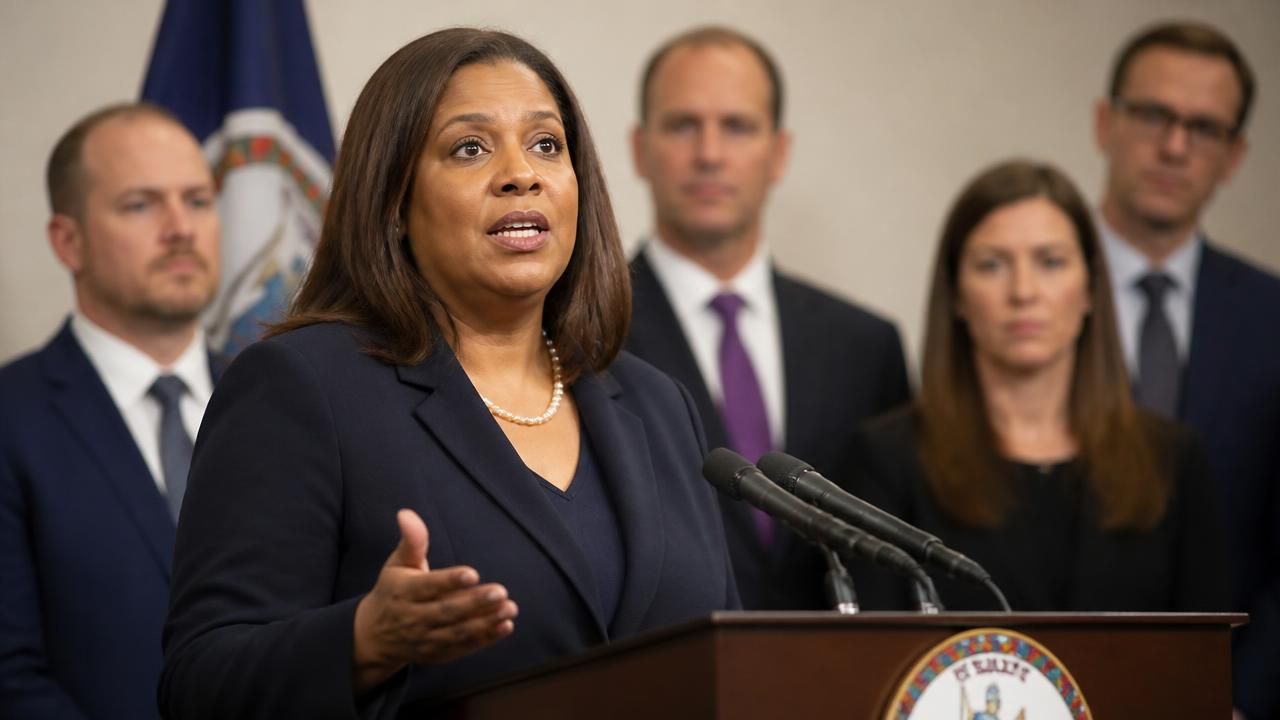
Virginia's attorney general has concluded that the Department of Homeland Security likely violated state law while conducting a voter fraud investigation, setting up a rare direct confrontation between a state's top law enforcement officer and a federal agency over the integrity of the voter rolls.
The finding centers on the department's decision to pull hundreds of agents from their regular duties and reassign them to the search for noncitizens registered to vote — an operation that critics say rests on a premise that decades of research has repeatedly failed to support.
A finding of probable violation
According to the attorney general, the scale and manner of the federal operation ran afoul of Virginia law, raising questions about data handling, the treatment of registered voters, and the legal authority under which federal agents operated inside state election infrastructure. The office did not characterize the matter as a criminal referral, but its language was unusually pointed.
The department has pulled hundreds of agents from their regular duties to find noncitizens on the voter rolls.
That single sentence captures the core of the dispute: not whether noncitizens should vote — they cannot, and it is a crime if they do — but whether deploying hundreds of federal personnel in pursuit of an offence that is vanishingly rare constitutes a lawful and proportionate use of state and federal resources.
The operation: hundreds of agents, few cases
Federal officials have defended the push as a routine exercise in safeguarding election integrity. The practical effect, however, has been to redirect investigators away from other DHS missions — a trade-off that state officials argue was never adequately justified to Virginia authorities.
Virginia is not the first state to push back. Election administrators across the country have warned that aggressive federal inquiries chill participation, generate error-ridden lists, and shift the burden of proof onto ordinary citizens who must then defend their registration. In prior cycles, similar list-matching efforts produced false positives at high rates, particularly among naturalized citizens, students, and voters who share common names.
Decades of evidence, and a persistent myth
The investigative premise collides with the scholarly record. Study after study, including work drawing on state audits and federal prosecutions, has found that voter fraud — and noncitizen voting in particular — is exceptionally rare in the United States. Prosecutions are numbered in the dozens nationally in most cycles, against tens of millions of ballots cast.
- Noncitizen voting is already illegal and prosecutable under federal law.
- Documented cases remain a tiny fraction of total ballots in every large-scale audit to date.
- Roll-maintenance errors, not fraud, account for the overwhelming majority of anomalies flagged by list matching.
- Removing eligible voters by mistake is a far more common outcome than catching an ineligible one.
Supporters of tighter verification counter that even a small number of illegal ballots undermines confidence, and that states have an obligation to keep their rolls current. That argument has real force in the abstract — but it does not by itself answer the attorney general's question of whether this particular operation complied with Virginia law.
Virginia's long history as a battleground
The state's outsized role in national politics explains the intensity of the fight. Virginia's 2006 U.S. Senate race, documented at the time in contemporaneous congressional-election reporting, was decided by roughly 9,000 votes out of more than 2.3 million cast — a margin that put roll accuracy and ballot administration under a microscope for years afterward.
By the 2012 campaign trail and again during the 2016 campaign trail, Virginia was again among the handful of states that both parties treated as decisive, with sprawling volunteer networks, heavy surrogate traffic, and relentless litigation over registration rules. Archived Wikinews dispatches from July 2012 and May 2016 chronicled that ground war precinct by precinct; in a telling footnote to the fragility of the digital record, several of those archived pages now return only a technical access notice rather than their original text.
The historical through-line is consistent: Virginia's elections are close enough that any change to the voter rolls — even a small one — can plausibly alter an outcome, which is precisely why both the state and the federal government have fought so hard over who gets to touch them.
How the story is being framed
Coverage has diverged sharply. Outlets focused on election administration have emphasized the attorney general's legal conclusion and the practical disruption to state election offices. National political desks have framed it as the latest front in a longer partisan conflict over federal involvement in elections. From the federal side, the emphasis is on statutory authority and the goal of clean rolls; from the state side, on state sovereignty and the rights of registered voters.
Both framings contain a shared, less contested fact: the resources spent searching for noncitizen voters vastly exceed the number of such voters any investigation has ever found.
What comes next
The attorney general's finding does not automatically halt the operation, but it raises the prospect of litigation, legislative hearings, and new state-level guardrails on federal access to voter data. Virginia lawmakers could tighten statutes governing data sharing, while the department may face challenges over records requests and the standards used to flag registrants.
The deeper question is structural. If hundreds of agents can be redirected toward a problem that the evidence says is minuscule, while legitimate voters bear the cost of defending their registrations, the debate is no longer only about fraud. It is about how much disruption a democracy is prepared to accept in the name of preventing it.