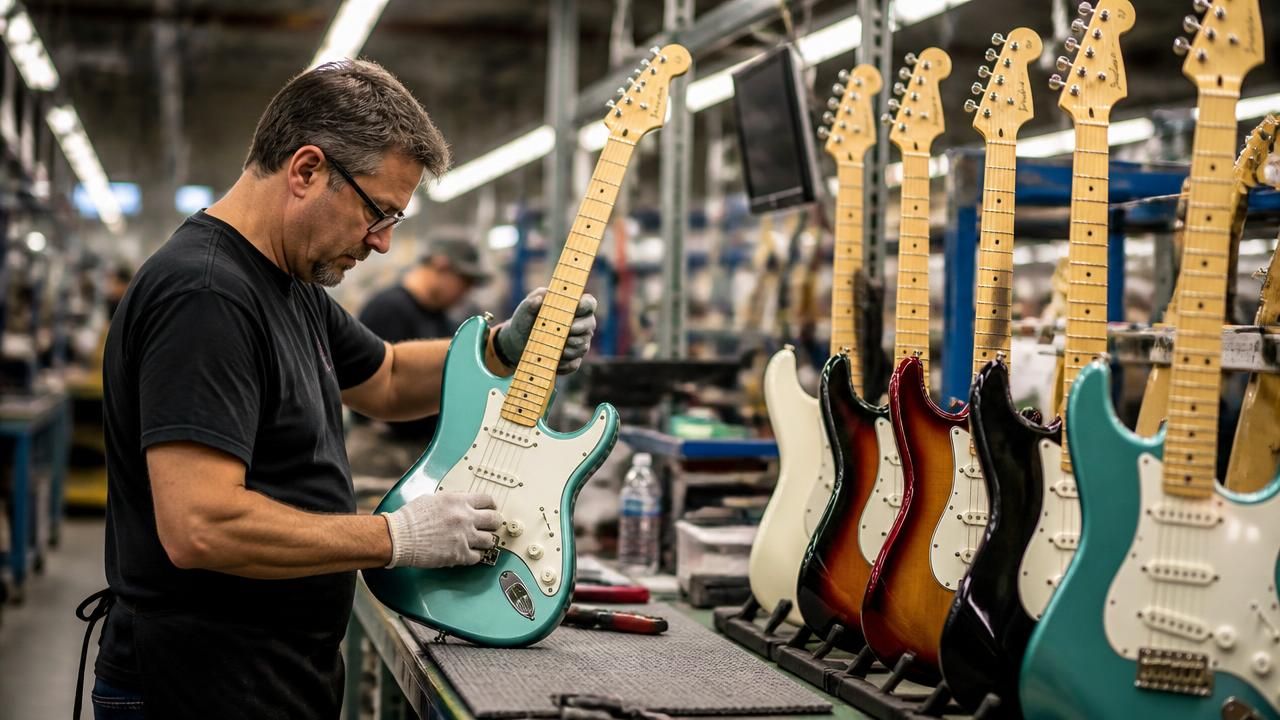
Few objects in industrial design are as instantly recognizable as the Fender Stratocaster. Introduced in 1954, its double-cutaway body, contoured waist and elongated headstock became the visual shorthand for "electric guitar" itself — so much so that when Unicode designers needed a guitar emoji, what they drew was, unmistakably, a Strat. That ubiquity is a triumph of branding. It is also, as Bloomberg's Paul Sloan reports, the company's central business problem.
"The Fender Stratocaster is a shape so universal it's the emoji on your phone's keyboard. Which is kind of Fender's problem."
— Bloomberg Markets, on Fender's long-running effort to "claim back the body of a guitar that's become an iconic shape."
A trademark built on sand
The paradox facing Fender Musical Instruments Corp. is structural, not managerial. Design patents in the United States last 14 years from grant. Fender's original Stratocaster and Telecaster patents were filed in the 1950s and expired decades ago, placing the shapes into the public domain. After that, the company's only remaining tools are trademark law — which protects identifiers of source, not functional or generic designs — and trade dress, a doctrine courts have applied skeptically to products whose look has become the standard for an entire category.
That skepticism is well documented across the industry. Gibson spent years pursuing trademarks on the Les Paul and SG silhouettes, launching an aggressive 2019 legal campaign against Dean Guitars and other competitors; its claims have been repeatedly narrowed, and in 2020 the U.S. Trademark Trial and Appeal Board cancelled one of its Les Paul shape registrations. Gibson's earlier litigation against PRS Guitars ended in 2004 with the smaller builder largely prevailing. The lesson for Fender is uncomfortable: the more iconic a shape becomes, the harder it is to own.
What Fender can actually enforce
Fender's practical strategy has therefore shifted from body shapes to the marks layered on top of them. The company has pursued counterfeiters who stamp "Fender" or "Stratocaster" on instruments they did not build — clear cases of passing off. It has also policed its headstock profiles, logos and model names, where courts are far more receptive.
The 2010s saw a wave of cease-and-desist letters targeting small boutique builders and online retailers, a campaign that generated significant backlash among players who argued Fender was harassing the very craftspeople who kept the design language alive. Meanwhile, Fender's own portfolio complicates the purity of its position: the company owns Squier, its budget import brand, along with Gretsch, Jackson, Charvel, EVH and Bigsby. Fender legally manufactures Stratocaster-shaped guitars in Asia at prices that undercut many of the copies it objects to.
The economics underneath the argument
Analysts frame the dispute less as a legal question than a margin question. The global electric guitar market is mature and crowded, with low barriers to entry for Asian contract manufacturers. Fender's response has been to move upmarket — the American Professional and American Vintage lines — and to lean on digital revenue, notably the Fender Play learning app, which grew sharply during the pandemic-era guitar boom. Trademark enforcement, in that context, is partly a pricing-defense mechanism: if a $200 copy looks like a $1,700 American-made instrument, the premium has to be justified by something other than silhouette.
How the story is being framed
Coverage of Fender's campaign varies sharply by outlet. Financial press tends to frame it as an intellectual-property asset-management story — a legacy manufacturer defending brand equity against commoditization. Music and enthusiast media more often frame it as a David-versus-Goliath narrative, emphasizing the luthiers and small shops on the receiving end of legal letters. Consumer-tech coverage, for its part, seizes on the emoji as evidence that the Stratocaster has crossed from product into language — a status that arguably makes trademark protection legally and culturally untenable.
Investigative follow-ups in the coming months are likely to focus on whether Fender files new registrations, how aggressively it enforces against parts suppliers and kit builders, and whether the company's ownership structure — it has twice explored public offerings under majority owner Servco Pacific — creates pressure to convert cultural ubiquity into defensible revenue.
A note on sourcing
This report draws primarily on Bloomberg Markets' analysis of Fender's trademark strategy. Several supplementary wire and community-journalism feeds consulted for this piece — including Wikinews items on the 2020 U.S. election cycle, a Texas congressional special election, a Reform Party presidential forum and Toronto Comicon — returned automated access-restriction notices rather than retrievable content, and therefore could not be independently verified or incorporated. Readers should treat the Fender analysis as the substantiated core of this story.
The broader question remains unresolved, and it is one every design-driven business eventually confronts: when your product becomes the category, do you own the shape — or does the shape own you?