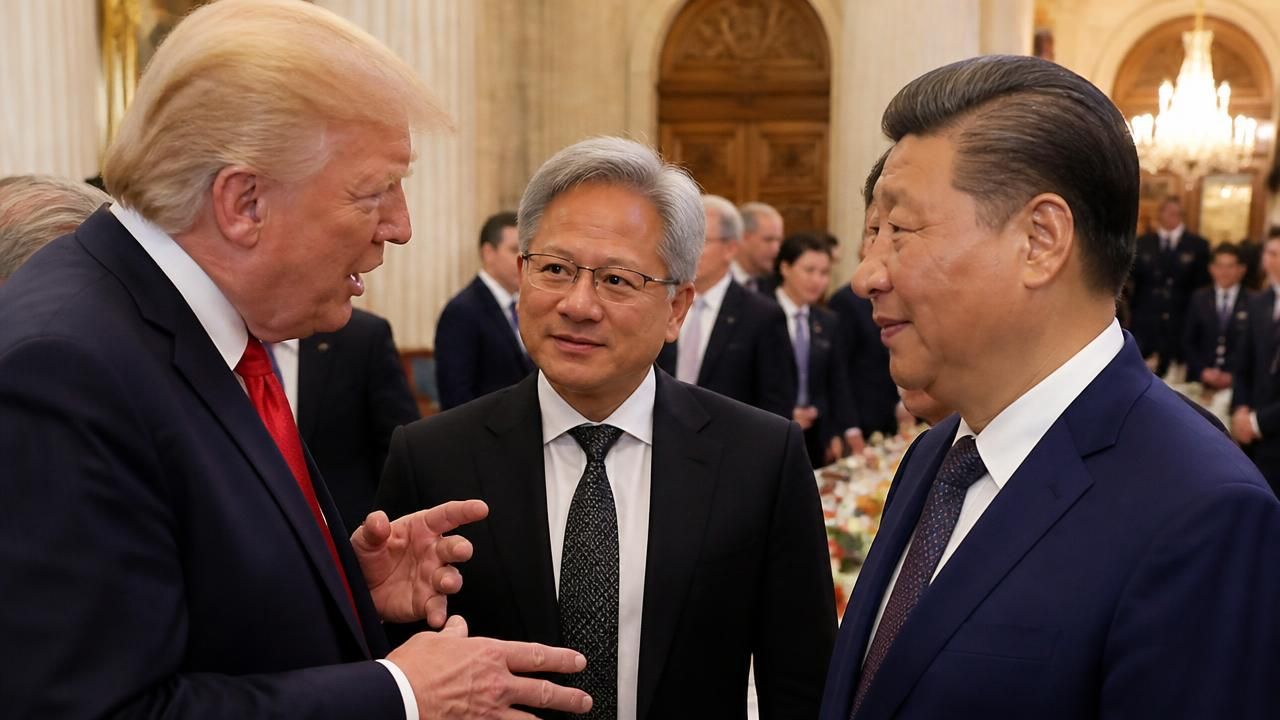
The guest list for President Trump's state dinner honoring Chinese President Xi Jinping is reading less like a diplomatic roster and more like a semiconductor supply chain. Nvidia chief executive Jensen Huang is expected to attend, according to people familiar with the arrangements, placing the most consequential figure in the global AI chip industry at the same table as the leader of the country his company has been barred from fully supplying.
The detail, first reported by Bloomberg and subsequently carried by Yahoo Finance and MSN, is the clearest signal yet that the most sensitive item on the bilateral agenda is not tariffs or soybeans but silicon — and who controls the compute that powers artificial intelligence.
A Dinner Table That Mirrors the Supply Chain
Huang's presence would put him alongside other U.S. and Chinese technology leaders in a room designed for symbolism but freighted with substance. Nvidia sits at the center of the U.S.-China technology rivalry: its accelerators are the backbone of global AI training, and successive rounds of U.S. export controls have forced the company to design downsized chips for the Chinese market, only to see those products restricted as well.
For the White House, inviting Huang is a way of signaling that American industrial leadership is part of the negotiating posture. For Beijing, the same table offers a chance to press its case that restrictions on advanced chips are an attempt to stall China's technological rise. Bloomberg's coverage of the run-up framed the dinner as a venue where policy and markets collide, with investors watching for any hint of loosening or tightening in export rules.
Tit-for-Tat: Sanctions Before the Handshake
The bonhomie of a state dinner belies a bruising few months. Washington has expanded entity-list designations and tightened rules on advanced computing exports; Beijing has retaliated with its own restrictions, including controls on rare earths and critical minerals essential to chipmaking, defense and electric vehicles.
CNN framed the central question bluntly:
As US and China throw up tit-for-tat sanctions, is Trump's Xi meeting at risk?
That question has become the organizing principle of coverage across outlets. NBC News reported that the two governments exchanged fresh economic blows over AI and trade even as planning for Xi's visit proceeded — a pattern analysts describe as "negotiate while escalating," in which each side builds leverage before sitting down.
The sequencing matters. Sanctions announced before a summit can be read as pre-negotiation positioning rather than a breakdown. But they also narrow the room for compromise: once measures are codified, unwinding them carries domestic political cost on both sides.
China's AI Ascent and a Stark Choice
Chinese firms have responded to export controls not by retreating but by improvising. Domestic champions have scaled up production of AI accelerators, optimized models to run on less powerful hardware, and poured investment into alternatives to Nvidia's ecosystem. The result, as one MSN analysis put it, leaves Trump with a stark choice: escalate the chip controls further, or relax them in exchange for concessions.
Both paths carry risk. Escalation could accelerate China's push for self-sufficiency, eventually eroding the leverage the controls were meant to create. Relaxation could be read as capitulation, handing Beijing access to the very technology Washington has spent years trying to withhold.
Why the Tech Leaders Are in the Room
- Signaling: CEO attendance conveys that corporate America is a stakeholder, not a bystander, in the talks.
- Lobbying: Semiconductor firms have pushed for clearer, more predictable export rules, arguing that blanket restrictions cede market share to foreign competitors.
- Leverage: Both governments want to demonstrate that their domestic industries stand behind them.
How the Story Is Being Framed
The framing differs sharply by outlet. Financial coverage, led by Bloomberg, treats the dinner as a market event — a venue where a single sentence about export policy could move billions in semiconductor valuations. Yahoo Finance and MSN emphasized the headline draw: the Nvidia CEO's attendance amid chip-war tensions.
CNN and NBC News approached it as a diplomatic story, questioning whether the summit can produce anything durable while sanctions fly in both directions. And the MSN analysis pushed furthest, casting the moment as an inflection point in the AI competition itself — a decision about whether the United States intends to slow China's ascent or compete with it on open ground.
What to Watch
Investors and policymakers will be watching for three things: whether any export-control relief is hinted at in readouts from the meeting, whether Beijing signals flexibility on rare earths or market access, and whether the two sides establish a regular channel for technology policy — something absent since the last round of talks stalled.
The optics of a state dinner suggest warmth. The substance suggests a relationship still defined by mutual suspicion, with a single dinner table serving as the only place where the world's two largest economies currently agree to sit together.