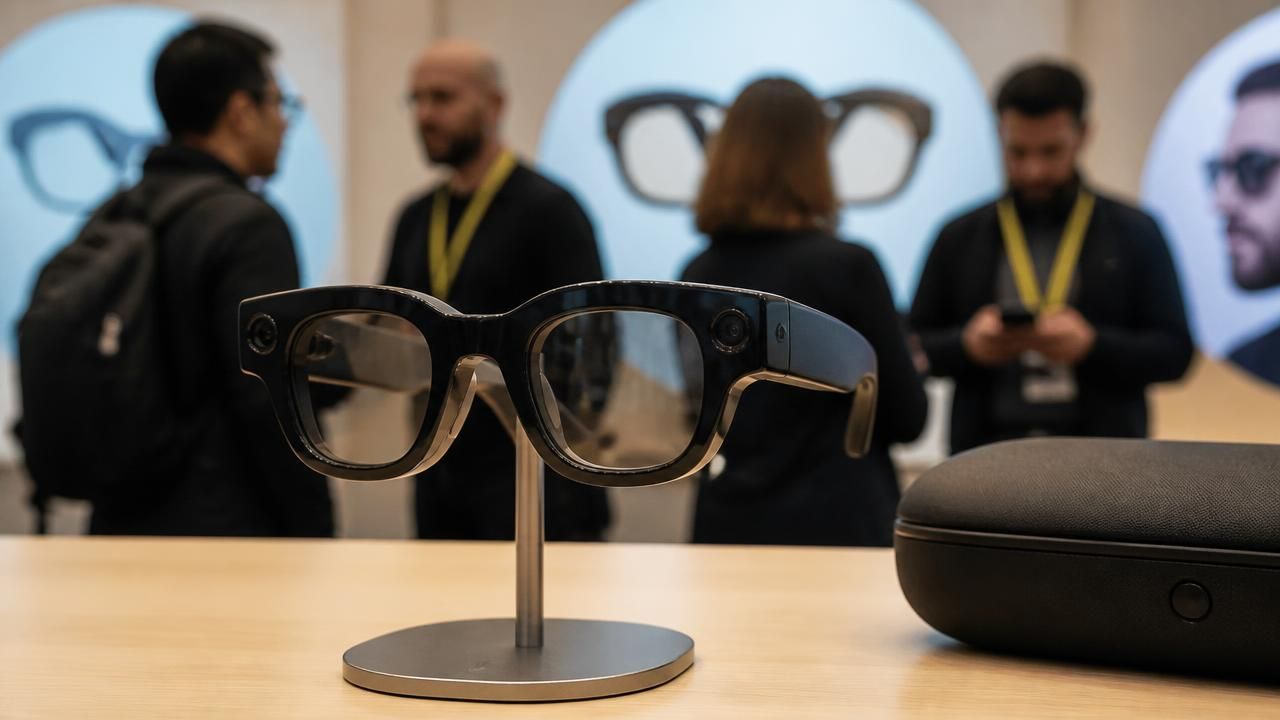
Snap has formally entered the consumer augmented reality hardware business, unveiling Specs — its first pair of AR glasses aimed at ordinary buyers — alongside a new AI assistant called Specs Intelligence. The glasses are priced at $2,195, a figure that has quickly become the central tension in early coverage, and the AI software is rolling out to iOS and Mac users alongside the hardware debut.
The launch marks the culmination of a bet Snap has been making, and repeatedly re-making, for nearly a decade. But the framing of the announcement differs sharply depending on where you read about it: The Verge leads with the software, MSN leads with the sticker price, WIRED leads with the gap between marketing and real capability, and Android Authority leads with the industry-wide implications.
What Snap actually announced
According to The Verge, the centerpiece of the launch is Specs Intelligence, an AI assistant that connects to a user's other digital accounts and helps manage work tasks, travel logistics and day-to-day scheduling. Snap is positioning it not merely as a chatbot but as an anticipatory service — software that surfaces what matters before you ask.
Snap describes Specs Intelligence as an "anticipatory AI service" that "helps you manage what needs attention today, so you can make progress toward your longer-term goals."
Users can also converse with the assistant directly, putting it in the same category as Meta's Muse and Gemini's Spark. Critically, Specs Intelligence is not locked to the glasses: it is available on iOS today, with Mac support as part of the rollout, meaning Snap can seed the assistant with users who have no intention of buying hardware yet — a classic platform play.
The price is the story
At $2,195, Specs costs more than a fully loaded MacBook Pro and roughly four times the price of a flagship smartphone. MSN's headline frames the entire launch around that number — "Snap launches $2,195 Specs smart glasses" — a signal that mainstream aggregators expect sticker shock to define the news cycle.
The pricing places Specs in genuinely premium territory. It is closer to Apple's Vision Pro, a full spatial-computing headset, than to the sub-$500 camera glasses that have driven mass adoption in the smart-eyewear category so far. Snap is effectively asking consumers to treat a pair of glasses as a primary computing purchase rather than an accessory — a psychological leap no company has yet convinced the mainstream to make.
- Product: Specs, Snap's first consumer AR glasses
- Software: Specs Intelligence, an anticipatory AI assistant with chat
- Price: $2,195
- Availability: AI assistant live on iOS, extending to Mac
- Competitive set: Meta's Muse, Gemini's Spark, Apple's Vision Pro
Capability versus hype
WIRED's coverage takes the skeptical angle, with a headline — "Here's What Snap's Expensive Specs Can Actually Do" — that pairs the price with a pointed question about utility. That framing reflects a recurring critique of AR hardware: demos dazzle, but daily use cases remain thin. The implication is that Snap's glasses must justify a four-figure outlay through functions a phone cannot already perform.
Android Authority, by contrast, reads the launch as a watershed. Its headline calls the glasses "powerful" and argues they "make the case for AR going mainstream" — casting Snap as the company that could finally push augmented reality out of the developer demo phase and into ordinary life. Digital Trends splits the difference, describing the device as Snap's "big bet on glasses as the next computer," a platform-level wager rather than a product launch.
A decade of bets on the same idea
Snap's path here has been unusually long and unusually public. The company shipped its first camera-equipped Spectacles in 2016 through vending machines that became a viral marketing moment; subsequent generations in 2017 and 2019 struggled to convert novelty into sustained demand. A 2021 version, aimed squarely at creators, narrowed the audience rather than widening it, and Snap took a substantial writedown on unsold inventory.
What changed is the technology stack. Standalone AR glasses require displays, waveguides, custom silicon and batteries that fit on a human face — components that have only recently become viable at scale. Snap has spent years building toward this moment while rivals with far deeper pockets, including Meta and Apple, have done the same.
Why the AI layer matters more than the glass
Strategically, Specs Intelligence may be the more consequential half of the announcement. By shipping the assistant on iOS and Mac first, Snap can accumulate usage data and user habits without waiting for hardware adoption curves. Meta has pursued the same logic with its Ray-Ban glasses and AI assistant, betting that ambient software — not displays — is the near-term killer feature.
That approach also hedges Snap's risk. If Specs sells modestly at $2,195, the company still has a cross-platform AI product with a distribution channel. If the glasses succeed, the assistant becomes the connective tissue that makes them sticky.
What to watch
Three questions will determine whether this launch is remembered as a turning point or another chapter in AR's long gestation. First, whether Snap publishes concrete specifications — battery life, field of view, weight — that hold up under independent testing. Second, whether developers build for the platform, since glasses without an app ecosystem are expensive novelties. Third, whether the $2,195 price holds or is discounted within a year, the clearest possible signal of demand.
For now, the coverage itself tells the story: one outlet sees an AI platform, another sees a price tag, a third sees hardware that has yet to prove itself, and a fourth sees the moment AR finally grows up. Snap, evidently, is betting all four readings are partly right.