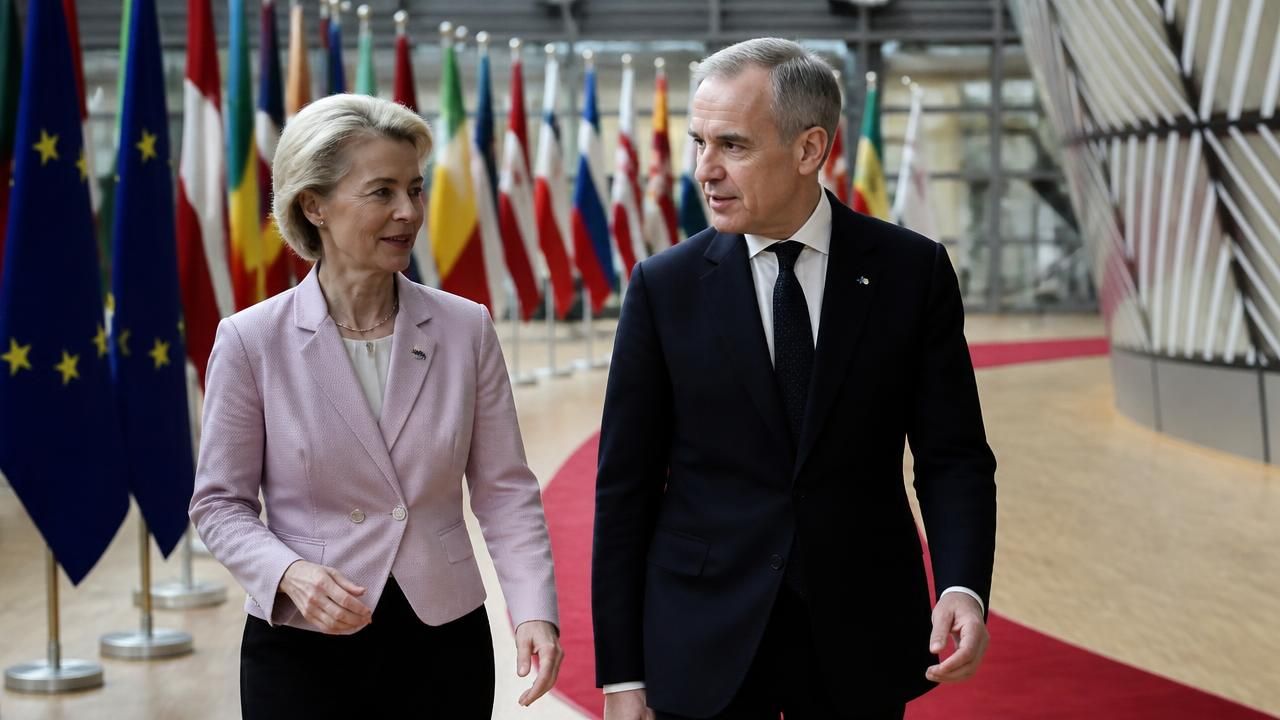
European Commission President Ursula von der Leyen said Wednesday that she wants Canada to become the European Union's first-ever "associate member," an unprecedented overture that would create a category of partnership the 27-nation bloc has never before offered any country outside its borders.
The proposal, announced as Canadian Prime Minister Mark Carney arrived in Strasbourg to address the European Parliament, amounts to one of the most striking diplomatic gestures of the post-war era — and it lands squarely in the middle of a widening transatlantic rift opened by U.S. President Donald Trump's tariff offensive against both Canada and Europe.
Reports of the offer were carried simultaneously by outlets on both continents, from NPR and NBC News to the Financial Times, Le Monde, The New York Times and the Associated Press, underscoring how quickly the story moved from a Brussels talking point to a global headline.
An offer without precedent
The EU's founding treaties lay out a handful of relationships with outside countries: candidate status, accession, and a dense web of association agreements with neighbors such as Ukraine, Turkey and the Western Balkans. None of them is called "associate member." Von der Leyen's language therefore suggests something new — a bespoke arrangement that would sit beneath full membership but far above a conventional trade deal.
Canada already has one of the deepest economic relationships with the EU of any non-European country, through the Comprehensive Economic and Trade Agreement, or CETA, which has been provisionally applied since September 2017. CETA eliminated tariffs on most goods and opened services and procurement markets, but it stops well short of the political integration implied by associate membership.
What associate membership would actually entail — voting rights, budget contributions, alignment with EU regulation, freedom of movement — remains undefined. EU officials gave no timetable and no legal blueprint, and any new status would almost certainly require ratification by member states, a process that has stalled or failed before.
Carney's Strasbourg moment
The timing was pointed. Carney, who took office pledging to diversify Canada's trade away from its overwhelming dependence on the United States, was in Strasbourg to attend the European Parliament and was also scheduled to meet British Prime Minister Keir Starmer. The Arkansas Democrat-Gazette framed the visit bluntly: "Carney seeks deeper EU ties for Canada."
For Ottawa, the appeal is straightforward. Roughly three-quarters of Canadian exports traditionally go to the United States, a concentration that has long been a strategic vulnerability and has become an acute one under a White House willing to use tariffs as leverage. Brussels, meanwhile, sees Canada as a like-minded partner on climate policy, digital regulation, sanctions enforcement and the rules-based trading order — and as a symbolic counterweight at a moment when Washington is retreating from both.
Von der Leyen cast the partnership as a response to an "openly hostile world," positioning closer EU-Canada cooperation as a defensive alignment of liberal democracies rather than a purely commercial transaction.
How different outlets framed it
The story's framing varied sharply by region, and the differences are revealing.
- U.S. outlets (NPR, NBC News, AP, The New York Times) led with Trump's tariffs, treating the EU offer as a downstream consequence of American trade policy. The Times' headline made the causal chain explicit: the offer came "as U.S. ties weaken for both."
- European outlets (Le Monde, the Financial Times) emphasized the institutional novelty — the FT described von der Leyen as "backing" Canada's associate membership bid, while Le Monde stressed that Brussels would be opening its door to a first-of-its-kind member.
- Business and market outlets (Seeking Alpha, aggregators) focused on the trade implications, treating the announcement as a signal about tariff risk and supply-chain diversification rather than a geopolitical turning point.
- Broadcast and regional outlets (MKFM, MSN syndication, the Caledonian Record) framed it in populist terms: a chance for Canada to join the EU "in the wake of Trump's trade war."
Why it matters — and what could go wrong
The proposal carries real weight even if it never becomes law. It signals that the EU is prepared to invent new institutional forms to keep allies close at a moment when its largest traditional partner is acting unpredictably. It also gives Carney a concrete deliverable to bring home as he builds a case that Canada can reduce its reliance on a single market.
But the obstacles are formidable. Associate membership has no legal basis in the EU treaties; creating one could require unanimous agreement among 27 member states, several of which guard their prerogatives jealously. Canada, for its part, is not seeking to join the EU in any traditional sense, and no Canadian government has suggested it would accept the free movement of people or the jurisdiction of the European Court of Justice that full membership entails.
The most likely near-term outcome is less dramatic than the headline: an upgraded political framework, deeper coordination on sanctions and critical minerals, and perhaps a new institutional label designed to signal commitment. That alone would mark a significant shift. For decades, the transatlantic relationship rested on the assumption that the United States was the anchor of the West. Von der Leyen's offer to Canada suggests that assumption is no longer being taken for granted — in Brussels, in Ottawa, or anywhere else watching the tariffs unfold.