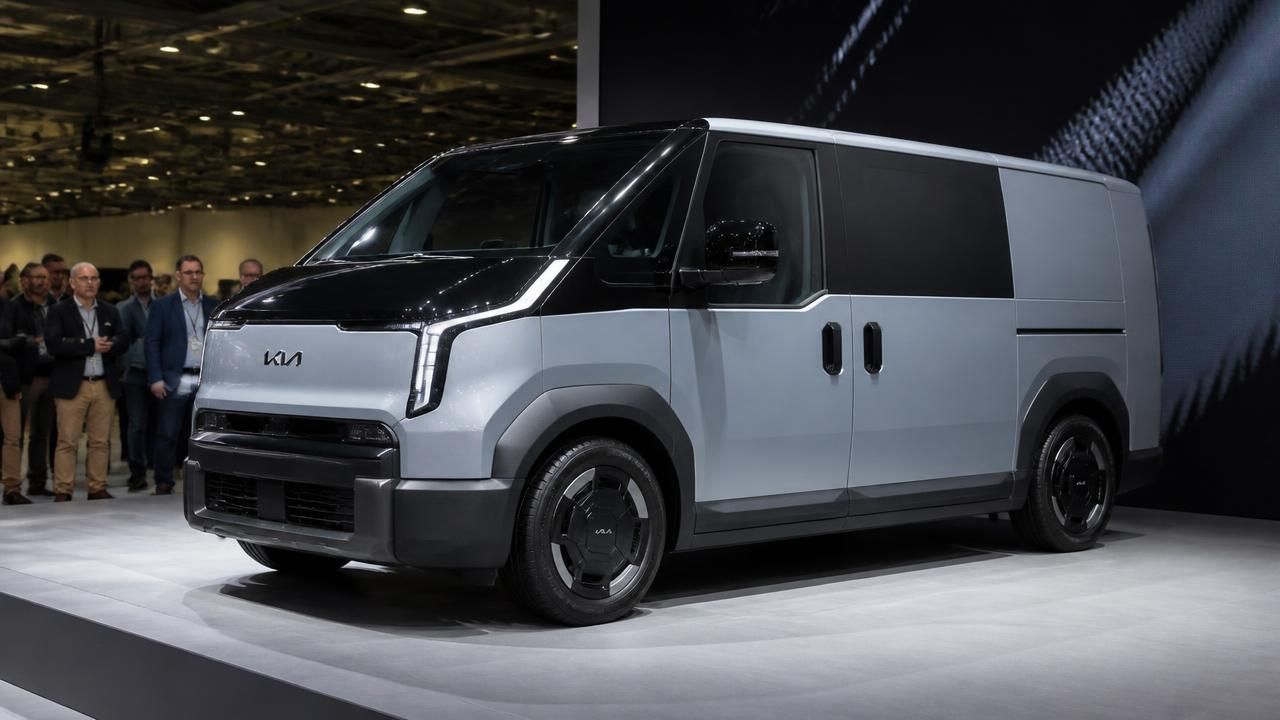
Kia has pulled the wraps off the PV7, its largest all-electric purpose-built vehicle to date, unveiling the van at IAA Transportation in Hanover, Germany. The reveal places the Korean automaker squarely in the path of the Ford Transit and the Mercedes-Benz eSprinter — and, notably, does so at Europe's premier commercial-vehicle show rather than a consumer auto expo.
The PV7 is the second model in Kia's Platform Beyond Vehicle (PBV) family, following the smaller PV5. Where the PV5 was pitched as an urban runabout and last-mile delivery tool, the PV7 scales the formula up: more cargo volume, more passenger configurations, and a substantially more flexible body architecture that Kia says can be adapted for delivery fleets, shuttle services, mobile retail and — as several outlets noted — campervan conversions.
The Hardware: 800 Volts and a Flexible Box
The headline technical claim is the PV7's 800-volt electrical architecture, a system most commonly associated with premium passenger EVs rather than work vans. InsideEVs framed the rollout around exactly that, describing the van as "bigger and better, with an 800V architecture and flexible body styles." In practice, an 800V system lets a vehicle accept higher charging power without proportionally thicker cables, which typically translates into dramatically shorter stops at a DC fast charger — often the difference between a fleet vehicle earning money and sitting idle.
Kia has not yet published full specifications for the PV7, including range, payload, battery capacity or pricing. What the company has emphasized is modularity: the PBV platform is designed around a standardized "skateboard" underbody onto which different bodies — and different business models — can be bolted. Kia has signaled that software updates and fleet-management services will be part of the pitch.
A Minivan Moment
The Verge approached the story from an entirely different angle, arguing that the PV7's arrival coincides with an unexpected cultural shift in the United States.
"You may not know it, but minivans are making a comeback in the US... Sales were up 21 percent in 2025, suggesting that the humble minivan is shaking off its 'uncool' stigma and finding new fans among an SUV-weary public."
Kia has been a beneficiary of that trend. Its Carnival minivan has been sold in the US since 2021, and the brand has leaned into boxy, utility-first design at a moment when three-row SUVs have grown heavier, thirstier and more expensive. An electric van with a conventional, van-like silhouette is, in that reading, less a commercial curiosity than a consumer product waiting for the right moment.
Campervans and the Lifestyle Play
Several outlets picked up on the recreational angle rather than the fleet angle. One MSN-syndicated report promised "even cooler camper van transformations," reflecting a growing overlap between commercial EV platforms, the van-life movement and aftermarket upfitters. A flat floor, a tall roof and an 800V charging system are precisely the ingredients that make an electric camper plausible — the historical knock against electrified campers being that remote campsites lack fast chargers. Standardized mounting points, which Kia's PBV program is designed around, would let converters build modular interiors without cutting into structural metal, potentially shortening conversion lead times considerably.
The Competitive Squeeze
Carscoops was blunt about the stakes, headlining its coverage: "Electric Kia PV7 Is Coming For The Ford Transit." That is a serious target. The Transit is the best-selling commercial van in the world, and Ford's electric E-Transit already holds an entrenched position with fleet buyers who value dealer networks and parts availability. Mercedes-Benz's eSprinter and Rivian's delivery vans occupy adjacent territory, while a wave of Chinese manufacturers is pressing hard into European commercial fleets.
Kia's differentiators, at least on paper, are the 800V charging speed, the PBV platform's modularity and the brand's existing manufacturing scale. Its liabilities are familiar: commercial buyers care less about novelty than about total cost of ownership, uptime and resale value, all of which take years to prove.
North America Still Waiting
For all the American framing, the PV7's availability remains unsettled. Canadian coverage of the reveal stressed that a launch in that market is "still unconfirmed," and Kia has not announced North American timing or pricing for the model. That is a meaningful gap: the PV5 and PV7 are built around a business model — vehicle-as-a-service, software subscriptions, fleet telematics — that is easier to launch in markets where Kia already has commercial-vehicle infrastructure.
- What: Kia PV7, an all-electric van on the PBV platform
- Where: Revealed at IAA Transportation, Hanover, Germany
- Key spec: 800-volt architecture for faster DC charging
- Body styles: Modular, configurable for cargo, passenger and specialty use
- Status: Specs, pricing and North American launch unannounced
Why It Matters
The PV7 is a useful test of whether electric vans can escape the niche. Fleet electrification has lagged passenger-car adoption because duty cycles, depot charging and capital costs all work against it. An 800V van with flexible bodywork lowers two of those barriers at once — charging time and customization cost.
It is also a test of Kia itself. The company spent the last decade repositioning from value brand to design-forward EV maker, and the PBV program is the next pivot: from selling cars to selling mobility platforms. The PV7's reception at Hanover, and whether fleet operators actually order it, will say more about that strategy than any concept car could.