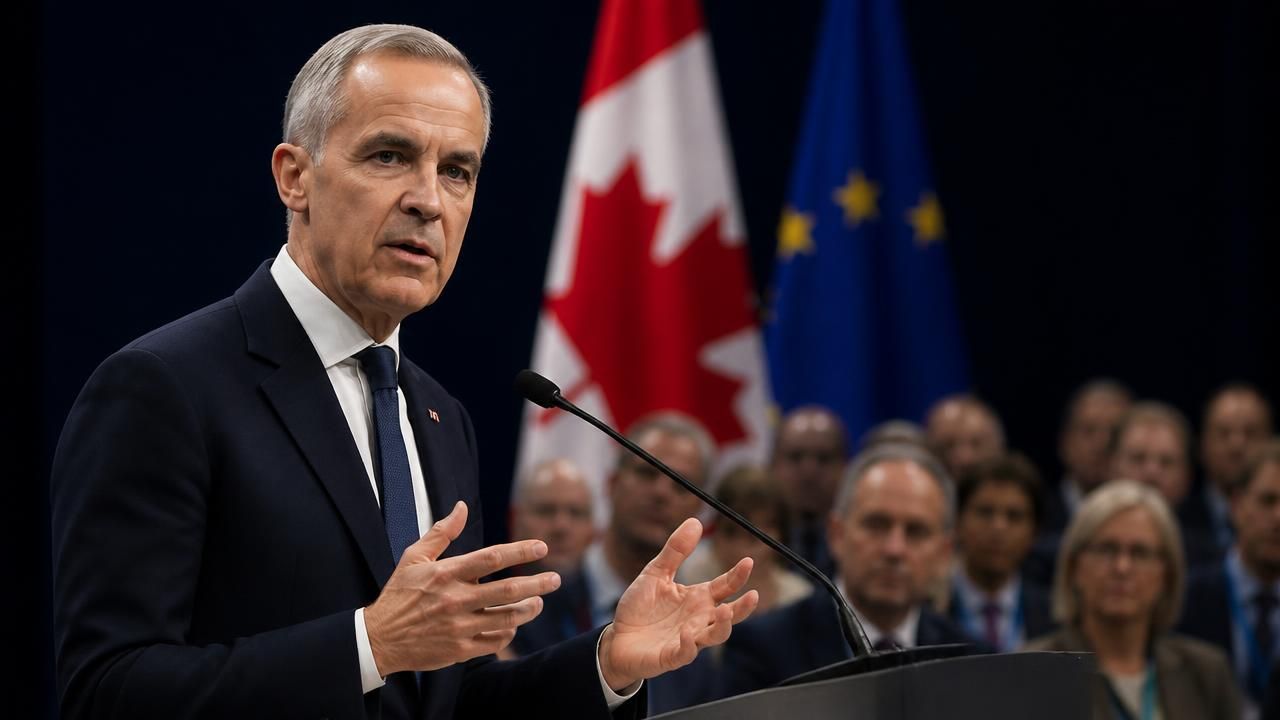
Prime Minister Mark Carney has said Canada will pursue a “unique security and economic alliance” with the European Union, using the inaugural Canada Investment Summit to pitch his country as a “safe harbour” for foreign capital and a base for building in what he called the “new global economic order.”
Speaking to an audience of investors, corporate executives and government ministers, Carney framed deeper ties with Brussels as a strategic hedge — a way to reduce Canada’s heavy reliance on trade with the United States at a moment when that relationship has been upended by tariffs, retaliatory measures and renegotiation of the continental trade pact.
Yet the proposal has already generated more heat than clarity. Carney publicly rejected the label of EU membership even as reports surfaced that he has floated making Canada an “associate member” of the bloc — a status that does not currently exist in EU law.
A Safe Harbour in a New Economic Order
The setting was deliberate. The Canada Investment Summit was designed to sell Canada to global capital, and Carney’s message was that political stability and resource wealth now constitute a competitive advantage. “Safe harbour” was the phrase he returned to, casting Canada as a predictable jurisdiction for investors unnerved by tariff volatility and geopolitical fragmentation.
“We will pursue a unique security and economic alliance with Europe.” — Mark Carney, Prime Minister of Canada
The framing reflects a hard economic reality: roughly three-quarters of Canadian goods exports cross the border into the United States, leaving Ottawa acutely exposed to trade actions taken in Washington. The Canada–EU Comprehensive Economic and Trade Agreement (CETA), provisionally applied since 2017, already gives Canadian exporters preferential access to the world’s second-largest single market, but a large share of its provisions — including investment protections — remain unratified by all member states.
What an 'Associate Membership' Could Look Like
According to reporting by The Wall Street Journal, Carney has raised the idea of associate membership — a conceptual halfway house that would stop well short of accession. In practice, analysts suggest such an arrangement could encompass:
- Expanded defence and security cooperation, including procurement and industrial collaboration;
- Deeper integration on critical minerals, energy and supply chains;
- Mutual recognition of standards and professional credentials;
- Coordination on sanctions, export controls and investment screening;
- Institutional consultation mechanisms short of voting rights or free movement.
Canadian and EU officials are reportedly working toward a broader trade and security package. For Brussels, closer ties with a G7 economy rich in energy, minerals and Arctic access carries obvious appeal as the bloc seeks to diversify away from both Russian resources and Chinese supply chains.
Not Everyone Is Convinced
The framing differs sharply across outlets. International coverage has largely described the initiative as a pragmatic realignment forced by US protectionism. Domestic critics have been far more sceptical. Columnist Adam Pankratz characterised the project as an “elitist quest to turn us into Europeans,” arguing that Canada’s economic DNA — resource extraction, energy exports, a continental manufacturing corridor — is oriented southward and cannot be rewired by rhetoric.
That critique points to a genuine tension. Canada’s geography, integrated auto and aerospace sectors, and shared electricity grids tie it to the United States in ways no European agreement can quickly replicate. Even enthusiastic supporters of the EU pivot describe it as diversification rather than substitution.
Farmers Fear the Fine Print
Agricultural producers have emerged as one of the most vocal concerned constituencies. Industry coverage has warned that a broadened EU arrangement could expose Canadian farmers to renewed pressure on supply management, geographic indicators and market access — the same flashpoints that nearly sank CETA’s ratification.
For dairy, poultry and egg producers operating under supply management, any negotiation that places agricultural concessions on the table in exchange for industrial or services access is viewed as an existential risk. European exporters, meanwhile, have long sought greater access to Canadian cheese and processed food markets.
The Wider Stakes
The initiative lands at a delicate moment. The US–Mexico–Canada Agreement is due for a joint review in 2026, giving Washington leverage over the terms of any renewal. Carney’s European overture can be read both as genuine strategy and as negotiating posture — a signal that Canada has alternatives, however imperfect.
There are also hard constraints. The EU’s own decision-making is slow, and any new treaty would require ratification across 27 member states, several of which guard agricultural and labour sensitivities jealously. Associate membership would likely require treaty change, a process measured in years rather than months.
What is clear is that the vocabulary of Canadian foreign economic policy has shifted. A country that spent decades treating continental integration as an inevitability is now openly shopping for other partners — and, for the first time in a generation, asking what it would even mean to belong somewhere else.