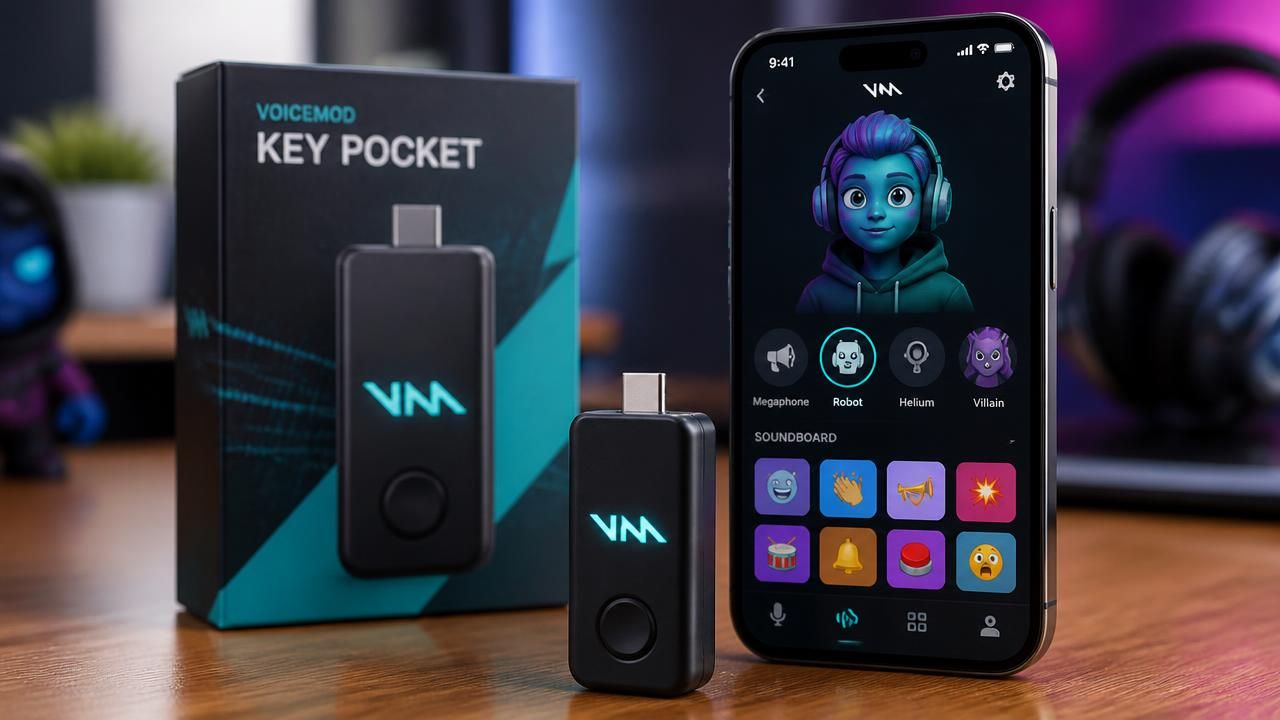
Voicemod, the Valencia-based company best known for the voice-changing software that has become a staple of Discord calls and Twitch streams, is taking its audio trickery off the desktop. The company has announced the Voicemod Key Pocket, a small hardware dongle that promises real-time voice modulation and soundboard effects directly on iOS and Android phones — no gaming PC required.
The device is priced at $99.90 as a standalone purchase, or $129.90 as part of a bundle that pairs the hardware with a Voicemod voice subscription, according to The Verge, which was first to detail the product. It is available now.
From PC to console to pocket
The Key Pocket is a direct descendant of the Voicemod Key, a dongle the company launched in late 2024 as a way to smuggle its PC-centric technology into living rooms. The original Key worked as a bridge: it plugged into an Xbox, PlayStation or Nintendo Switch, while a smartphone running the Voicemod app acted as the interface between the hardware and the console. In effect, the phone did the thinking while the dongle did the talking.
The Key Pocket inverts that relationship. Instead of treating the handset as a control surface for a console, it makes the phone itself the destination — the place where voices are altered and sound effects are triggered. That is a meaningful shift for a company whose entire identity has been tethered to desktop software.
What the device actually does
According to the company and early product coverage, the Key Pocket is designed to work while users are:
- Playing games on mobile or console
- Making voice calls
- Streaming or recording content
- Chatting in social apps and voice rooms
The core pitch is real-time transformation — a user speaks, and the listener hears a different voice, instantly. Voicemod's soundboard feature, a long-time favourite among streamers, lets users fire off pre-loaded clips and effects mid-conversation.
The use cases extend well beyond pranks. Some streamers rely on voice alteration to preserve anonymity. Others use it for accessibility — giving people who are non-verbal, or who dislike their own voice, a different option. And there is a safety dimension that Voicemod has leaned on before: masking a real voice can reduce harassment aimed at women and younger players in competitive voice chat, where abusive behaviour remains stubbornly common.
Why mobile is the hard part
Voice changing is compute-heavy. Latency is the enemy: if a transformed voice lags behind the speaker's lips by even a fraction of a second, conversation becomes unbearable. On a desktop, powerful CPUs and GPUs absorb that load. On a phone, the processing budget is far tighter, and the audio path — from microphone, through an app, out to a call or game — is more locked down by Apple and Google than it is on a PC.
That is presumably why Voicemod chose hardware rather than a pure app. A dedicated dongle can sit between the microphone and the phone, handling conversion in a controlled environment and sidestepping some of the operating system's restrictions. It is a strategy reminiscent of how Elgato and other peripheral makers built businesses on capabilities that software alone could not reliably deliver.
The competitive field is crowded, though. Free and low-cost voice-changer apps already exist on both major app stores, and platform owners are not shy about baking audio features into their own stacks. Voicemod's counterargument is quality, latency and cross-platform consistency — the same pitch that turned its free desktop app into a default tool for a generation of creators.
How the story was reported
Coverage of the launch was strikingly uniform, reflecting a press-release-driven rollout. The Next Web framed the news around the company's escape from the PC: “Voicemod launches Key Pocket, bringing voice changing to phones and consoles.” The Verge focused on the product details and pricing. On the distribution side, the announcement was carried largely verbatim through wire and syndication channels, appearing on Yahoo Finance and MSN under near-identical headlines.
Voicemod Launches Voicemod Key Pocket, Bringing Real-Time Voice Changing and Soundboards to Mobile, Console, and Social Platforms
Not every outlet that published the story actually delivered it: at least one aggregator page returned an error rather than content, a reminder that a headline appearing in a search result is not the same as reporting. The net effect is a launch with wide reach but thin independent scrutiny — typical for consumer hardware announcements, and precisely the moment when skepticism is most useful.
The business logic
The $99.90 price point and the $129.90 bundle reveal the strategy plainly. Voicemod is not selling a gadget so much as a subscription funnel. The hardware gets into users' hands; the bundled software tier converts them into recurring revenue. It is the same playbook used by fitness trackers, smart doorbells and, more recently, AI hardware startups: subsidise or bundle the device, monetise the software.
That model carries risk. Hardware margins are unforgiving, supply chains are complex, and consumer peripherals have a habit of ending up in drawers. Voicemod must also convince buyers that a dedicated dongle offers something a software update cannot — a harder argument on phones than on PCs, where the company already proved the concept.
What to watch
The reception of the Key Pocket will hinge on three things: latency in real-world calls, whether iOS and Android permit the necessary audio routing, and whether creators embrace yet another accessory. If those hurdles are cleared, the launch marks a genuine milestone for Voicemod — the moment a desktop utility became a platform-agnostic audio brand. If not, the Key Pocket risks becoming a fascinating piece of engineering that most people never needed.