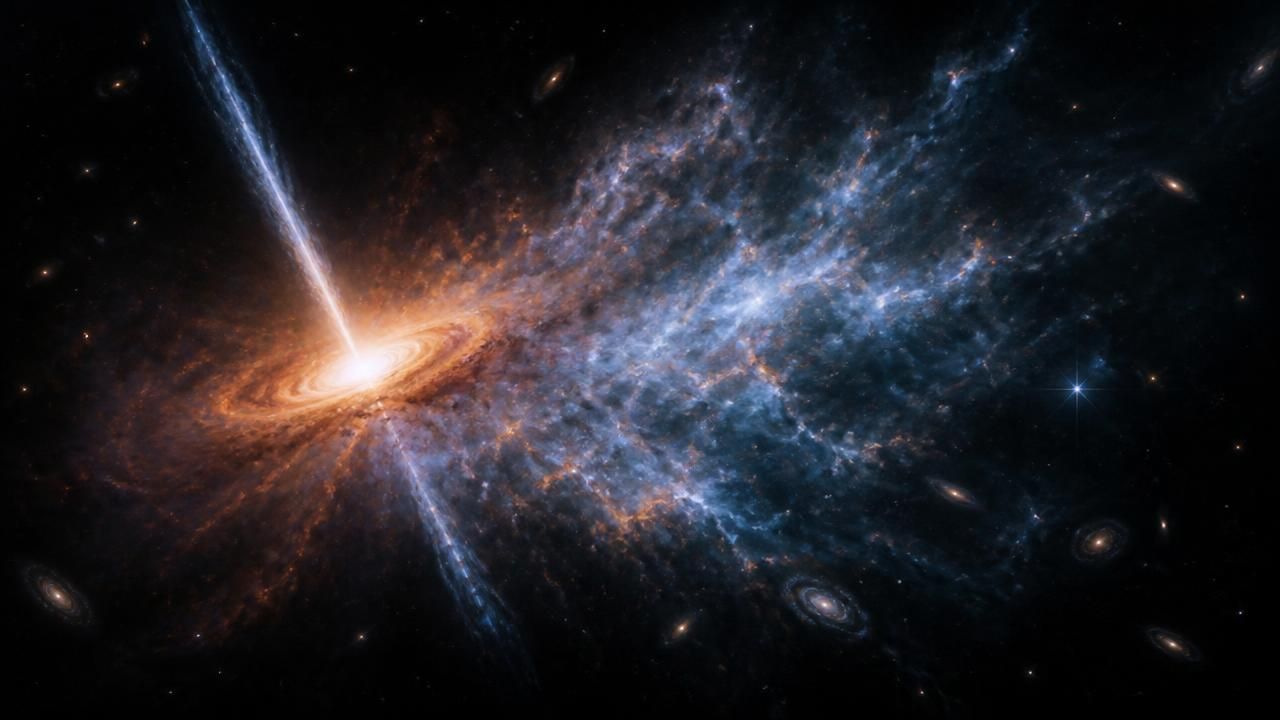
The winds streaming off a supermassive black hole are roughly 100 times more powerful than astronomers had estimated, according to new X-ray observations that trace the resulting turbulence some 300,000 light-years into intergalactic space — roughly three times the diameter of the Milky Way's disk, and far beyond the borders of the black hole's own galaxy.
The result, drawn from data collected by the Japanese-led XRISM X-ray observatory, reframes how dramatically a single collapsed object can reshape its cosmic surroundings. The energy carried by the outflow is described as rivaling several billion supernova explosions, a figure that pushes black holes from the status of local curiosities into the role of large-scale cosmic engineers.
An X-ray eye on a violent quasar
The observations target the supermassive black hole powering a quasar — the intensely bright core of a galaxy where infalling matter heats to millions of degrees and radiates across the electromagnetic spectrum. XRISM's Resolve spectrometer, a microcalorimeter that measures the precise energy of individual X-ray photons, was able to detect the signature of highly ionized gas moving at extreme velocities.
What the instrument revealed was not a compact, tightly collimated breeze but a sprawling, turbulent outflow. Gas accelerated near the black hole's event horizon appears to plow outward and dissipate its energy across a volume hundreds of thousands of light-years wide — a scale that had not appeared in earlier models.
The energy involved rivals several billion supernova explosions, revealing just how dramatically black holes can influence the space around them.
The headline numbers are striking by almost any measure:
- Roughly 100 times more powerful than earlier estimates of the same wind.
- Turbulence traced about 300,000 light-years from the black hole.
- Energy output comparable to several billion supernovae.
- Outflow extent well beyond the host galaxy's visible structure.
Why 'feedback' matters
For decades, astrophysicists have puzzled over a persistent mismatch: computer simulations of galaxy formation tend to produce galaxies far more massive than the ones actually observed. The leading fix has been black hole feedback — the idea that energy dumped by a growing supermassive black hole heats or expels surrounding gas, throttling star formation and limiting how large a galaxy can grow.
That mechanism requires black holes to punch above their weight. The new XRISM result suggests they do so by a wider margin than expected, and over a wider area. If winds routinely reach hundreds of thousands of light-years, they may influence not only their host galaxy but neighboring galaxies in the same group or cluster — a phenomenon sometimes called AGN-driven feedback on circumgalactic scales.
Earlier generations of X-ray telescopes, including Chandra and XMM-Newton, established that quasars blow powerful winds. But those instruments could not resolve the detailed velocity structure of the gas with the spectral sharpness XRISM provides, leaving the total energy budget uncertain by orders of magnitude. Source coverage of the new work consistently emphasized the same three numbers — the 100-fold revision, the 300,000-light-year reach, and the supernova-scale energy — while science-focused outlets stressed the physics of turbulence and aggregator platforms foregrounded the sheer scale of the phenomenon.
A multi-wavelength puzzle
The black hole in question has also proven elusive in other ways. Related coverage noted that a well-studied galaxy's central black hole had been "hiding its most violent behavior" — a reminder that dust and gas can mask even the most energetic events from optical and ultraviolet telescopes. X-rays cut through much of that shroud, which is precisely why XRISM's contributions matter.
A parallel line of reporting described a supermassive black hole that erupted in X-rays, with radio jets following roughly 300 days later. That delay is significant: it suggests the accretion disk and the relativistic jets do not respond in lockstep, and that a single outburst propagates through the system on its own timetable. Together, the two findings paint a picture of black holes as variable, multi-stage engines rather than steady furnaces.
What comes next
Observers caution that a single measurement is not a population study. The team's immediate task is to determine whether such extreme outflows are common among quasars or whether the object examined is an outlier caught during a particularly violent episode. Follow-up spectroscopy of additional quasars, combined with radio and optical data, will help establish how often black holes launch winds of this magnitude.
The stakes extend beyond bookkeeping. If supermassive black holes routinely inject energy on scales of hundreds of thousands of light-years, then models of galaxy evolution — and of how the intergalactic medium became enriched with heavy elements — will need adjusting. The universe's largest structures may bear the fingerprints of its smallest, densest objects.
For now, the message from XRISM is clear: the winds from a supermassive black hole are not a local weather system. They are a climate.