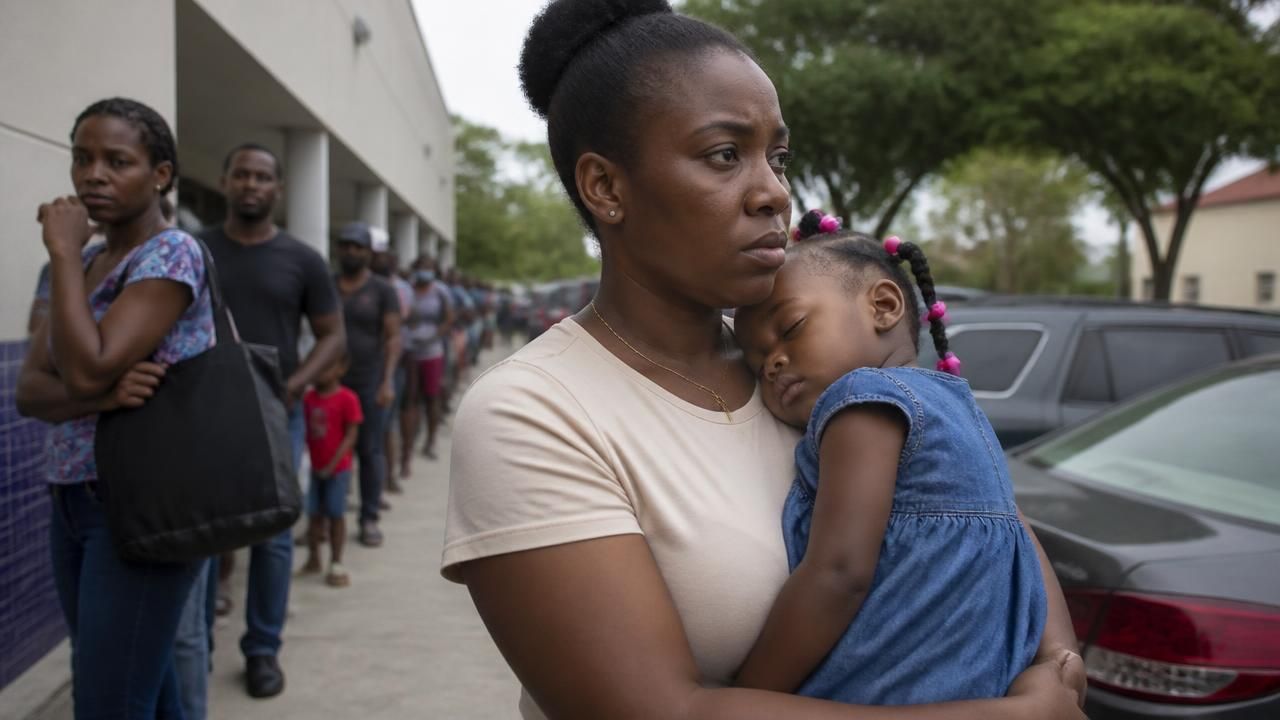
MIAMI — The text messages began arriving before dawn. By midday, the group chats among Haitian families in Little Haiti, North Miami and beyond had filled with the same questions: Do we stay? Do we go? What happens to the children?
For thousands of Haitians across the United States, the end of Temporary Protected Status (TPS) is no longer a legal abstraction. It is a deadline — one that arrived this week after a yearslong legal battle that ultimately reached the U.S. Supreme Court, clearing the way for the Trump administration to terminate the designation that has allowed Haitian nationals to live and work legally in the country.
What TPS Did — and What Losing It Means
TPS is a humanitarian program that lets people from countries experiencing armed conflict, natural disasters or other unsafe conditions remain in the United States and obtain work authorization. Haiti was designated in the aftermath of the 2010 earthquake that killed more than 200,000 people and leveled much of Port-au-Prince. The status was renewed repeatedly across administrations of both parties, allowing recipients to build lives — mortgages, small businesses, careers, American-born children.
The Department of Homeland Security announced last year that Haitian nationals would no longer qualify. Estimates of how many people are affected vary widely, but the figure runs into the hundreds of thousands. Now, advocates say, those families are facing removal to a country wracked by gang violence, a collapse in public health infrastructure, cholera outbreaks and extreme poverty.
The Legal Fight That Reached the Supreme Court
The termination did not happen quietly. It followed a protracted legal battle over whether the administration followed proper procedure in ending the designation, with the dispute escalating all the way to the nation's highest court. When the legal options were exhausted, the protections officially lapsed — and the enforcement landscape shifted overnight.
The words used by New Jersey's News 12 to describe the mood among Haitian immigrants in the state were blunt and immediate: “fear, panic.”
Miami: Grief, Anger and Defiance
In South Florida, home to one of the largest Haitian diaspora communities in the country, NPR found a community meeting the moment with a mixture of sorrow, fury and resolve. Churches have become impromptu legal clinics. Attorneys are working pro bono. Neighbors are pooling money for filing fees and, in some cases, plane tickets.
The emotional register varies by household. For some, the loss is primarily economic — a job, a lease, a car payment. For others, it is existential: parents weighing whether to leave U.S.-born children behind with relatives, or to bring them to a country many have never seen.
New York City Dismisses Haitian Workers
The New York Times reported that New York City — whose municipal workforce and care economy rely heavily on immigrant labor — has moved to dismiss Haitian workers whose employment authorization depended on TPS. The dismissals illustrate a quieter consequence of the policy change that extends well beyond immigration courts: the abrupt removal of documented, taxpaying employees from workplaces that badly need them.
Pennsylvania and New Jersey: Jobs and Stability Lost
Reporting from Pennsylvania described thousands of Haitians losing jobs and the stability that came with them, while News 12 New Jersey documented households thrown into crisis across the Garden State. Taken together, the regional reports trace the same arc in different geographies: a federal decision in Washington producing shockwaves in hospitals, nursing homes, warehouses, farms and restaurants from the Northeast corridor to the Gulf Coast.
The Caregiving Question
PolitiFact examined one of the most consequential downstream effects: whether the end of TPS for Haitians will trigger a caregiving crisis. The question is not rhetorical. Haitian immigrants are heavily represented in home health care, nursing assistance and long-term care roles — positions that were already strained by chronic understaffing before the policy change.
- Home health aides: A workforce that provides in-home support to elderly and disabled Americans, often in states with aging populations.
- Nursing homes and assisted living: Facilities that have reported persistent staffing shortages since the pandemic.
- Hospitals: Support roles including patient transport, environmental services and dietary staff.
- Childcare and domestic work: Sectors where immigrant labor is disproportionately concentrated and where formal worker protections are weakest.
Industry analysts warn that removing a stable, work-authorized population from these roles could worsen wait times, raise costs and push families toward more expensive institutional care. Whether the effect rises to the level of a full-blown crisis remains an open, and contested, question.
Different Lenses on the Same Story
The coverage itself reveals how differently this story is framed depending on where you read it. NPR centers the human and emotional dimensions — grief, defiance, courage — and lets families narrate their own futures. The New York Times approaches it through institutions, focusing on the city that must dismiss employees it depends on. Regional outlets in Pennsylvania and New Jersey emphasize the local labor-market shock and the raw panic inside immigrant households. PolitiFact takes the analytical route, testing the claim that the policy change will produce a caregiving crisis.
Each framing is accurate; none is complete. Together they describe a single event — the lapse of a legal protection — rippling outward into families, employers, municipal budgets and an already fragile care economy.
What Comes Next
Advocates are pursuing several avenues: lawsuits challenging the termination, congressional legislation that would create a path to permanent residency for long-term TPS holders, and state-level measures offering limited protections. Each faces steep political odds.
Meanwhile, in Miami, New York, Philadelphia and Newark, the practical work continues — legal consultations booked weeks out, children's school records gathered, savings counted. As one longtime Miami organizer put it, the community is not waiting for the politics to resolve itself. It is preparing for the worst while insisting, publicly and repeatedly, that Haiti is not a country to which anyone should be sent right now.