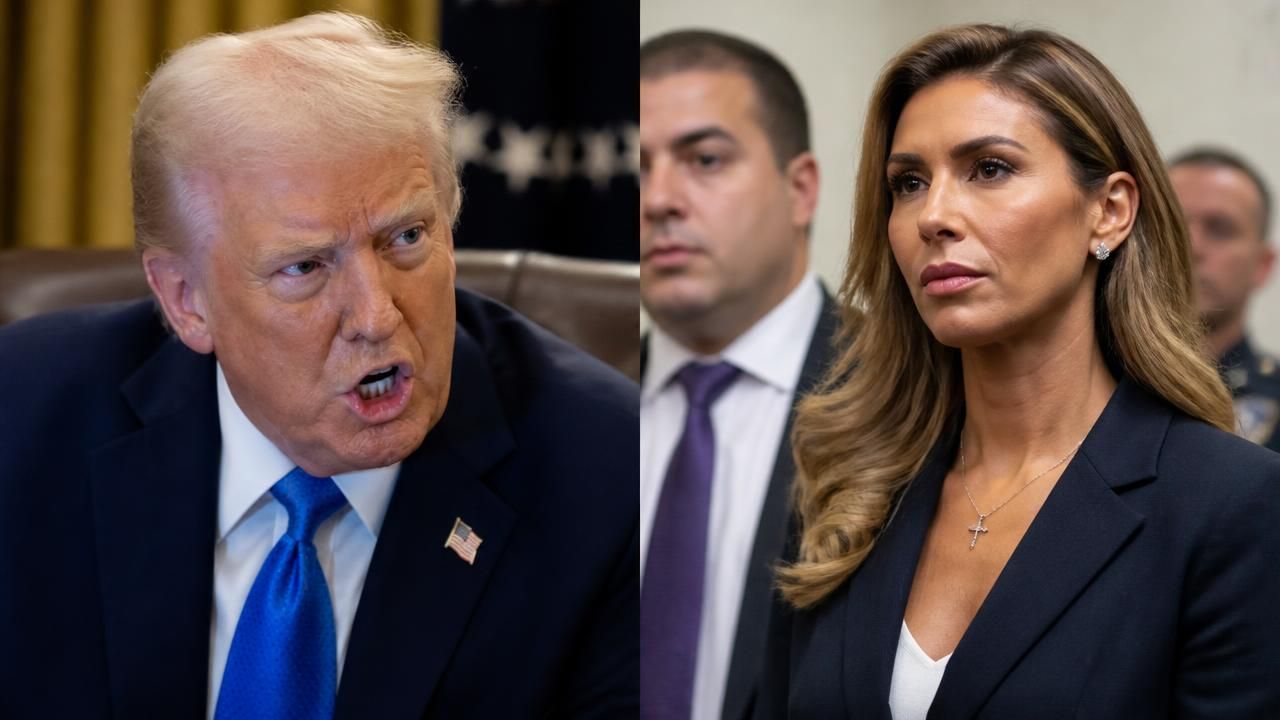
Donald Trump privately erupted after learning that Alina Habba, a longtime legal adviser and one of his former lawyers, had signed a $50 million deal with the family of a wealthy Venezuelan billionaire who was seeking a presidential pardon, according to a New York Times report. The reaction was not only about the scale of the fee. According to the account, Trump told allies he wanted some of the money directed to his future presidential library, a detail that turned a story about a lawyer’s payday into a broader examination of access, influence and the pardon power.
The Times framed the matter in stark terms in its headline:
A Billionaire Wanted a Trump Pardon. His Family Gave Alina Habba a $50 Million Deal. — The New York Times
The report was quickly picked up by MSN.com and other syndicators, each emphasizing a different element. One version said the billionaire had scored a Trump pardon after the $50 million deal. Another focused on Trump’s private anger after learning of Habba’s payday. A third highlighted Habba’s denial that she had obtained a pardon for the Venezuelan billionaire through the arrangement. Together, the accounts describe a dispute that is as much about competing headlines as about the underlying facts, which remain only partially public.
What the report says
According to the Times account, the family of a wealthy Venezuelan businessman seeking clemency from Trump agreed to pay Habba $50 million. Habba, a prominent legal ally of Trump who has represented him in high-profile matters, has denied that the deal was connected to securing a pardon for the billionaire. The available summaries do not name the billionaire, specify the offense at issue, or establish the exact timing of any pardon. They also do not indicate that Trump himself received any of the $50 million.
The most politically explosive detail is Trump’s reported private reaction. The Times says Trump was angry about the size of the contract and told allies he wanted some of the money to go to his future presidential library. That claim, if confirmed, would raise questions about how the former president views financial support from people seeking government favors. It also underscores the unusual position of Habba, who has been both a personal lawyer and a public defender of Trump, and who would have been well positioned to understand the value of access to him.
A denial and a disputed chain of events
Habba’s denial is central to the story. According to MSN’s summary of the reporting, she rejects the characterization that the $50 million deal was a pardon arrangement for the Venezuelan billionaire. That denial does not resolve the broader questions: Why did the family agree to pay such a large sum? What legal work was Habba said to be performing? Did the payment have any connection to clemency proceedings? And did Trump or his associates know about the deal before it became public?
The Times report, as relayed by aggregators, does not answer all of those questions. It does, however, describe a president who was focused on the money and on his future library — a detail that is likely to intensify scrutiny from ethics watchdogs and political opponents. The White House and Habba’s representatives did not provide additional comment in the summarized accounts.
How different outlets framed it
The New York Times presented the story as a window into the pardon process and the influence industry that surrounds a president. Its headline emphasized the billionaire’s desire for a pardon and the family’s $50 million deal with Habba. MSN.com’s versions, by contrast, leaned into the palace-intrigue angle: Trump’s eruption, his desire for a cut for his library, and Habba’s denial. That divergence is typical of how a single investigative scoop travels through the media ecosystem. The original outlet supplies the reporting and the legal context; aggregators distill it into sharper, more personality-driven headlines that often reach a larger audience.
The result is a story that can be read in two ways. One reading is about a lawyer’s lucrative contract and a client’s hope for presidential mercy. The other is about a president’s reaction to learning that someone close to him had secured a huge payday — and his immediate instinct that some of it should benefit him. Both readings matter because they point to the same underlying issue: the intersection of private money, personal loyalty and public power.
Why it matters
The U.S. Constitution gives the president broad pardon power, but modern administrations have generally handled clemency through a structured process involving the Justice Department’s pardon attorney, FBI checks and White House review. Large payments to a president’s lawyer or to his political network can create at least the appearance of pay-to-play, even if no law is broken. Ethics experts have long warned that clemency decisions are especially vulnerable to influence peddling because they are discretionary, difficult to reverse and often involve people with significant resources.
Trump has long tested traditional boundaries around pardons, political money and personal business. The reported $50 million deal with Habba fits into that pattern: it involves a wealthy foreign-born businessman, a lawyer with close ties to Trump, and a president who has shown little reluctance to mix personal and political considerations. The denial from Habba means the story is contested, but it does not make the questions go away.
What remains unknown
Several key facts are still missing. The billionaire’s identity has not been disclosed in the summarized reports. The nature of any pardon or clemency grant is unclear. It is not known whether the $50 million was paid in full, what services Habba was expected to provide, or whether the arrangement was disclosed to federal authorities. There is no evidence in the provided accounts that Trump received any of the money or that his future library has received funds from the deal.
For now, the story is a reminder of how quickly a private legal arrangement can become a public controversy when it touches a presidential pardon. The Times has reported the outline; MSN and other outlets have amplified the most dramatic details and the denial. What remains is a familiar Washington question: when money, lawyers and clemency converge, who is really paying for access — and what are they buying?