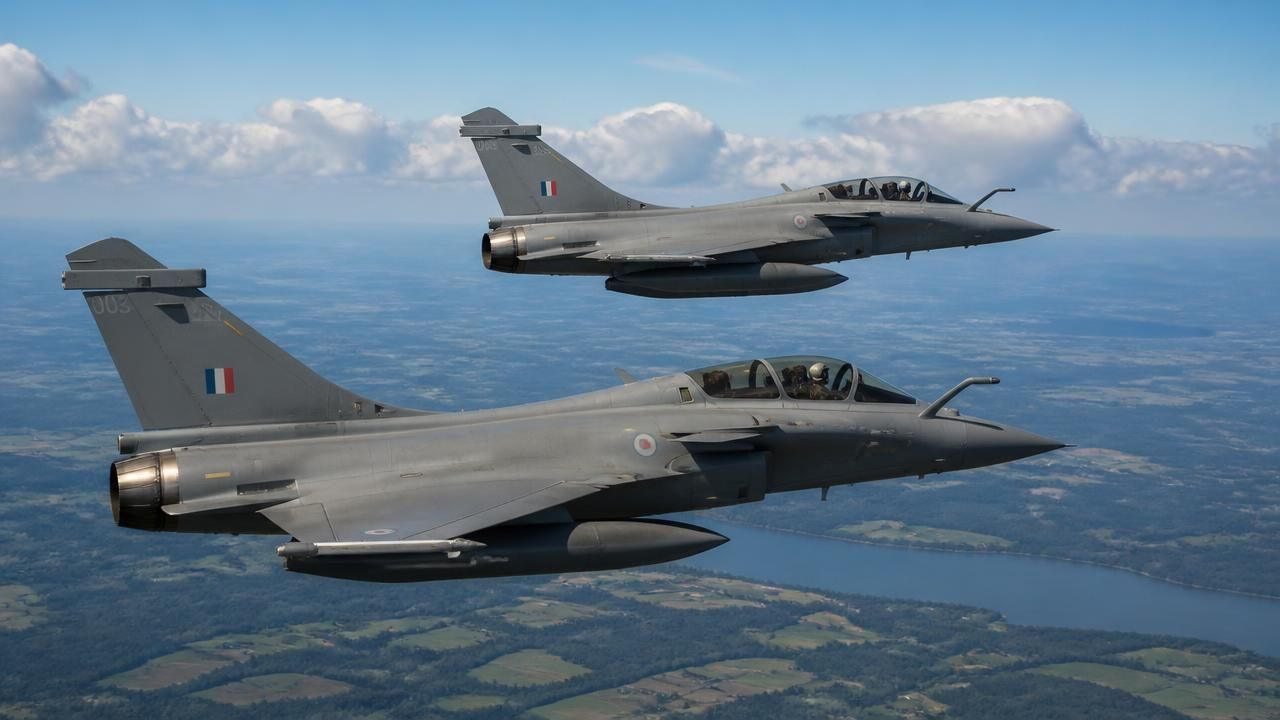
NATO fighter jets shot down an unidentified drone over Lithuania after it crossed into the country's airspace from neighbouring Belarus, alliance officials and multiple news outlets reported — an interception that several governments and media organisations described as the first of its kind for the Baltic state.
The incident unfolded less than a day after NATO leaders concluded a summit at which they pledged that strikes falling close to the alliance's territory would push the trans-Atlantic organisation to step up its support for Kyiv. Coming on the same day that a Russian frigate reportedly fired flares at a Danish helicopter, the downing has sharpened concerns about the spillover of the war in Ukraine into NATO airspace.
What Happened
According to accounts carried by The Guardian, France 24, RFI, India Today, Meduza, The New Indian Express and others, the drone entered Lithuanian territory from the direction of Belarus before being engaged by NATO aircraft conducting air-policing duties in the region. The aircraft was described in early reports as "unidentified," and there was no immediate confirmation of its origin, payload or type.
NATO operates a standing Baltic air-policing mission out of Šiauliai in Lithuania, with rotating detachments from allied air forces. That mission — established after the Baltic states joined NATO in 2004 — has become one of the alliance's most visible forward-presence commitments since Russia's full-scale invasion of Ukraine in 2022.
A First for the Alliance's Eastern Flank
Several outlets, including Meduza and Yahoo News, framed the episode as the first time NATO jets have shot down a drone over Lithuania, assigning it symbolic weight beyond its immediate military significance. For a country of roughly 2.8 million people sharing a long border with Belarus and a strategic frontier with Russia's Kaliningrad exclave, the interception is being read as a test of the alliance's Article 5 credibility.
How the Story Is Being Framed
The coverage varies markedly in emphasis, reflecting each outlet's regional vantage point:
- Diplomatic and alliance framing: The Guardian, NPR and France 24 place the downing in the context of NATO's post-summit posture and its stated willingness to escalate support for Kyiv after incidents near allied territory.
- Attribution to Belarus: Yahoo News, India Today and ThePrint foreground the drone's reported entry from Belarus, raising questions about Minsk's direct involvement or its role as a transit corridor.
- Escalation framing: MSN, The Sun and other outlets emphasise the timing — hours after the Kremlin issued what was described as a chilling threat, and alongside the flare incident involving a Russian frigate and a Danish helicopter.
- Regional-security framing: RFI treats it as "the latest Baltic security incident," part of a pattern rather than an isolated event.
Notably, none of the reports on which this account is based included an official claim of responsibility, and NATO did not immediately characterise the drone as Russian-made or Russian-launched. That ambiguity is itself central to the story: the alliance must respond decisively without prematurely attributing an act that could trigger a wider confrontation.
Strikes close to the alliance's territory would drive the trans-Atlantic organization to increase support for Kyiv, NATO leaders pledged at their summit — a commitment that now faces its first live test over Lithuanian soil.
Why It Matters
The Baltic region has become the most sensitive point of contact between NATO and Russia. Since 2022, there have been repeated — though previously rare — violations of allied airspace by drones and aircraft, incidents involving shadow-fleet tankers in the Baltic Sea, and sabotage of undersea cables and pipelines that Western officials have linked to Russian intelligence operations.
Lithuania, Latvia and Estonia have all invested heavily in counter-drone capabilities, and NATO has expanded its integrated air and missile defence posture along the eastern flank. The downing demonstrates that the alliance is prepared to use lethal force against incursions rather than merely escort or monitor them — a doctrinal shift with real escalation risk.
The Wider Military Context
The episode coincides with heightened Russian naval and air activity in the Baltic. Reports of a Russian frigate firing flares at a Danish helicopter underscore how quickly a routine patrol can turn into a near-miss between NATO and Russian forces. Danish and other allied vessels operate in the same waters as Russia's Baltic Fleet, and the margin for error is thin.
What Comes Next
Alliance officials are expected to examine the drone's wreckage and flight path to establish its origin. Lithuania is likely to invoke NATO consultation mechanisms, and the incident will feed directly into discussions about strengthening air defence and counter-UAS systems across the eastern flank.
The Kremlin's response — whether it denies involvement, stays silent, or issues further warnings — will shape how the episode is remembered: as a contained technical incident, or as another marker on the slow, dangerous climb toward direct confrontation between Russia and the West. For now, the downing over Lithuania stands as a reminder that the war's edges are no longer confined to Ukraine.