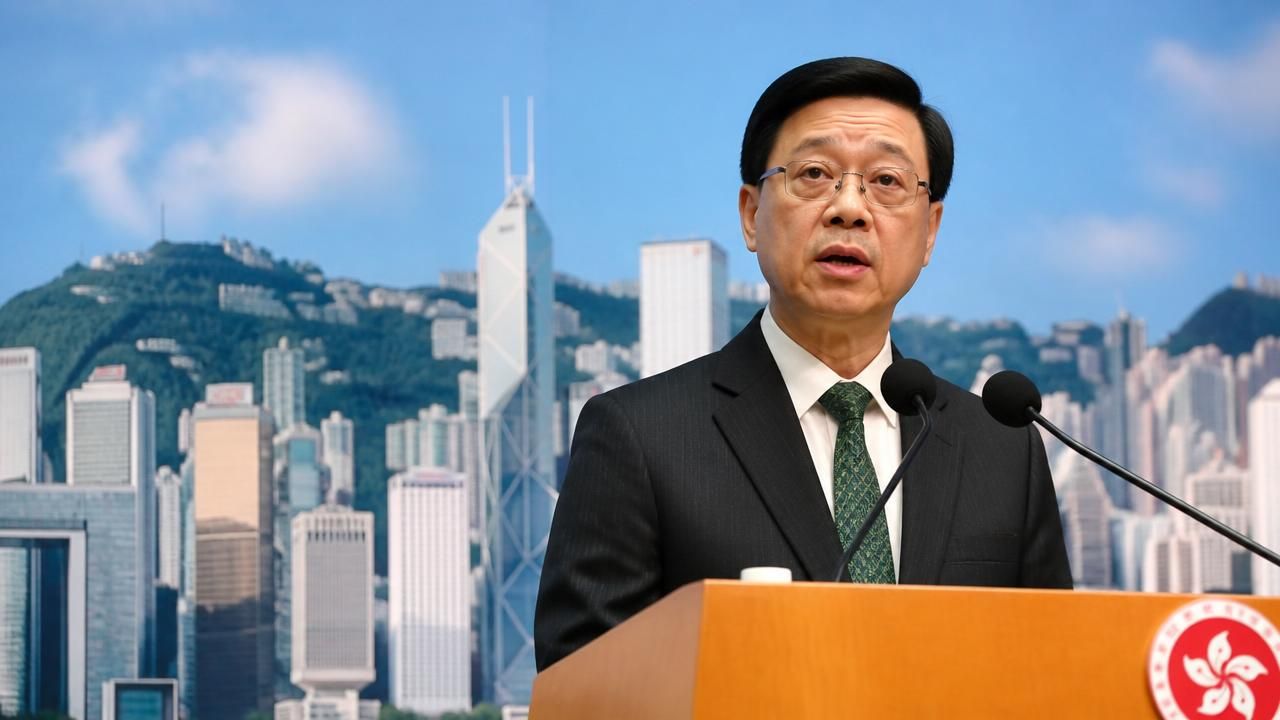
Hong Kong will on Wednesday unveil its first-ever five-year development blueprint, released in tandem with the Chief Executive's annual Policy Address — a dual rollout that signals a significant shift in how the city plans its economic future and how closely it intends to synchronise that planning with Beijing.
The move, first reported by Bloomberg and confirmed across a wave of government-linked and regional outlets, marks the first time the territory has adopted the kind of medium-term, goal-driven planning cycle that mainland China has used for decades. Chief Executive John Lee is expected to present the five-year plan and the Policy Address together, framing the pair as complementary documents: one setting strategic direction, the other detailing annual deliverables.
A blueprint modelled on Beijing
The plan's most striking feature is its structure rather than any single policy. Five-year plans are a hallmark of mainland governance, and Hong Kong's adoption of the format — complete with public consultation — has been described by the Associated Press and others as an echo of Beijing's playbook.
The government opened a consultation period ahead of the launch, soliciting input from business groups, professionals, academics and the public. Officials have portrayed the exercise as a way to give the city's economy a longer horizon than the one-year cycle of a traditional Policy Address allows, particularly as Hong Kong navigates sluggish growth, property-market weakness and intensifying regional competition.
Lee: goals, not a change of system
Anticipating concern that economic planning implies a drift away from Hong Kong's free-market foundations, Lee has been explicit that the blueprint is about targets, not transformation. According to statements carried by regional outlets, the Chief Executive said the five-year plan will "set goals" rather than alter the economic system, and will adhere to both the capitalist system and the "One Country, Two Systems" principle under which the territory operates.
"The five-year plan will set goals, not alter the economic system… it will adhere to the capitalist system and the 'One Country, Two Systems' principle." — Chief Executive John Lee
That framing matters politically. Since the 2020 imposition of the National Security Law and the overhaul of the electoral system, Hong Kong's leadership has faced persistent questions from international investors about whether the city retains meaningful autonomy from the mainland. Lee's insistence on continuity is aimed squarely at that audience.
Biomedicine as a flagship ambition
Among the more concrete industrial goals to emerge ahead of the launch is an ambition to establish Hong Kong as a biomedicine powerhouse. The sector has long been identified as a natural fit for the city: it boasts world-ranked medical and life-sciences faculties, a robust intellectual-property regime, and access to mainland capital and patient data through the Greater Bay Area.
Positioning biomedicine as a flagship industry would place Hong Kong alongside a growing list of Asian economies competing for biotech investment, and would tie the territory's research base more tightly to national priorities in health and technology self-sufficiency. Whether the plan attaches funding, land and regulatory reform to the ambition — or merely names it — will be the test of its seriousness.
Banks cast as partners, not bystanders
Speaking ahead of the rollout, Lee also emphasised that banks have a key role to play in delivering the five-year plan, according to RTHK. The remark positions the financial sector both as a beneficiary of the strategy and as an instrument for executing it — expected to channel credit toward designated priority industries, support infrastructure and green financing, and help fund the Greater Bay Area integration projects that underpin much of the planning.
- Strategic planning: the territory's first medium-term development blueprint, aligned with national priorities
- Industrial policy: a stated goal of becoming a biomedicine hub
- Finance: banks expected to finance priority sectors, per Lee
- Governance: public consultation preceded the plan, mirroring mainland practice
- Continuity claims: officials say the capitalist system and "One Country, Two Systems" remain intact
How the story is being framed
Coverage of the announcement reflects sharply differing emphases. Bloomberg, which broke the news and devoted airtime to the plan's implications on "The China Show," frames the story primarily through the lens of alignment with the mainland and what the shift means for the city's future as an international financial centre. Government outlets such as news.gov.hk and RTHK stress mechanics and continuity — what is being set, and who is being asked to help deliver it. Regional aggregators and wire services, including the Associated Press's syndicated reporting, foreground the novelty of consultation and the broader echo of Beijing's planning model, a framing that carries implicit questions about autonomy.
Historical context sharpens the stakes. Hong Kong's last large-scale attempt at industrial strategy, the 1990s-era push toward a technology hub, produced mixed results and limited lasting diversification. A five-year cycle, by contrast, creates measurable milestones — and, by extension, measurable accountability that previous policy statements largely avoided.
What to watch
Wednesday's documents will be scrutinised for three things: whether the biomedicine ambition comes with money and regulatory change; whether the plan includes explicit key performance indicators and review mechanisms; and whether the investment community reads the package as continuity or as a further step toward mainland-style governance. For a city whose reputation rests on predictability and openness, the answers may prove as consequential as any policy inside the document itself.