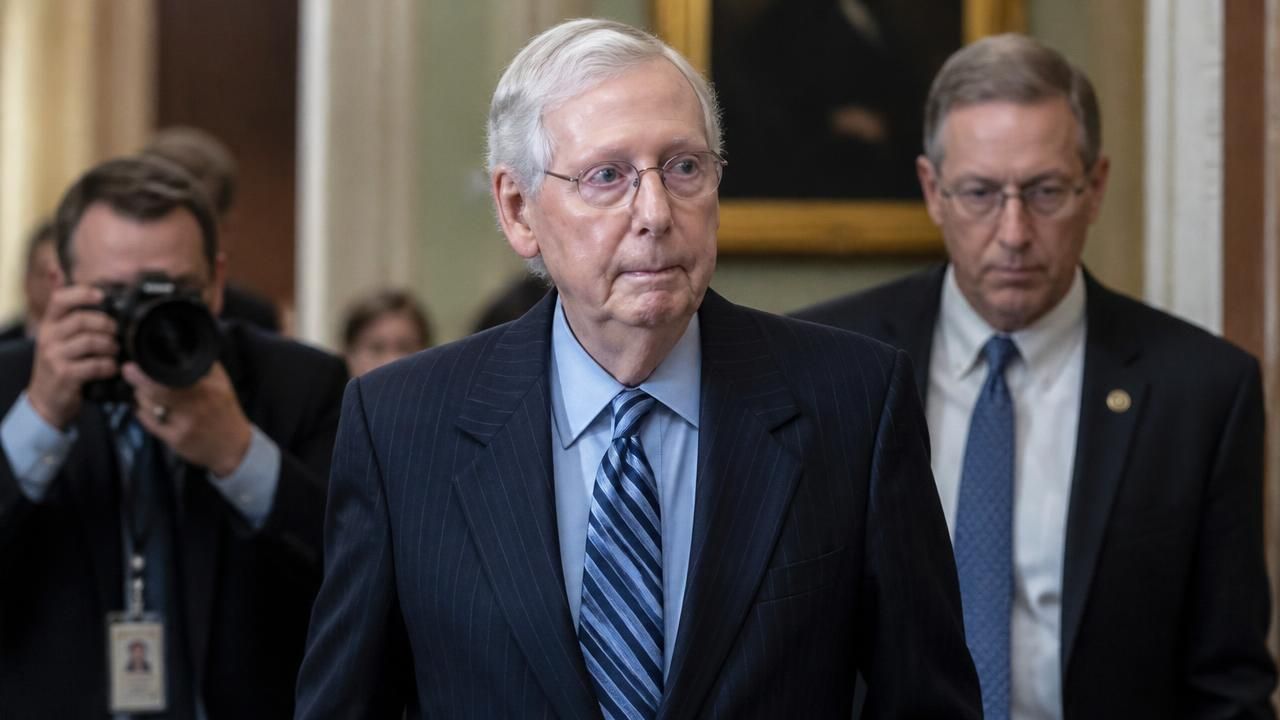
Senator Mitch McConnell returned to the Capitol and cast his first vote since June, ending an absence of more than 13 weeks that had left his seat vacant through a stretch of the legislative calendar and turned the question of his whereabouts into a running Washington mystery.
The 84-year-old Kentucky Republican, who spent nearly two decades as his party's leader in the chamber, had not been seen in the Senate since a health incident sent him to the hospital earlier in the summer. His return — described by one headline as "a frail-looking McConnell" arriving back in Washington — closes a chapter that had grown from a routine medical update into a sustained examination of fitness, power and the institutional consequences of one senator's absence.
How the story unfolded
The arc of coverage tracked the calendar of the Senate itself. In the first weeks, the story was framed as a temporary hospitalization and a recovery. As the absence stretched past a month and then two, the tone shifted.
- Early summer: McConnell is hospitalized after a fall, and his office signals a period of recuperation.
- Midsummer: Questions sharpen, with outlets asking bluntly, "Where is Mitch McConnell?" and examining "the impacts of his prolonged absence."
- Recess: Coverage notes he "remains missing from the Senate 3 months after being hospitalized for fall."
- Senate reconvenes: Headlines split. "McConnell a no-show as Senate returns" runs alongside "Mitch McConnell expected to return to Senate this week."
- The return: He arrives to cast his first vote since June.
A news vacuum filled by headlines
The fragmented nature of the coverage was itself telling. Much of what the public saw arrived as aggregated headlines rather than detailed reporting: brief, unadorned dispatches that varied wildly in certainty. Some declared he "could return to the Senate as early as Monday." Others stated flatly that he "returns to the Senate after three-month absence due to health issues." Still others, published within days of each other, insisted "questions swirl around Mitch McConnell's return as Senate set to reconvene Monday" while simultaneously reporting that he had already returned.
"Where is Mitch McConnell? The impacts of his prolonged absence" — a question posed by multiple outlets as the Senate prepared to reconvene.
The New York Times framed the return in the starkest institutional terms, noting that the senator's absence had "fueled questions about his ability to continue serving" — a formulation that goes beyond scheduling and touches the central tension of an aging Senate. The Wall Street Journal, by contrast, treated the event more as a logistical milestone: a senator returning to the Capitol after three months. Regional outlets such as The Detroit News and MLive leaned into the accessibility question, publishing explainer-style updates answering "Where is Mitch McConnell?" for readers who had lost the thread.
The stakes of an empty seat
McConnell's absence was never purely personal. With Republicans holding a narrow majority, a single missing senator can complicate — or stall — nominations, procedural votes and party-line legislation. During his absence, the Senate's arithmetic narrowed, and leadership had to plan around one fewer reliable vote.
There is also the question of representation. Kentucky's constituents went roughly a quarter of a year without a voting senator in Washington, a period that spanned appropriations work and the kind of committee business where seniority translates directly into influence. McConnell remains a senior member of the Appropriations and Rules committees, and his institutional knowledge is not easily substituted.
Age, health and an uncomfortable Washington ritual
McConnell's career has been punctuated by public health scares before. In 2023, he froze mid-sentence during two separate press conferences, episodes his office attributed to lightheadedness and, in one case, to lingering effects of a concussion. Those moments prompted a round of questions that this longer absence revived at a higher volume.
The Senate is, statistically, one of the oldest bodies in the democratic world. Its median age sits in the mid-sixties, and several members are in their eighties. That reality has made health transparency a perennial flashpoint, with critics arguing that voters deserve fuller disclosure and defenders countering that medical privacy applies to senators as it does to anyone else.
What comes next
McConnell's return restores a vote and a voice, but it does not resolve the underlying storyline. Republicans face a demanding legislative calendar, and each future absence will be measured against this one. McConnell has said he intends to serve out the remainder of his term, which runs through 2027, and has signaled he will not seek reelection.
For now, the immediate questions — Where is he? Is he back? Will he vote? — have been answered. The larger one, about how long a senator can govern from the edge of the chamber's capacity, remains open, and will likely follow McConnell for the rest of his time in Washington.