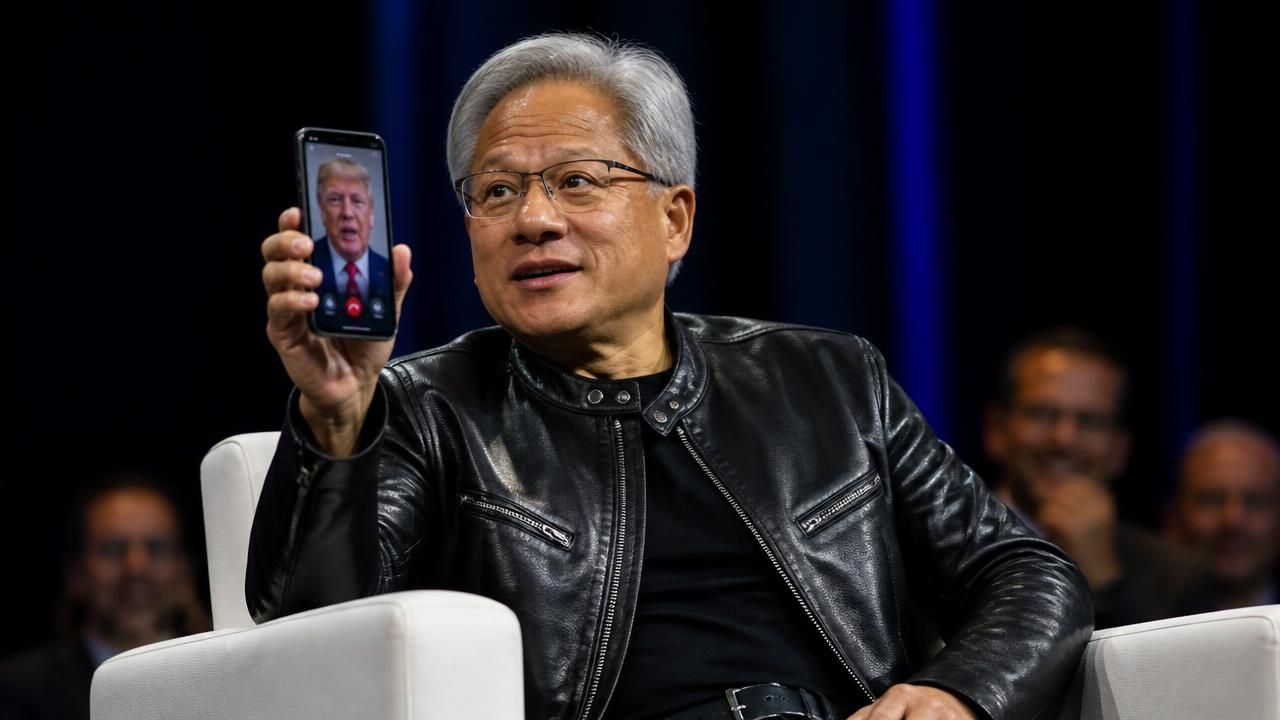
Nvidia CEO Jensen Huang turned a keynote-stage appearance into a live political moment on Monday, taking a phone call from President Donald Trump and putting him on speakerphone in front of a large crowd at the All-In Summit. The president used the surprise call to dismiss fears about artificial intelligence as a “hoax” and to declare that “the robots will not be taking over.”
The scene, first reported by The Verge and quickly amplified by CNBC, WIRED, Yahoo, and MSN, was not the first time Huang has taken a call from Trump while at work. But it was among the most public: the Nvidia chief, whose company sits at the center of the AI boom, effectively handed the microphone to the president during a major tech forum.
A speakerphone moment with political charge
According to The Verge, Trump launched into his take on recent fears about AI development, calling them a “hoax” and telling the crowd that robots would not be taking over. CNBC framed the same remarks around a different target: opposition to data centers. The network’s headline said Trump phoned Huang at the All-In Summit and called data center opposition a “hoax.”
“The robots will not be taking over. It’s all a hoax.” — President Trump, on speakerphone
The dual framing matters. Trump’s comments touched two intertwined debates: whether AI poses an existential or economic threat, and whether the massive data centers required to train and run AI models should face local resistance over energy use, water consumption, and land impact. By calling both concerns a hoax, the president aligned himself with the accelerationist wing of the tech industry and against regulators, environmental critics, and AI safety advocates.
Huang’s balancing act
For Huang, the call was another instance of navigating the political and commercial crosscurrents around Nvidia. The company’s chips power the largest AI models, and its fortunes depend on continued investment in data centers and AI infrastructure. Huang has previously taken calls from Trump during work, according to The Verge, and has been careful not to antagonize an administration that can shape export controls, antitrust policy, and federal support for AI research.
But the onstage speakerphone call was something different. It converted a corporate appearance into a de facto political rally, with the president’s voice booming through the venue. WIRED described the moment as Huang taking a call from Trump in the middle of an all-hands, while The Verge and CNBC identified the setting as the All-In Summit. The discrepancy in headlines—corporate interruption versus public spectacle—shows how quickly the event was packaged for different audiences.
AI doomers vs. accelerators
The call landed during a particularly busy week for AI news. Over the weekend, Anthropic CEO Dario Amodei published a long essay titled “We Must Pace the Frontier,” arguing for slowing the pace of frontier AI development. Amodei’s position represents a growing strand of thought in the industry: that safety, alignment, and societal readiness should govern how fast the most powerful systems are built and deployed.
Trump’s remarks on Monday were the opposite. MSN’s headline framed the event as Trump and Huang uniting against AI doomers, while Yahoo distilled it as Trump calling the Nvidia CEO onstage to dismiss AI regulation concerns. The president’s language—“hoax”—echoed his previous uses of the term to attack political and media narratives, but here it was aimed at a technical and regulatory debate.
The divide is not abstract. AI safety researchers warn about misuse, job displacement, and loss of human control. Data center opponents warn about strained power grids, water shortages, and local environmental damage. Many in the tech industry, including Nvidia’s customers, argue that slowing down cedes leadership to China and delays benefits in medicine, science, and productivity.
What the moment signals
The onstage call also served as a reminder of how central Nvidia has become to the political economy of AI. The company’s hardware is the scarce resource in the AI buildout, and its CEO has become a de facto ambassador for the industry. When Huang takes a call from the president in public, it signals alignment—or at least a willingness to be seen as aligned—between the White House and the most valuable company in the AI supply chain.
For Trump, the appearance offered a chance to claim credit for the AI boom while dismissing its critics. For Huang, it was a high-wire act: pleasing a president who wants faster buildout, without alienating customers, researchers, and governments worried about safety and local impact.
What remains unanswered is whether the “hoax” framing will translate into policy. If the White House uses it to push back against data center moratoriums, environmental reviews, or AI safety rules, the speakerphone moment may be remembered as more than a stunt. If it remains rhetoric, it will be another example of the tech industry’s uneasy partnership with political power.
Either way, the image was unmistakable: the leader of the free world on speakerphone, telling a room full of technologists that the robots are not coming—and that the people worried about them are the ones who have it wrong.