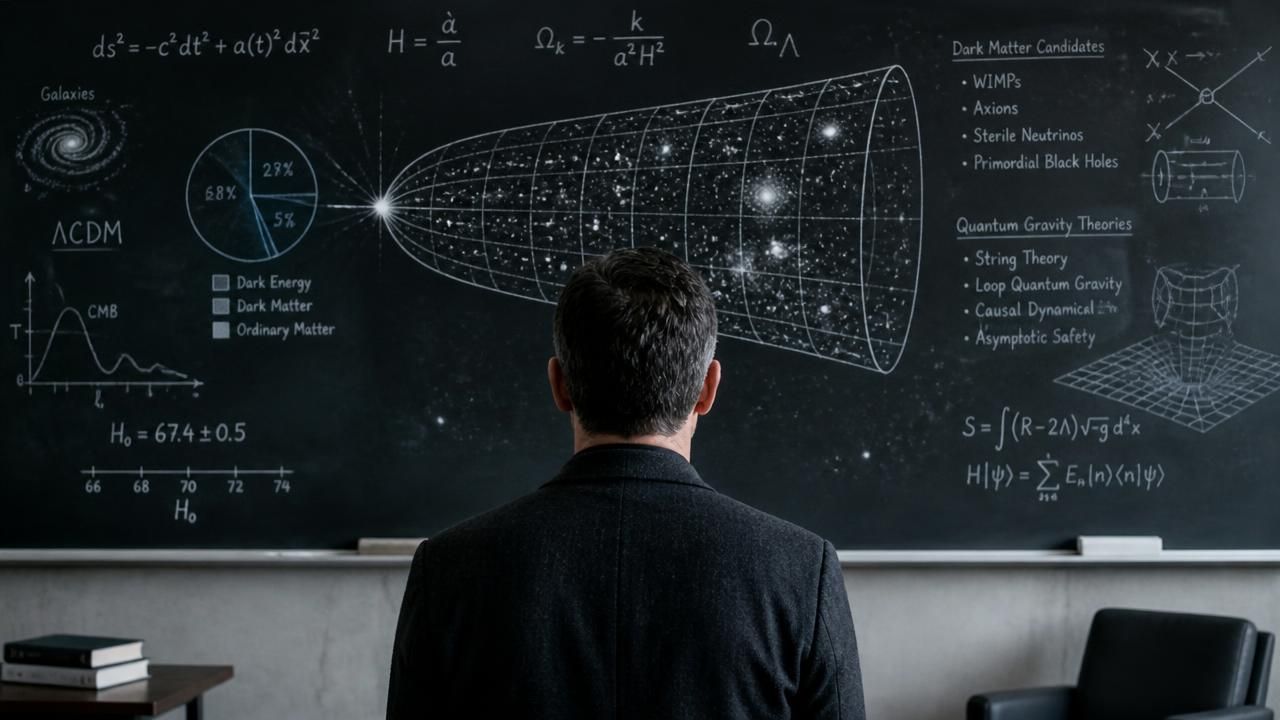
Ask a physicist how the Universe works and you may get a different answer depending on whom you ask. That is the central, uncomfortable finding of the largest worldwide survey of physicists ever conducted — a poll whose results suggest that the field's most fundamental questions remain genuinely unresolved.
According to Science Daily, the survey found that no majority of respondents backed the standard cosmological model, no single leading explanation for dark matter, and no single theory of quantum gravity. The divisions, researchers said, show just how alive and unsettled the frontiers of physics remain.
A Field Without a Majority
The standard model of cosmology — often called Lambda-CDM — has served for decades as the working framework for how the Universe evolved: an expanding cosmos filled with ordinary matter, dark matter, and dark energy. Yet when physicists were asked directly what they believe, the framework failed to command majority support. Neither did any of the rival candidates for dark matter, from weakly interacting massive particles to axions, nor any of the competing approaches to quantum gravity, such as string theory or loop quantum gravity.
"No majority backed the standard cosmological model, a leading explanation for dark matter, or any single theory of quantum gravity."
One area of stronger agreement stood out, and it was perhaps the most philosophically loaded question of all: 68% of respondents said the Big Bang does not necessarily represent the beginning of time. In other words, a clear majority of physicists are open to the idea that what we call the origin of the Universe may be a transition rather than an absolute beginning — a view that echoes longstanding proposals in quantum cosmology, including bouncing and cyclic models.
Framing the Same Story, Three Ways
The way outlets framed the survey says as much about science communication as it does about physics. Phys.org emphasized institutional gravity, describing the study as the "largest-ever survey of physicists" that puts the Standard Model of cosmology "under scrutiny." MSN leaned into the human reaction — "Someone asked physicists what they really believe about the universe and... yikes" — while The Atlantic framed it as a reckoning: "The Truth Physics Can No Longer Ignore."
The contrast is instructive. Where a trade publication sees a field stress-testing its own foundations, a general-interest outlet sees a crisis. Both readings draw on the same data; only the emphasis differs.
The Hubble Tension: Where the Disagreement Bites
The survey's divisions are not purely philosophical. They surface in one of the most concrete measurements in cosmology: the expansion rate of the Universe, known as the Hubble constant. Different methods of measuring it produce persistently different answers — a discrepancy known as the Hubble tension. Measurements calibrated on the cosmic microwave background tend to give a lower value; those built from nearby supernovae and Cepheid variables give a higher one.
Into that gap step new techniques. Physicists at the University of Illinois and the University of Chicago have developed a new method to measure the expansion rate, according to EurekAlert, while a Brown University physicist received a Department of Energy grant to attack a fundamental question about the Universe. The underlying hope is shared: if the mismatch is real and not a measurement artifact, it could point toward new physics beyond the standard cosmological model.
Simulations, Vacuum Decay, and Headlines
The same unsettled frontier produces some of the most eye-catching headlines in science. One widely circulated item declared that physicists had "ruled out" or "proved" that the Universe is not a simulation. Such claims typically rest on narrow technical arguments — for example, that certain quantum computational resources required to simulate a quantum system of the Universe's scale grow so explosively that a classical simulation becomes infeasible. That is a statement about computational limits, not a metaphysical verdict, and physicists themselves tend to be more cautious than the headlines.
A second thread concerned an even more dramatic scenario: physicists simulating a quantum process that could, in principle, end the Universe. The reference is to vacuum decay — the possibility that the Higgs field sits in a metastable state and could, under extraordinarily improbable conditions, tunnel to a lower-energy configuration. The event, if it ever occurred, would propagate at the speed of light and would be unsurvivable and unpredictable. Researchers stress that the timescale involved vastly exceeds the age of the Universe.
A third line of work explores how time itself emerges. Researchers reported creating a tiny model universe in which time emerged without a clock — a toy system in which temporal ordering arises from internal correlations rather than from an external timekeeper. It is a small step, but one aimed squarely at the conceptual gap between quantum theory and gravity.
Why the Disagreement Matters
- It is honest. A field that reports no majority on its core framework is one that is still doing science rather than defending orthodoxy.
- It is productive. The Hubble tension, the dark matter question, and quantum gravity are not dead ends; they are the precise locations where new theories are most likely to be tested.
- It is communicable. The gap between what researchers conclude and what headlines claim is where public understanding of science is won or lost.
None of this means physics is broken. It means physics is unfinished — and, by the admission of its own practitioners, more open than the tidy textbook narrative suggests. The next generation of surveys, telescopes, and tabletop experiments will not settle every question. But they may at least narrow the space in which physicists can disagree.