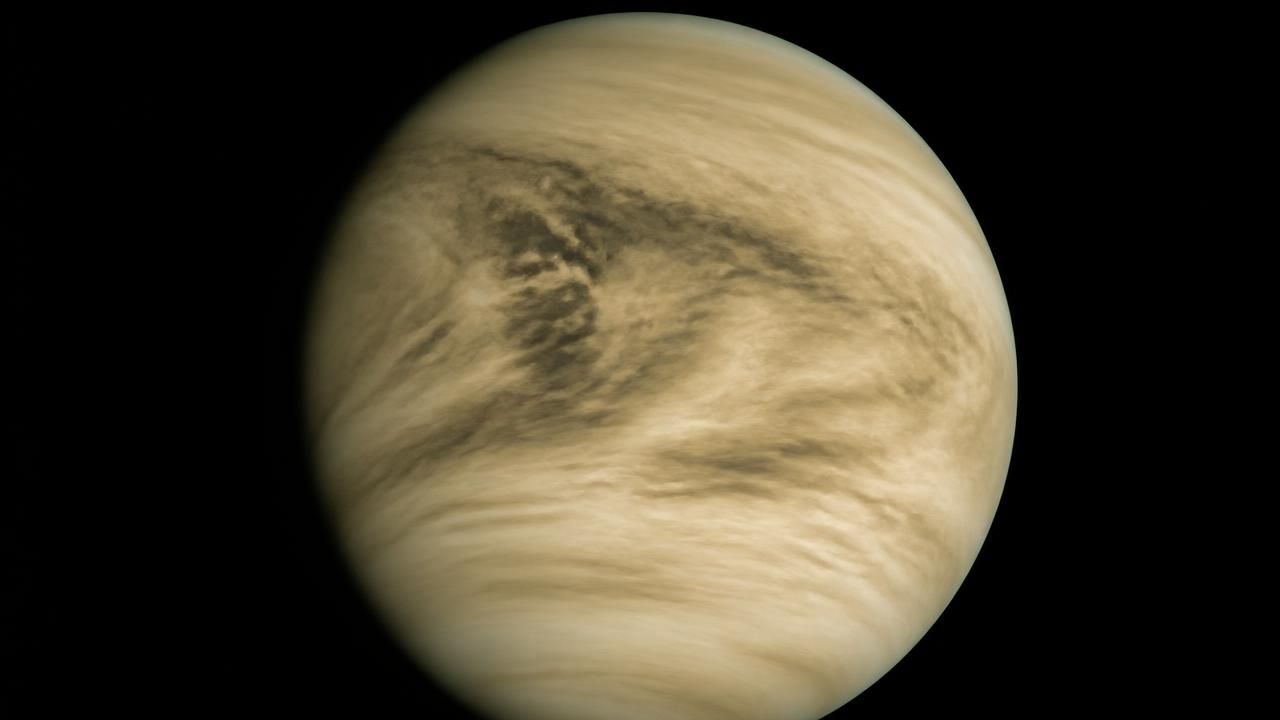
For more than a century, astronomers peering at Venus through ultraviolet filters have seen something that should not be there: vast, dark streaks and swirls racing through the planet's otherwise pale yellow cloud deck. The patterns are not true color; they appear only in ultraviolet light, where an unidentified substance absorbs sunlight far more efficiently than the surrounding sulfuric acid droplets. Now, a new set of calculations has put the tightest constraints yet on just how dark that material must be, sharply narrowing the list of plausible candidates and giving future Venus missions a clearer target to chase.
The work addresses one of planetary science's most stubborn mysteries. Venus is wrapped in clouds made mainly of sulfuric acid, which reflect sunlight and give the planet its brilliant appearance in visible light. But in ultraviolet images, the cloud tops are mottled with dark markings that shift over days and weeks, driven by Venus's super-rotating atmosphere. The absorber responsible has been debated since the 1920s, when early ultraviolet photography first revealed the patterns. It has been attributed to everything from sulfur allotropes and chlorine compounds to iron-bearing aerosols and, more speculatively, organic molecules or even microbes suspended in the clouds.
The results sharply narrow the possibilities and could help future spacecraft determine whether the mysterious substance is organic, inorganic, or something unexpected.
A Matter of Absorption
At the heart of the new study is a deceptively simple question: how strongly must the unknown material absorb ultraviolet light to produce the observed contrast? Scientists modeled how sunlight travels through Venus's cloud layers, accounting for scattering by sulfuric acid droplets and absorption by gases. They then compared those models with the observed darkness of the ultraviolet markings. The calculations yield a required absorption strength, often expressed as the imaginary part of the material's refractive index at ultraviolet wavelengths.
That number matters because different candidate substances absorb very differently. Some proposed materials are far too transparent to explain the dark patterns; others would absorb so strongly that the clouds would appear uniformly black rather than patchy. By bracketing the absorption strength, the new analysis eliminates a wide range of possibilities and focuses attention on materials that can both absorb ultraviolet light and survive in Venus's extreme cloud chemistry.
What the Constraints Mean
The researchers found that the absorber must be efficient but not extraordinary. It must darken the clouds enough to match ultraviolet observations, yet not so much that Venus would lose the bright, high-contrast features that have been tracked for generations. That balance is a powerful filter.
- Simple sulfur dioxide and other common gases in the cloud layer are unlikely to be the main culprit, because their ultraviolet absorption is too weak or spectrally mismatched.
- Elemental sulfur and polysulfur species remain plausible, but only if they exist in the right particle sizes and concentrations.
- Iron-bearing compounds, such as ferric sulfate or iron chloride particles, are still possible, but they face challenges in explaining the full range of observed colors and lifetimes.
- Organic material, whether produced by photochemistry or delivered by meteoritic dust, cannot be ruled out, but it must absorb ultraviolet light strongly enough while resisting destruction by sulfuric acid.
Why Venus's Dark Clouds Matter
Venus is often described as Earth's twin gone wrong. It is roughly the same size and mass as Earth, but it has a runaway greenhouse atmosphere with surface temperatures hot enough to melt lead and pressures equivalent to being nearly a kilometer deep in Earth's oceans. Its clouds, however, occupy a comparatively temperate layer about 50 to 70 kilometers above the surface, where temperatures and pressures are closer to those at Earth's surface. That contrast has fueled decades of speculation about whether the clouds could host chemistry that is prebiotic or even biological.
The ultraviolet absorber sits near the top of that cloud layer, where it is exposed to harsh solar radiation. If the material is organic, it could be a sign that Venus's atmosphere is actively making complex carbon compounds. If it is inorganic, it could reveal unexpected photochemistry involving sulfur, chlorine, or metals. Either way, identifying it would sharpen models of how Venus's atmosphere works and how much water and other volatiles the planet has lost over its history.
Future Spacecraft as Detectives
The new constraints are not a solution, but they are a roadmap. Future missions to Venus are designed to sample the atmosphere, image the clouds in multiple wavelengths, and track the ultraviolet markings over time. NASA's DAVINCI mission is planned to drop a probe through the atmosphere, analyzing gases and cloud particles directly. NASA's VERITAS and the European Space Agency's EnVision are expected to study the surface and atmosphere from orbit, including with instruments sensitive to ultraviolet and near-infrared light. India's proposed Shukrayaan orbiter and private concepts could add further observations.
Those missions could distinguish between candidate absorbers by measuring their spectral fingerprints, particle shapes, and altitude distributions. A material that looks plausible in a model can be confirmed or eliminated when its absorption spectrum is measured in situ. The new calculations tell instrument teams what range of absorption they should be prepared to detect, and they give theorists a narrower set of chemical pathways to simulate.
The Century-Old Puzzle Continues
For now, Venus's dark ultraviolet clouds remain one of the solar system's most elegant unsolved problems. The planet's pale yellow exterior hides a chemistry that is still mostly unknown, and the dark patterns are a visible clue that something in the clouds is interacting with sunlight in a way scientists cannot yet explain. The new study does not identify that something, but it makes the mystery more tractable. By pinning down how strongly the absorber must absorb light, it turns a broad question into a sharper one: what kind of material can be dark in ultraviolet, stable in sulfuric acid, and mobile enough to paint Venus's clouds with shifting shadows?
Answering that question will require the next generation of Venus explorers. When they arrive, they will not be starting from scratch. They will be following a trail of ultraviolet shadows that has fascinated astronomers for a hundred years, now illuminated by a stricter set of physical limits.