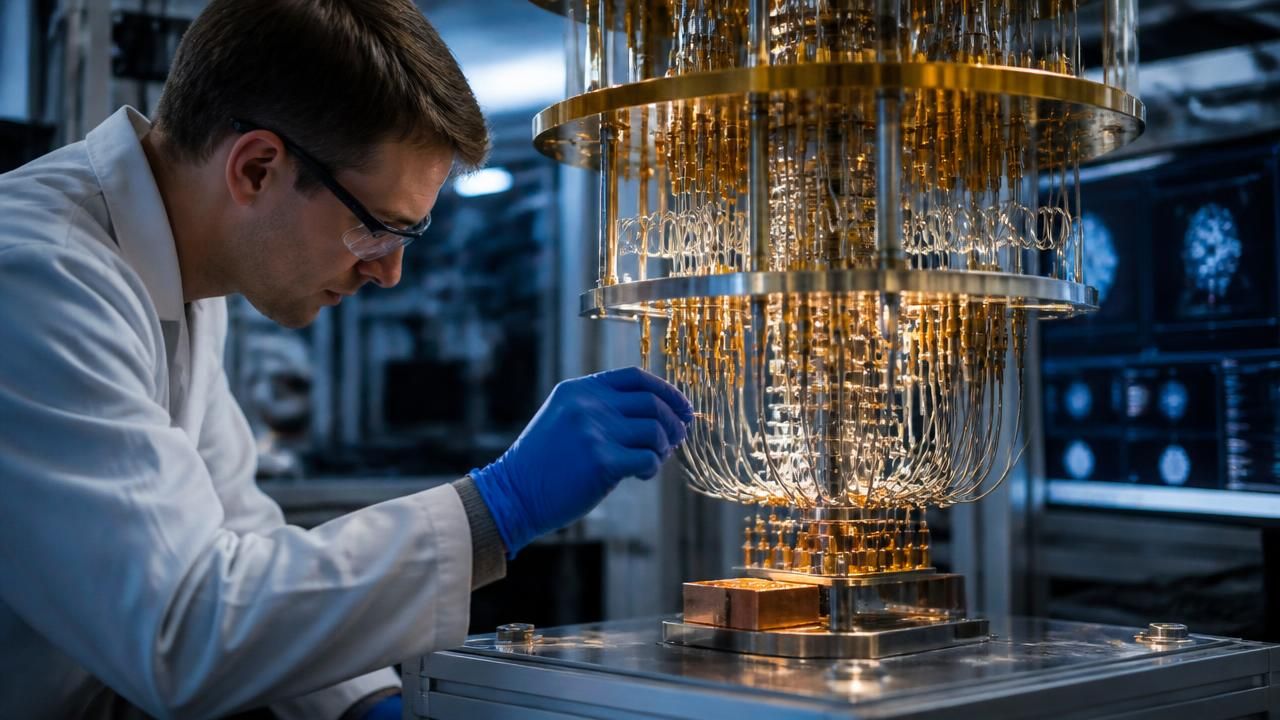
A New Wave in Quantum Computing
Quantum computing has long been haunted by a simple problem: qubits are fragile. The slightest vibration, heat, or electromagnetic noise can destroy the delicate quantum states they carry. For decades, the solution has been to isolate qubits ever more aggressively—colder refrigerators, better shielding, more error-correcting qubits. But a cluster of recent reports suggests a different path: instead of fighting waves, harness them. From microscopic sound waves in diamond to chip-scale acoustic atoms and tiny magnetic waves, researchers are exploring whether phonons and magnons can protect, transmit, and miniaturize quantum information.
Harvard's Phonon Shield
According to Science Daily, researchers at Harvard have demonstrated a way to protect quantum information using microscopic sound waves. By continuously surrounding a diamond-based qubit with mechanical vibrations, they extended its coherence time by roughly threefold. The approach uses phonons—quantized packets of sound—as a protective buffer. Rather than letting environmental noise scramble the qubit, the phonons create a dynamic environment that stabilizes it.
The same phonons could eventually both transmit and protect quantum information, opening the door to compact sound-based quantum networks on chips.
That dual role is significant. If phonons can both shield a qubit and carry its state from one place to another, they could serve as the wiring and the shielding of a future quantum chip. Sound waves travel more slowly than light, which makes them easier to confine and control on a small scale. They also couple naturally to many solid-state qubits, including the diamond nitrogen-vacancy centers used in the Harvard experiment.
The Acoustic Atom
Phys.org reports a complementary advance: a chip-scale 'acoustic atom' that controls sound waves to imitate atomic energy levels. The device is not a real atom but a tiny acoustic resonator designed to mimic the discrete energy states of an atom. Just as electrons in an atom can occupy only certain energy levels, the acoustic atom traps phonons in quantized states. This allows researchers to manipulate sound waves with atomic-like precision, potentially creating a new building block for quantum simulation and computing.
The acoustic atom could be used to store and process quantum information in vibrational modes. Because it is chip-scale, it may be easier to integrate with existing semiconductor manufacturing than some competing quantum technologies. It also offers a natural interface between sound-based quantum systems and more conventional superconducting circuits, which operate at microwave frequencies and can couple to mechanical resonators.
Magnetic Waves for Penny-Sized Quantum Computers
ScienceDaily reports that tiny magnetic waves could unlock quantum computers the size of a penny. Magnetic waves—known as spin waves or magnons—can carry information through magnetic materials with very low loss. Unlike sound waves, they operate at higher frequencies and can couple directly to electron spins, which are natural qubits. If researchers can control magnons at the quantum level, they could enable dense, chip-scale quantum architectures that are far smaller than today's room-sized dilution refrigerators.
The promise of magnonics is not just miniaturization. Magnetic waves can interact with each other and with light, offering routes to hybrid quantum systems. They can also travel through insulating magnetic materials, reducing the heat and noise that plague charge-based electronics. For quantum computing, the key challenge is reaching the quantum regime—cooling magnons enough and isolating them from loss—but the ScienceDaily report suggests that progress is accelerating.
D-Wave's $550 Million Bet on Cheaper Error Correction
On the commercial side, Forbes reports that D-Wave's $550 million quantum computing bet makes error correction 10 times cheaper. D-Wave, known for its quantum annealers, is investing heavily in error correction and mitigation. The Forbes headline frames the move as an economic breakthrough: if error correction can be made an order of magnitude cheaper, the path to useful quantum computers becomes far more practical.
Error correction is the central obstacle to scaling quantum computers. Today, thousands of physical qubits are needed to create a single reliable logical qubit. That overhead drives up cost and complexity. D-Wave's approach may differ from gate-based quantum computers—annealers have different error models—but the company's bet signals that the industry is shifting from a race for qubit count to a race for error-correction efficiency.
Converging Perspectives
Each outlet frames the story differently. Science Daily emphasizes coherence and sound-based networks. Phys.org highlights a chip-scale acoustic atom that imitates atomic energy levels. ScienceDaily focuses on magnetic waves and extreme miniaturization. Forbes approaches the same broad problem from a business angle: the cost of error correction.
Yet the underlying theme is the same. Quantum information is fragile, and protecting it is expensive. The new wave-based approaches suggest that the solution may not be to build ever-larger refrigerators but to encode quantum states in waves that are naturally robust and easy to control on a chip.
Challenges remain. Harvard's threefold coherence improvement is significant but still far from what practical quantum computers need. The acoustic atom must be scaled and entangled with other devices. Magnetic-wave qubits must demonstrate high-fidelity readout and long coherence. D-Wave's claim of 10x cheaper error correction will need independent verification and may not apply to all quantum architectures.
Still, the convergence of these results points to a broader shift. Instead of treating sound and magnetic waves as sources of noise, researchers are turning them into tools. If the trend continues, the quantum computers of the future may be smaller, cheaper, and more robust—perhaps even small enough to fit on a chip the size of a penny.