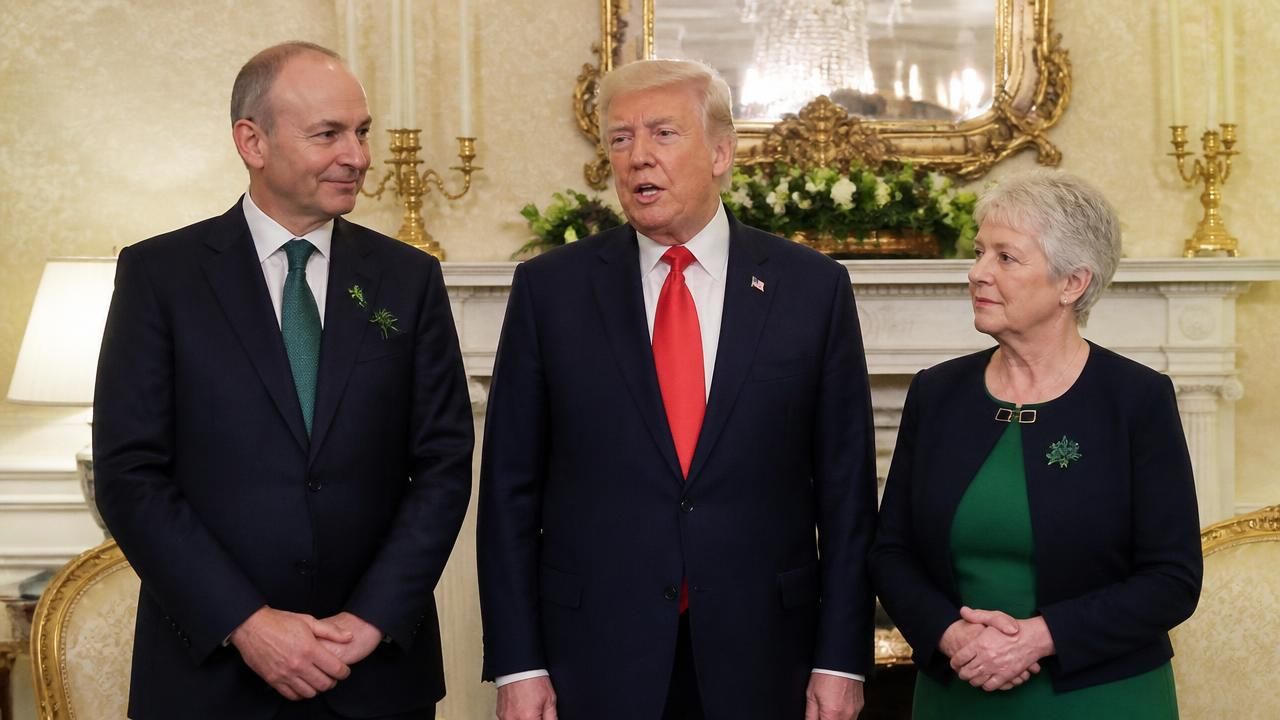
President Trump held talks in Dublin with Ireland's President Catherine Connolly and Taoiseach Micheál Martin during a weekend visit centered on a major golf tournament, according to NPR News. The meetings marked one of the president's few formal engagements on a trip that was otherwise built around his own commercial property on Ireland's Atlantic coast.
After the Dublin sessions, Trump was scheduled to travel west to Doonbeg, County Clare, where his golf resort sits on more than 400 acres of dunes overlooking the Atlantic. The Boston Herald framed the trip from the outset around that destination, headlining its coverage with the president's journey to the Irish Open at his Doonbeg course — a reminder that for Trump, statecraft and the family business have long been difficult to disentangle.
A weekend of diplomacy, wrapped around golf
The itinerary is a familiar one. Trump bought the struggling Doonbeg links in 2014 and has returned repeatedly since, including a 2019 presidential visit during which he met then-Taoiseach Leo Varadkar at Shannon Airport rather than in Dublin. That trip drew scrutiny over the cost of policing and the optics of a sitting president spending official time at a property he owns.
The same questions shadow this visit. Security for a US presidential movement in rural Clare falls largely on An Garda Síochána, and previous visits have prompted debate in the Dáil about who ultimately pays. Local businesses, meanwhile, have generally welcomed the attention: Doonbeg is a village of roughly 300 people, and presidential motorcades bring a temporary, if disruptive, economic jolt.
The diplomatic agenda was not ceremonial alone. Ireland and the United States are bound by deep commercial ties — American multinationals employ hundreds of thousands of Irish workers, and Ireland runs one of the largest goods surpluses with the US of any country in the world, driven overwhelmingly by pharmaceuticals. Trump has repeatedly singled out that arrangement, and Irish officials have spent much of the past year trying to insulate the relationship from tariff threats and tax disputes.
A remark that touched a nerve
If the Dublin meetings were designed to stay on message, the trip's most consequential moment came off-script. According to SFGate, Trump said that Irish reunification would be “fantastic” — a comment the outlet reported touched a nerve.
Trump said reunification would be “fantastic” — a remark that, as SFGate framed it, “touched a nerve.”
The comment lands in the middle of a live constitutional argument. Under the 1998 Good Friday Agreement, the future of Northern Ireland is to be decided by the principle of consent — a border poll can be called by the British secretary of state if it appears likely that a majority would vote for a united Ireland. Sinn Féin has made planning for that vote a central demand; unionist parties warn that pressing the issue prematurely would destabilize a settlement that took decades to build.
Washington has traditionally avoided taking a public position, deferring instead to the agreement and to the communities it governs. A presidential aside does not change policy, but in Belfast and Dublin it is read as a signal — and one that can be amplified by whichever side finds it convenient. Nationalists will hear encouragement; unionists will hear an American president casually entertaining their worst-case scenario.
How the story was framed
The divergence in coverage is instructive. NPR led with the mechanics of the visit — the meetings, the participants, the golf tournament driving the schedule. The Boston Herald led with the golf, casting the trip as a presidential pilgrimage to Doonbeg. SFGate led with the reunification remark and its political fallout, treating the diplomatic meetings as backdrop. Outlets carrying the wire version of the story, including the Seattle Times, ran with the same meeting-first framing as NPR, while at least one aggregator page circulated the item alongside entirely unrelated content — a small illustration of how unevenly a single news event travels across the modern media ecosystem.
None of the framings is wrong. Together they describe a trip that was simultaneously a diplomatic engagement, a business errand and, briefly, a diplomatic incident.
What to watch
- Trade: Whether the Dublin meetings produce any movement on pharmaceutical tariffs or the US–Ireland tax relationship.
- Northern Ireland: Whether the White House walks back, clarifies or stands by the reunification comment — and how London and Belfast respond.
- The optics: Whether Irish politicians press the question of who pays for presidential security at a privately owned resort.
- Local reaction: Previous visits have drawn small protests in Dublin and near Doonbeg, and Irish public opinion on Trump remains sharply negative.
For now, the president's weekend ends where it began: on a golf course he owns, in a country where his words carry weight he may not have intended.