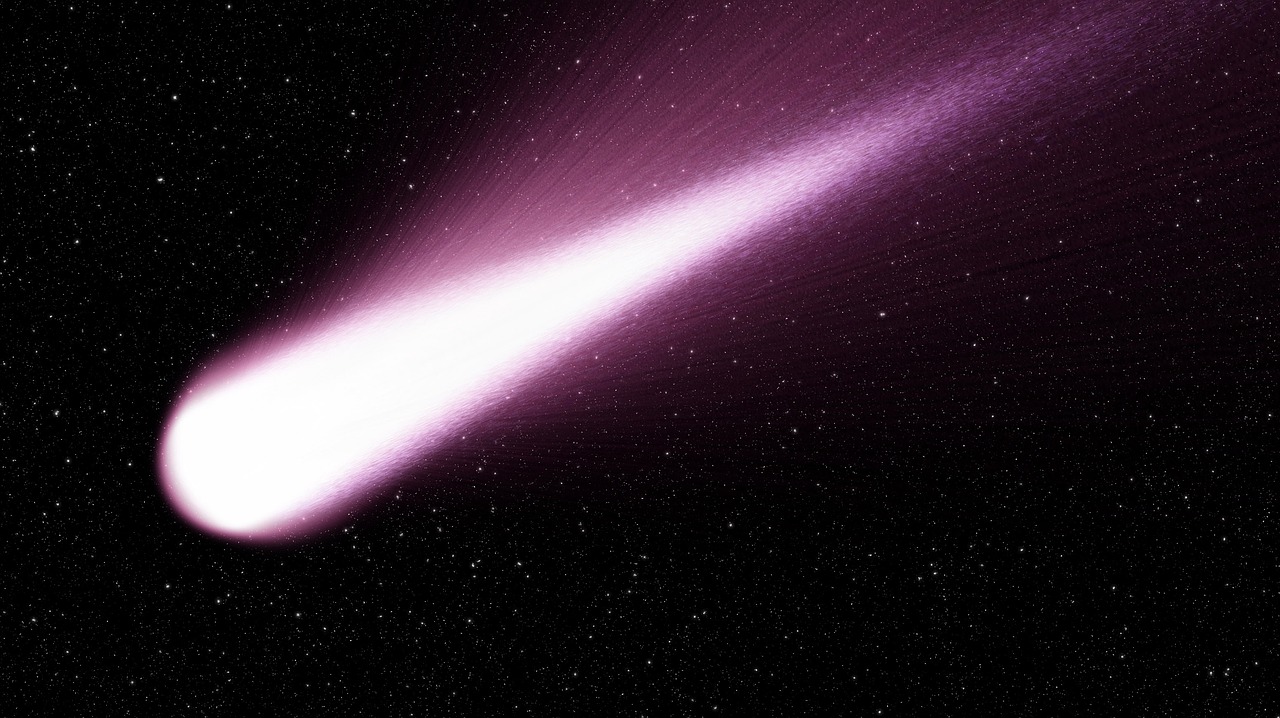
Astronomers have uncovered a striking chemical fingerprint in the interstellar comet 3I/ATLAS, a visitor from another star system. New observations from the Atacama Large Millimeter/submillimeter Array (ALMA) in Chile reveal that the comet contains exceptionally high concentrations of methanol, a finding that suggests it formed under conditions profoundly different from those that gave rise to most comets in our Solar System. Perhaps even more intriguing, ALMA's high-resolution data show that tiny icy grains surrounding the comet are releasing methanol like miniature comets, offering an unprecedented close-up view of an object that originated beyond our Sun.
A Rare Intruder from Interstellar Space
3I/ATLAS is only the third confirmed interstellar object to pass through our Solar System, following the famous 1I/'Oumuamua in 2017 and 2I/Borisov in 2019. Unlike those earlier discoveries, 3I/ATLAS was detected relatively early in its approach, giving astronomers valuable time to study it. The object was spotted by the Asteroid Terrestrial-impact Last Alert System (ATLAS), a network of telescopes designed to track near-Earth asteroids, and its swift, hyperbolic trajectory quickly confirmed that it came from beyond the Solar System.
Because interstellar visitors carry material from their home systems, they act as natural probes of planet-building processes occurring elsewhere in the galaxy. Every such object offers a rare opportunity to compare the chemistry of other solar systems with our own. 3I/ATLAS is especially important because it is a comet, not an asteroid like 'Oumuamua. Comets are primitive relics of planetary formation, preserving volatile ices that can tell us the temperature and composition of the disk from which they formed.
A Methanol-Rich Fingerprint
The ALMA observations focused on wavelengths that enable astronomers to identify the spectral signatures of complex molecules. The spectrum of 3I/ATLAS revealed an unmistakable outpouring of methanol (CH₃OH). Methanol is a simple organic alcohol and a key ingredient for astrochemistry, as it can react to form more complex molecules essential for life. While methanol has been detected in comets throughout our Solar System, the sheer abundance found in 3I/ATLAS is exceptional.
"Interstellar comet 3I/ATLAS contains exceptionally high levels of methanol, suggesting it formed under conditions very different from those that shaped most comets in our solar system."
In typical Solar System comets, methanol is present but usually at concentrations far below the levels observed here. The high methanol fraction implies that the comet's formation environment was cold and rich in methanol ice, perhaps a region of its parent protoplanetary disk where methane and water ices were efficiently processed into methanol. This suggests a much more efficient synthesis of complex organic molecules than what occurred in our own solar system's outer regions.
Icy Grains as Miniature Comets
Perhaps the most detailed observation came from ALMA's ability to resolve the area around the comet's nucleus. The telescope detected a swarm of tiny icy particles, each releasing methanol gas as they are warmed by sunlight. These grains are essentially miniature comets, individually shedding material and enriching the coma. Such an active halo of submillimeter-sized grains is not seen around typical comets in our Solar System, where larger particles and more uniform outgassing dominate. Here, the grains appear to be releasing methanol directly, providing a clean signature of the material that formed the comet itself.
The discovery was made possible by ALMA's extreme resolution at millimeter wavelengths, which allowed the team to map the distribution of methanol gas and separate the diffuse coma from the solar-wind-driven streams. The observations give astronomers a level of detail that would have been impossible to achieve with spacecraft visiting comets. As one team member put it, we are seeing interstellar material in action, close to its most pristine state.
Why Does Methanol Matter?
Methanol is considered a building block for larger organic molecules, including amino acids and sugars, which are essential for life as we know it. Its abundance in an interstellar comet provides a live sample of the kind of organic reservoir that may have been delivered to young planets. The unusually high methanol levels could also point to a different mixing history in the comet's home disk. Solar System comets are thought to have formed at various distances from the Sun, and their ice compositions vary depending on temperature gradients. But 3I/ATLAS pushes those variations to new extremes.
- Methanol is the simplest complex organic molecule, and its formation requires an efficient low-temperature hydrogenation of carbon monoxide.
- In interstellar clouds, methanol forms when carbon monoxide ice reacts with atomic hydrogen, a process that dominates at temperatures around 10 Kelvin.
- The high methanol fraction in 3I/ATLAS suggests a cold, protected environment in which carbon monoxide was abundant and could be converted before the comet accreted.
- This contrasts with many comets in our Solar System that contain a mixture of ices from both warmer and colder zones.
Implications for Planet Formation
The findings have broader implications for understanding how planets form around other stars. If interstellar comets routinely show this kind of chemical diversity, then the recipe for organic delivery to exoplanets may be far more varied than we thought. Some exoplanetary systems might produce countless methanol-rich comets, seeding their planets with the ingredients for life, while others may emerge almost dry. Astronomers are already planning follow-up observations to track 3I/ATLAS for as long as it remains visible.
The comet is now receding from the Sun, but its stored dust and volatile inventory will continue to be studied using archival data and new high-resolution telescopes. Scientists also hope to compare its chemistry with future interstellar visitors, many of which will be discovered by the upcoming Vera C. Rubin Observatory. This first detailed look at a methanol-laden visitor from another star system is a powerful reminder that we have barely begun to explore the cosmic library of organic chemistry.
A Window into Foreign Worlds
Comets are time capsules, preserving the conditions of their birth environments for billions of years. But until recently, all the time capsules we could examine belonged to our own solar system. With 3I/ATLAS, astronomers have cracked open a capsule from another star, and it contains a surprisingly rich brew. The exceptional methanol abundance and the miniature comet-like grains are reshaping our understanding of how organic molecules survive and evolve across interstellar space. As more interstellar objects are found, each will contribute another piece to the puzzle of how chemistry and life may vary throughout the galaxy.
This research was conducted as part of a collaborative international effort involving observations from ALMA, located in the Atacama Desert of Chile. The data are set to be analyzed further in the coming months, and the team hopes to secure additional observing time to monitor the comet's fading activity. For now, 3I/ATLAS has already delivered a profound insight: the universe may be far richer in complex organic chemistry than we ever imagined.