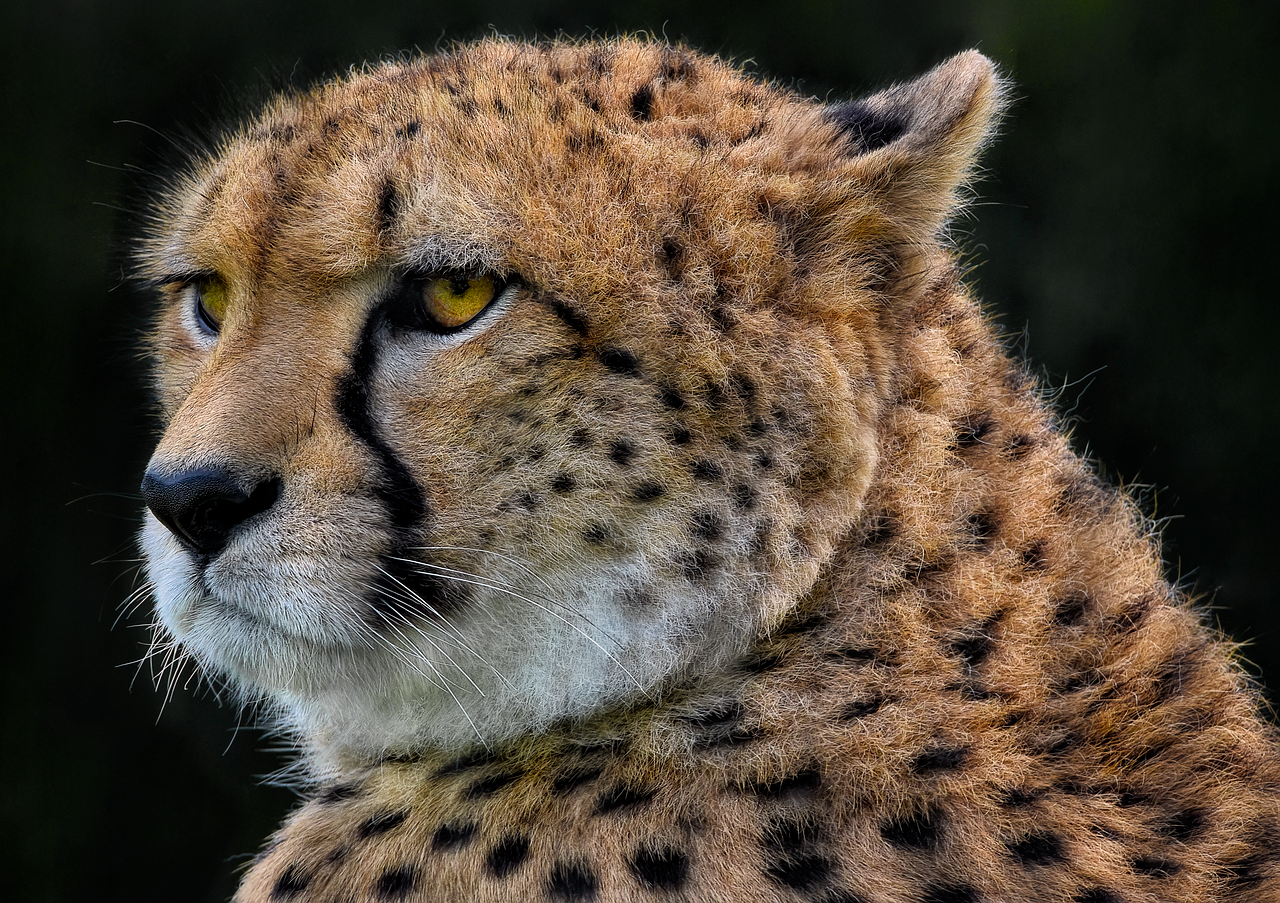
For more than a century, the American cheetah has been a celebrated icon of convergent evolution: a big cat that independently evolved the slender limbs, flexible spine, and blunt claws of an African cheetah. Its scientific name, Miracinonyx, even means "wondrous claw." Textbooks have used it as a textbook example of how similar environments can sculpt the same body plan. But a striking new analysis of fossils from the frozen Yukon is now shattering that narrative. The extinct cat was not a cheetah at all, researchers report, but a close relative of the modern puma—and at least some northern populations survived by doing something un-catlike: eating fish, perhaps even salmon.
The discovery, based on isotopic analyses of collagen extracted from bones, paints a far more complex picture of this Ice Age predator. It suggests that Miracinonyx was not a single-purpose sprinter, but an ecologically flexible carnivore, able to shift between hunting on land and feasting on river runs of spawning fish. The findings, published this month by an international team of paleontologists, overturn decades of assumptions and raise new questions about how extinct species adapted to changing climates.
A Name Built on Bones
The story of the "American cheetah" began in the early 20th century, when paleontologists first uncovered cheetah-like skeletons across the central United States. The long legs, compressed skull, and enlarged nasal cavities all seemed to mirror the modern cheetah (Acinonyx jubatus)—so much so that early descriptions classified the fossils as true cheetahs. Later, in the 1970s, scientists split Miracinonyx into two species: the widespread M. trumani of the southern plains and the smaller, more primitive M. inexpectatus, which ranged farther north.
Yet there were always hints of trouble with the cheetah analogy. Cranial features, particularly around the inner ear and jaw, looked more like those of the puma (Puma concolor). DNA studies in the 2000s confirmed that Miracinonyx was not even closely related to Old World cheetahs. Instead, its closest living relatives are the puma and the jaguarundi. But without direct behavioral evidence, paleontologists held on to the idea that Miracinonyx filled a cheetah-like ecological role, sprinting after pronghorn antelope across the grasslands.
The new study, led by paleontologists from the University of Alaska and the Canadian Museum of Nature, challenges even that assumption. "We kept interpreting the bones through a cheetah-shaped lens," says Dr. Emily Whitcomb, the study's lead author. "But when we looked at the geochemistry, the lens broke."
Isotopic Clues in Ancient Teeth
Whitcomb and her colleagues focused on Miracinonyx inexpectatus fossils recovered from a Pleistocene cave deposit in the Yukon Territory, near the edge of the Beringian ice sheet. Radiocarbon dating placed the bones between 30,000 and 40,000 years old, a time when the region was a mix of steppe grassland and boreal forest, with rivers teeming with salmon.
The team performed stable isotope analysis on collagen extracted from bone fragments. The ratios of carbon-13 and nitrogen-15 in animal bone reflect dietary intake. Herbivores across the site had distinct, predictable signatures. But when the scientists measured the Miracinonyx samples, they were in for a shock. "The nitrogen values were far too high for a pure ground-mammal predator," says Dr. Michael Tsonis, a co-author and geochemist. "They were in the range of marine or freshwater feeders."
The most plausible explanation, the researchers say, is that these cats regularly consumed anadromous fish such as salmon. Salmon complete their life cycle in oceans but spawn and die in freshwater rivers, concentrating heavy nitrogen isotopes from the marine food web. A land predator feeding on salmon—or scavenging post-spawn carcasses—would carry a similarly elevated isotopic signature.
"This is essentially the same fingerprint you see in bears that eat salmon," Tsonis explains. "It is not something you might expect in a sprinting cheetah analogue."
"We kept interpreting the bones through a cheetah-shaped lens. But when we looked at the geochemistry, the lens broke." — Dr. Emily Whitcomb, lead author
A Flexible Lifestyle in the North
The fossil locality, dubbed the Bluefish Caves, lies in the northern Yukon. It has produced a rich record of Ice Age fauna, including horses, bison, mammoths, and small mammals. The cave sediments also hold stone tools, indicating that humans were present during this time. The new data suggests that M. inexpectatus did not merely coexist with these species; it found a way to exploit an ecological niche that avoided direct competition with larger carnivores.
"Northern winters were brutal," Whitcomb notes. "Hunting ungulates on snow requires enormous energy. But rivers ran thick with salmon every autumn, and the body of a spawning fish is packed with fat. A predator that could learn to lean into that resource had a decisive advantage."
The paper proposes that M. inexpectatus may have been seasonally resourceful: hunting small vertebrates and young ungulates in summer, and shifting to fish (or carrion of spawning fish) during autumn and early winter. The idea is bolstered by tooth wear patterns on the Yukon specimens, which show a mix of bone-crunching and flesh-slicing wear. "We also see broken teeth consistent with crushing fish skulls," Whitcomb adds.
This dietary flexibility likely allowed the species to survive at high latitudes while southern populations of M. trumani continued to prey on pronghorns and other grassland animals—a true cheetah-like existence. "The two species probably divided the continent ecologically," Whitcomb says. "But only the northern one had to deal with deep snow and frozen rivers, which probably drove this unexpected flexibility."
Rethinking an Icon
The implications reach beyond one species. For decades, paleontologists have used Miracinonyx as a model to study how predators evolve at high speeds and how prey shapes predator anatomy. If Miracinonyx was actually a puma relative, then its cheetah-like limbs represent an emergent phenomenon—a body plan that evolved for reasons other than chasing pronghorns.
Alternative hypotheses already exist. Modern pumas, for instance, are opportunistic ambush predators that can occasionally chase prey over short distances. A longer-legged build might have helped M. trumani travel long distances across open terrain, rather than sprint in short bursts. In the north, flexibility and resourcefulness—not sheer speed—may have been the key to survival. "The story of the American cheetah has always been told as a story of speed," says Dr. Helena Grayson, a paleoecologist not involved in the study. "This new work tells a richer story of survival: intelligence, adaptability, and an appetite that was broad enough to include fish."
Researchers are now eager to apply isotopic techniques to other extinct carnivores. In particular, they wonder whether the iconic sabertooth cats and dire wolves also had more varied diets than pure bone-crunching or flesh-slicing. "We have been too eager to assign single labels," Whitcomb reflects. "Reality is much messier."
Lessons for Modern Conservation
This new view of Miracinonyx also offers lessons for today's conservation challenges. As climate change rapidly alters habitats and prey distributions, modern predators are being forced to adapt or face decline. Knowing that a relatively specialized-looking cat was able to switch food sources broadens our understanding of predator resilience.
Pumas themselves—the living relatives of Miracinonyx—already demonstrate remarkable behavioral flexibility. Research in Patagonia, for example, has shown that pumas along the coast hunt marine mammals and even take advantage of seabird colonies. The new fossil evidence suggests that such flexibility has deep evolutionary roots. "Ecological flexibility is written in this lineage's DNA," says Whitcomb. "It may be one reason the puma has survived across two continents, while so many other Pleistocene cats disappeared."
But the discovery is also a cautionary tale about scientific error. "The name 'American cheetah' stuck for over a hundred years because it fit a nice narrative," Grayson observes. In an era of rapid environmental change, she argues, scientists should be slow to put species in boxes. "When we label an animal by a single assumption, we risk missing what it truly is. The Yukon fossils are a reminder that nature always has surprises."
The team plans to analyze additional specimens from Alaska and the continental United States to trace how the species shifted diets as the Ice Age drew to a close. One thing is certain: despite its name, the American cheetah was never a cheetah. It was something far more extraordinary—a puma that dared to fish.