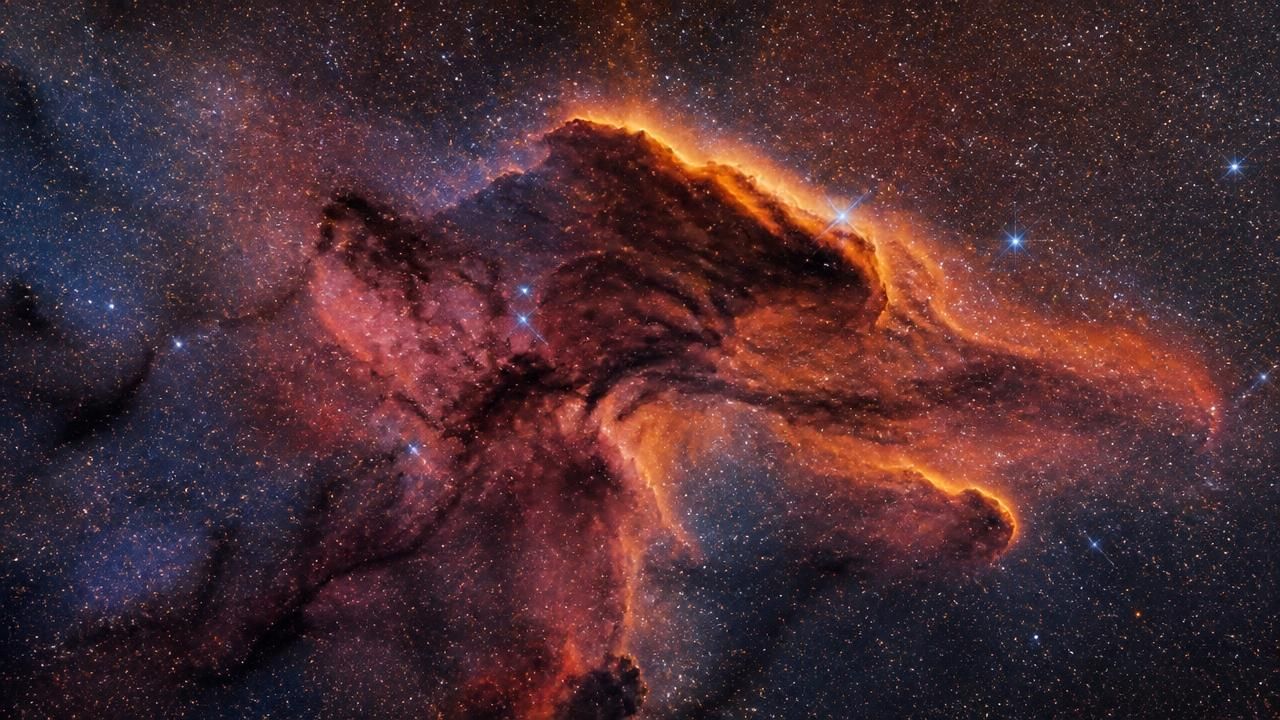
Astronomers and astrophotography enthusiasts have a new reason to look skyward. On September 7, 2026, NASA's Astronomy Picture of the Day featured a breathtaking 25-hour exposure of the Pelican Nebula (IC 5070), captured by photographer Mark Killion from Utah, USA. The image reveals the nebula's intricate filaments of gas and dust, as well as the bright ionization front where young stars are reshaping their birthplace.
The Pelican Nebula is not just a pretty picture; it is a scientific treasure. Located approximately 1,800 light-years away in the constellation Cygnus, IC 5070 is a region of intense star formation. Its proximity and orientation make it an ideal laboratory for studying the complex processes that govern the birth and evolution of stars.
An Iconic Pair: Pelican and North America
The Pelican Nebula is part of a larger complex that includes the more famous North America Nebula (NGC 7000). Separated by a dark molecular cloud of dust, they appear as two distinct objects, but they are physically linked. The dark lane, cataloged as LDN 935, acts as a silhouette against the glowing hydrogen gas, creating the illusion of a pelican's head and beak when viewed through small telescopes.
Mark Killion's deep image, which incorporates 25 hours of exposure, captures the subtle filaments of dust that thread through the region. These dark, wispy structures are not simply empty space; they are dense concentrations of cold interstellar material, the raw ingredients for future generations of stars.
"The Pelican Nebula is slowly being transformed," explains the APOD editorial team, which includes astronomers Robert Nemiroff, Jerry Bonnell, Cecilia Chirenti, and Keighley Rockcliffe. "IC 5070 is divided from the larger North America Nebula by a molecular cloud filled with dark dust."
The Physics of an Ionization Front
The most striking feature in the new image is the bright orange region on the upper right, known as an ionization front. This boundary marks the interface between the cold, neutral gas of the molecular cloud and the hot, ionized gas created by radiation from young, massive stars. High-energy ultraviolet photons strip electrons from hydrogen atoms, causing the gas to glow. Over time, this process erodes the cloud, much like a glacier retreating.
"The light from young energetic stars is slowly transforming the cold gas to hot gas," the APOD explanation reads. "The advancing boundary between the two, known as an ionization front, is visible in bright orange on the upper right."
Why Filaments Matter
Within the ionization front, the image reveals dense tentacles of cold gas that resist the erosion. These structures are of particular interest to astronomers studying triggered star formation. As the ionization front presses inward, it compresses dark clumps of gas, potentially causing them to collapse and form new stars. In some cases, the same massive stars that shape the nebula may ultimately trigger the birth of their siblings.
The 25-hour exposure, taken with narrowband filters, highlights the interplay between hydrogen, oxygen, and sulfur emissions. The resulting false-color composite allows researchers to trace the temperature and density structure of the nebula, providing data that theoretical models of star formation rely on.
A Changing Landmark
The Pelican Nebula is, on astronomical timescales, a fleeting structure. The balance between radiation pressure and gravitational collapse is dynamic, and the shape we recognize today will not persist. The APOD team notes this transient nature:
"Millions of years from now, the Pelican Nebula, bounded by dark nebula LDN 935, might no longer be known as the Pelican, as the balance and placement of stars and gas will surely leave something that appears completely different."
This realization underscores the broader theme of cosmic evolution. Just as Earth's landscapes change over millennia, so too do the vast clouds of the interstellar medium — albeit on timescales that dwarf human history.
A New Era for APOD
This particular APOD also marks a transition for the program itself. The main site has moved from apod.nasa.gov to science.nasa.gov/apod as part of a consolidated NASA web presence. The new platform retains the signature daily image and explanation, but with improved accessibility and integration with NASA's broader Science Mission Directorate.
For educators and amateur astronomers, APOD continues to serve as a gateway to the universe. Each day, a new image or photograph is featured alongside a brief explanation written by a professional astronomer. The archive, spanning multiple decades, has become a cherished resource for visualization in classrooms, planetariums, and social media.
The Art and Science of Astrophotography
Mark Killion's work illustrates the growing sophistication of amateur astrophotography. With commercially available telescopes and cameras, dedicated individuals can now produce images that rival those from professional observatories. The 25 hours of exposure time represent careful planning, precise tracking, and extensive post-processing. This image is a collaboration between human creativity and the raw physics of the cosmos.
As APOD continues its mission to discover the cosmos one picture at a time, the Pelican Nebula serves as a reminder of the delicate and violent processes that shape our universe. It is not just a picture; it is a window into the ongoing transformation of gas and dust into stars, planets, and ultimately, the elements that make up our own existence.