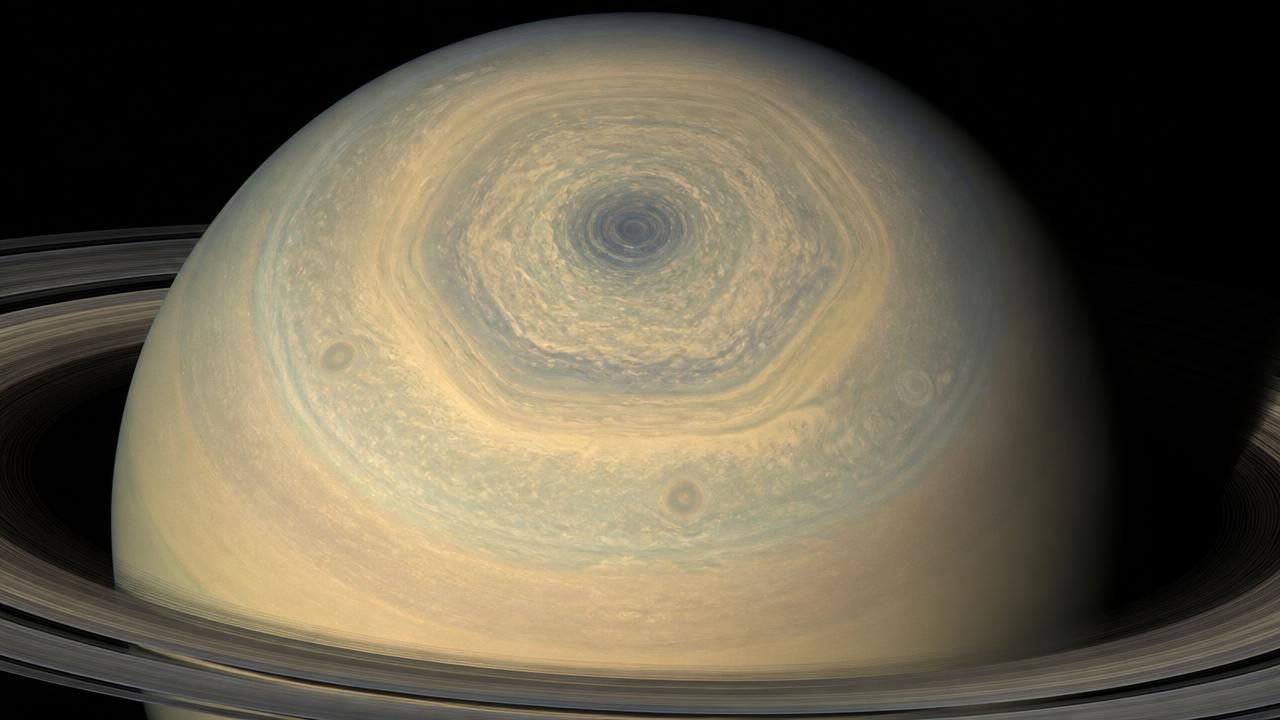
NASA's Hubble Space Telescope has spotted something unexpected at Saturn's south pole: a colossal, 10-sided atmospheric pattern rotating around the planet's southern polar vortex. Dubbed a 'decagon' by researchers, the newly recognized phenomenon gives Saturn a striking counterpart to the famous six-sided hexagon that has long been observed at its north pole. The discovery is the latest twist in the evolving weather story of the ringed giant, hinting that the planet's atmosphere is more changeable than previously thought.
A New Pattern in the South
Saturn's northern hexagon has been known since the Voyager flybys of the 1980s. The jet stream pattern, about 30,000 kilometers across, has remained stable for decades, and its presence was confirmed and studied in detail by the Cassini mission, which orbited Saturn from 2004 to 2017. No comparable polygonal shape had been found in the south, despite Cassini's long-term reconnaissance. But now new observations from Hubble show that a similar structure is creeping into existence at the south pole — only with 10 sides rather than six.
According to the research team, this decagon appears to be young, perhaps only a few years old, and it is strengthening. The pattern was identified in imaging data collected by Hubble's Outer Planet Atmospheres Legacy (OPAL) program, which has been tracking Saturn and other gas giants on an annual basis since 2014. The polar region is difficult to observe from Earth, but Hubble's vantage point in low Earth orbit and its ultraviolet and optical cameras can resolve such features.
Why Now?
Saturn takes about 29.4 years to orbit the Sun, meaning each season lasts a little over seven years. The planet's south pole has spent recent years in winter darkness, and like the north pole, it is now emerging into sunlight. The sudden appearance of the decagon may be a response to seasonal change.
Scientists believe polygonal jets arise from differential motion — the speed difference between alternating wind bands around the pole. When eastward- and westward-moving currents interact, they can be twisted into wave-like shapes. In the case of the hexagon, the wave is trapped in a channel and persists. The decagon may now be experiencing the same phenomenon due to new amounts of solar heating reaching the southern polar atmosphere.
This is a remarkable and unexpected development in Saturn's atmosphere, and studying it could help us understand the dynamical forces that create these striking patterns on other planets, including Jupiter's numerous eddies and storms.
The discovery raises urgent questions: Is this a one-off event? Could it last for decades like the north polar hexagon? Or will it dissipate once Saturn's annual cycle advances further?
A Missing Piece in the Swirl
The south pole of Saturn is a volatile place. Cassini revealed a huge, hot cyclonic vortex there, ringed by strong winds and dotted with small storms. Unlike the north pole's hexagon, the southern vortex did not exhibit clear polygonal boundaries. Instead, infrared observations showed a blanketing of stratospheric haze.
The new Hubble images from 2018 onward show what looks like a slowly crystallizing pattern: a ring with ten distinct vortices embedded in a meandering jet. The team reports that the structure first became detectable in 2018 and grew more distinct in subsequent observations. By 2021, the decagon was clearly defined, and it seems to have accelerated the local jet stream.
Why ten sides? The number of sides is likely the most stable wave number for the atmospheric conditions at the time. For the north, that number is six for Saturn's northern summer. Thus the decagon may be a natural counterpart: when the Sun illuminates the other hemisphere, the atmosphere may organize itself into a different number of lobes.
Implications for Planetary Science
This discovery has broader implications beyond Saturn. Atmospheric physicists use polygonal patterns as natural laboratories to study fluid dynamics on a planetary scale. On Earth, jet streams are mostly unstable and shift rapidly, but on giant planets, stable global waves can persist for many years. By comparing the north and south polar atmospheres of the same planet, scientists can isolate how rotation, temperature, and solar heating influence the composition and behavior of these jet streams.
Understanding Saturn's decagon is also relevant to probing the planet's interior, if the phenomenon is rooted beneath the visible cloud tops. Gravity and magnetosphere data from Cassini have previously suggested that deep winds trail off gradually, and any changes in the upper atmosphere can be linked to deeper circulation patterns.
The fate of the decagon will remain a mystery until future observations can be obtained. NASA's James Webb Space Telescope has also begun observing Saturn, but Hubble's time-series observations are uniquely suited to track changes in atmospheric features over many years. The Outer Planet Atmospheres Legacy program is expected to continue monitoring Saturn for at least another decade. If the decagon persists, it might provide the best chance to catch a polygonal atmospheric pattern in the process of formation — an event no scientist has directly witnessed before.
What's Next?
Astronomers plan to combine Hubble data with ground-based observations from facilities like the Keck Observatory, the Very Large Telescope, and the Subaru Telescope to measure winds within the decagon more precisely. They also want to use thermal infrared images to determine how temperatures at the pole might be driving the decagon's movement.
- Continue regular Hubble monitoring of Saturn's south pole through OPAL.
- Deploy ground-based adaptive optics to capture high-resolution views of the decagon.
- Use computer models to simulate how changing sunlight can trigger new polygon modes.
The next few years will be crucial. Saturn's southern hemisphere is heading toward summer solstice, which brings maximum sunlight to the region. If the decagon is a seasonal phenomenon, it should become even more pronounced — or it may mutate into an entirely different shape. Either outcome will force a reevaluation of our models of Saturn's weather.
For now, the decagon stands as a reminder that even planets as well-studied as Saturn are still capable of surprising us. When Hubble first observed this colossal shape, it did so simply because the program's goal is to observe long-term weather patterns. It was another piece of a puzzle that has been in the making for more than four decades, and the story is far from complete.