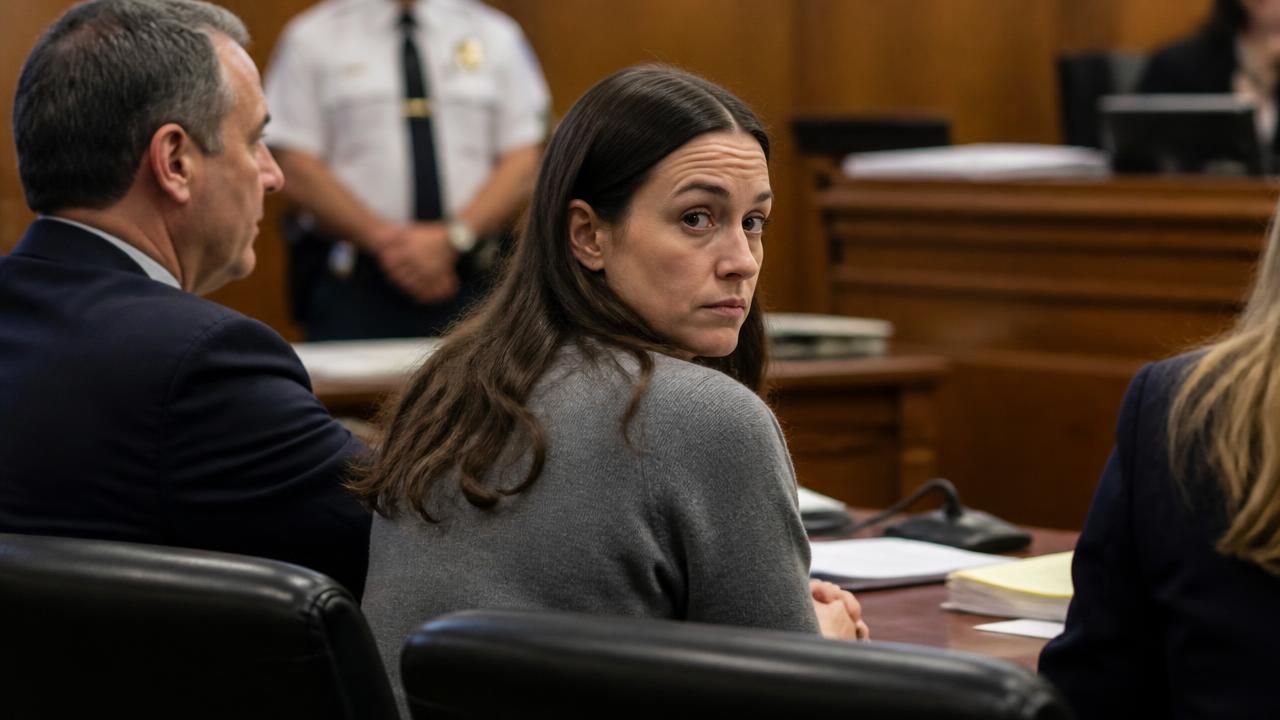
In an extraordinary turn inside a Plymouth County courtroom, the murder trial of Lindsay Clancy—the Massachusetts mother accused of killing her three young children—hovered on the edge of collapse Thursday as the judge indicated he was ready to declare a mistrial. But in a dramatic last-minute maneuver, the defense attorney won a temporary reprieve, halting the mistrial order and buying precious time to appeal to the state’s highest court.
The scene unfolded as the jury, which had been deliberating for a seventh day, remained deadlocked. Judge William F. Sullivan reportedly announced that he saw no prospect for a unanimous verdict and intended to discharge the panel. Yet before he could make the declaration official, defense attorney Kevin Reddington rose to request an emergency stay, asking for the opportunity to petition the Massachusetts Supreme Judicial Court (SJC). The judge granted a one-hour window—an unusual concession that threw the case into a state of legal limbo.
Who Is Lindsay Clancy?
Clancy, a former labor and delivery nurse from Duxbury, Massachusetts, is accused of strangling her three children—5-year-old Cora, 3-year-old Dawson, and 7-month-old Callan—in January 2023. She has pleaded not guilty by reason of insanity, with her defense arguing that she suffered from severe postpartum psychosis and was not criminally responsible for her actions. The case has drawn national attention, igniting debates about maternal mental health, the criminal justice system’s treatment of postpartum disorders, and the boundaries of the insanity defense.
Prosecutors have countered that Clancy planned the killings, citing internet searches and text messages they say indicate premeditation. The trial, which began in late 2025, has featured dueling psychiatric experts and weeks of testimony, leaving the jury with a stark choice between conviction and acquittal—or, as the deadlock suggests, an inability to agree.
The Jury Deadlock and the Judge’s Decision
Reports from inside the courtroom describe mounting tension as the jury sent out multiple notes indicating they were stuck. After seven days of deliberations, Judge Sullivan appeared to conclude that further deliberations would be futile. According to NBC News and CBS News, the judge said he was inclined to declare a mistrial, a procedural step that would end the trial without a verdict.
But Reddington, known for his combative style, objected immediately. He argued that a mistrial would prejudice his client and requested time to file an emergency appeal with the SJC—a move characterized by the New York Post and The Independent as a “Hail Mary” attempt. The judge, after initially signaling his readiness to dismiss the jury, agreed to pause the process, reportedly saying he would give the defense one hour to seek a stay. The chaotic moment was described by MSN as “judge declares mistrial then puts it on hold,” while the BBC noted that the judge “permits defence to file an emergency appeal.”
“This is not a mistrial yet. The defense has asked for time to seek an emergency stay, and I am going to allow that process to unfold,” the judge was reported as saying, according to NPR.
What Does the Emergency Appeal Argue?
Reddington’s emergency motion, filed with the SJC, is believed to challenge the declaration of a mistrial on multiple grounds. Legal analysts suggest the defense may argue that the jury was not truly deadlocked and should have been given a Allen charge—a set of instructions urging holdout jurors to reconsider—or that a mistrial without the defendant’s consent could expose Clancy to double jeopardy.
Under U.S. law, a judge may declare a mistrial without the defendant’s consent only if there is “manifest necessity.” If the judge’s decision is found to lack that basis, a retrial could be barred. Reddington has not yet publicly detailed the exact arguments in his filing, but his request for an emergency stay suggests he is aiming to prevent the mistrial entirely, possibly hoping that continued deliberations might yield a verdict—perhaps even an acquittal on some counts.
The SJC’s response remains unclear. As of Thursday evening, the court had not issued an immediate ruling, leaving the trial in suspense. The Stamford Advocate reported that the status of the stay request was “unclear,” and Fox News noted that the trial “hangs in the balance.”
What Happens If a Mistrial Is Declared?
If the SJC declines to intervene or rejects the stay, Judge Sullivan would formally declare a mistrial. The jury would be dismissed, and prosecutors would face a choice: retry Clancy or drop the charges. A retrial would require empaneling a new jury and essentially replaying a months-long case, a costly and emotionally draining prospect for all involved. For the victims’ family—Clancy’s husband, Patrick Clancy, who has spoken publicly about his grief—another trial would prolong an already agonizing ordeal.
If the SJC grants the stay, it could order the judge to let deliberations continue or even direct a judgment of acquittal, though that latter option is considered unlikely. Legal experts say emergency stays from the SJC in the middle of a trial are rare, underscoring the gravity of the situation.
Media Framing: “Hail Mary” and Legal Tactics
The divergent language in coverage illustrates how outlets are interpreting the defense’s move. The New York Post and The Independent both used the football metaphor “Hail Mary,” suggesting a desperate, low-probability gamble. Rolling Stone described it as a “last-ditch effort,” while NBC News and NPR used the more neutral phrasing “emergency appeal.” The Daily Mail, in a piece that was inaccessible, reportedly noted that Reddington’s tactics have “divided the legal profession,” with some praising his tenacity and others questioning whether he is improperly prolonging the trial.
One notable voice came from Bryan Kohberger’s defense attorney, who offered an outside perspective on Reddington’s strategy, according to the Daily Mail’s headline. Though the content was blocked, the framing suggests that Reddington’s moves are seen as unconventional yet aggressive advocacy. Defense attorneys often have a duty to pursue every possible avenue for their client, but such maneuvers can also be criticized as delay tactics.
Implications and Context
The Clancy case has already left a mark on the legal landscape. It has highlighted the challenges of prosecuting cases where the defendant’s mental state is the central issue. If a mistrial is declared, the case would join a small but significant subset of high-profile trials that ended without a verdict, underscoring the difficulty of unanimous decision-making in emotionally charged cases.
The decision also carries potential policy implications. Mental health advocates have argued that the case should spur greater investment in postpartum mental health screening and treatment. At least one state law, “Clancy’s Law,” has been proposed in Massachusetts to expand access to maternal mental health services, though it has not yet passed.
As the legal world waits for the SJC to act, one thing is clear: The Lindsay Clancy trial is not over—at least not yet. Whether the mistrial stands or is blocked, the case will likely remain a subject of national debate for months to come.