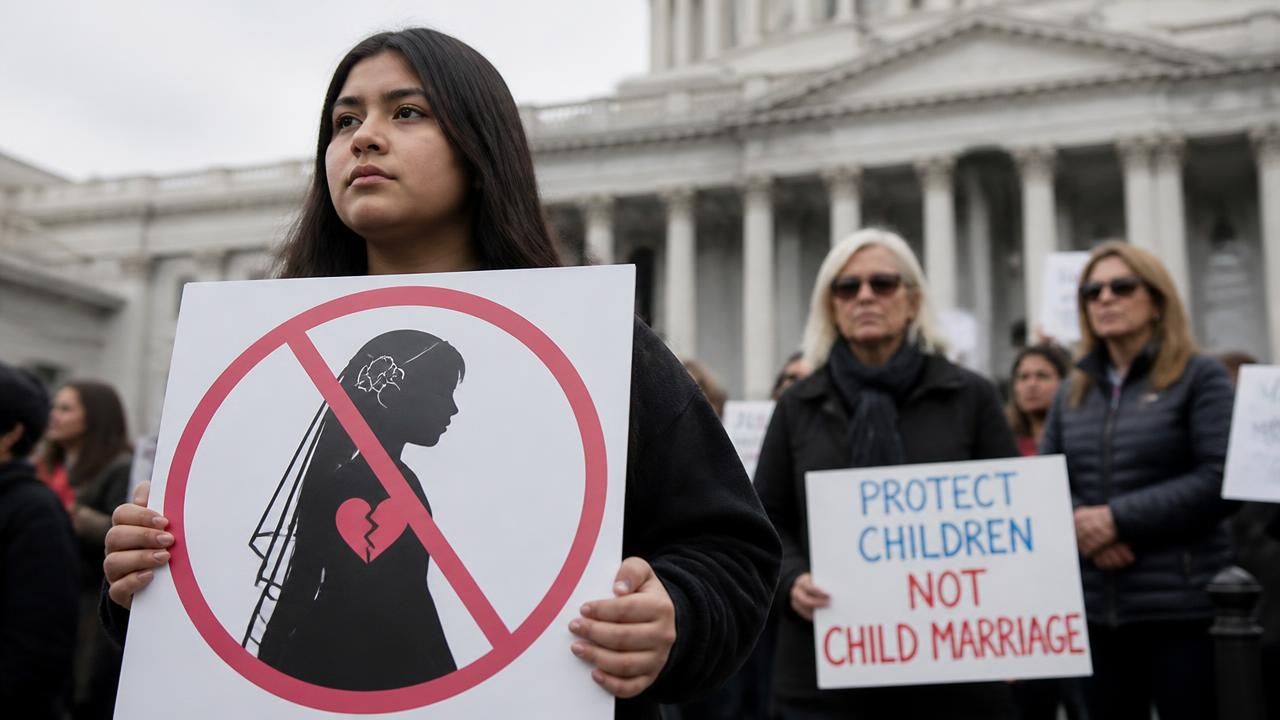
A child marriage ban in the United States is back on the legislative agenda, but its path is tangled. A new bipartisan federal bill would set the marriage age at 18 nationwide, overruling state laws that still allow younger minors to wed in certain circumstances. Meanwhile, the United Nations is preparing to create its first-ever dedicated day to focus attention on the practice, a sign of the issue's international urgency.
A Federal Minimum: The Proposal
Introduced this month in both the Senate and the House, the bill is designed to close loopholes that permit a 16- or 17-year-old, and in rare cases even a 14-year-old, to be married with parental or judicial consent. The bill would make 18 the legal age of marriage in every state and U.S. territory, with no exceptions. Supporters say it is a civil rights milestone, giving minors the same protection they receive in other areas of law, such as contracting, voting, and military service.
The measure has attracted unusual bipartisan support, but also opposition from some Republicans and religious groups. Critics argue that Washington should not impose a one-size-fits-all standard on states, which have traditionally handled marriage law. Some also worry that an absolute ban could force pregnant teenagers into solitary childbirth or deny them the perceived stability of a partner.
“The real issue is that in America, a 45-year-old man can still marry a 14-year-old girl in dozens of states,” said a Senate staffer familiar with negotiations. “This bill is about ending that disgrace.”
How Child Marriage Persists
U.S. law historically allowed children to marry at remarkably low ages. Under English common law, girls could be given away as brides at age 12 and boys at 14. That legacy persisted for centuries. Even as the U.S. moved to regulate child labor and education, marriage remained a patchwork of state statutes. Some states set age floors at 16 or 17 with parental agreement; others require court approval, sometimes with a pregnancy clause. As a result, most U.S. states still permit some form of child marriage. According to the advocacy group Unchained at Last, more than 300,000 minors were legally married in the U.S. between 2000 and 2018. The overwhelming majority were girls, married to adult men.
The U.N. Acts
The U.N. General Assembly is expected to designate a specific day in 2026 to draw attention to global efforts to end child marriage. The proposed calendar date, likely October 11, will already be recognized as the International Day of the Girl Child. The resolution would mark the first time the U.N. has singled out child marriage with its own dedicated observance. UNICEF, which has championed the proposal, notes that 12 million girls are married every year, often dropping out of school and facing heightened risk of domestic violence and maternal death due to early childbirth.
“A dedicated day will give advocates and communities an annual moment to highlight solutions,” a U.N. official said on condition of anonymity because the resolution is still being drafted. “It may sound symbolic, but symbols matter in human rights.”
Controversy at Home
The push for a federal age limit has put Congress in an awkward position. In 2008, the U.S. State Department declared that child marriage is a human rights abuse, yet the federal government has repeatedly declined to pass binding law on it. The U.S. is the only United Nations member that has not ratified the Convention on the Rights of the Child, and it has not ratified the Convention on the Elimination of All Forms of Discrimination against Women (CEDAW). Those omissions make the domestic bill all the more symbolic.
Opponents see it as an attack on traditional values. For example, the Family Research Council has argued that setting a strict age limit could interfere with the rights of parents to make choices for their children, particularly under religious law. But such positions are increasingly out of step with public opinion. A 2023 Ipsos poll found that 78% of Americans supported a nationwide ban on marriage for minors under 18.
Even some states considered progressive have taken years to comply. While states like Delaware and New Jersey have adopted pure bans, other states such as Florida and Tennessee have introduced only partial restrictions. Observers say legislative inertia is due to a lack of public awareness.
What the Bill Would Do Differently
A major provision of the new bill is its enforcement mechanism. It would tie federal funding for states to their compliance, thus providing financial leverage.
If enacted, it would:
- Prohibit marriage of anyone under 18 across all jurisdictions
- End all exceptions for parental approval, judicial waivers, and pregnancy
- Require the federal government to issue annual compliance reports
- Extend the protections to U.S. territories
According to Cornell Law School professor Cynthia Grant Bowman, an expert on family law, a federal statute would be constitutional because it relates to interstate recognition of marriages. “States can set their own rules, but they must respect the public policy of the federal government when federal funds are at stake,” she said.
Historical Precedents
United States federal lawmakers have previously set national ages for behaviors once left to states, including the legal drinking age, the minimum age for a driving license? Actually drinking age tied to highway funds. So there is precedent. An 18-year minimum for marriage is far less punitive than some federal mandates.
Impact on Girls
Researchers have found that married girls in the U.S. are far more likely to drop out of school, live in poverty, and experience domestic violence. They are also less likely to be able to access support services because they are legally tied to an adult. The pandemic exacerbated the problem: online wedding applications dropped, but forced marriages may have gone underground.
Next Steps
The bill has been referred to the Judiciary Committee, and no floor vote is scheduled. Its sponsors say they will push for hearings in the fall, hoping that the U.N. designation can lend momentum. Even if the bill fails, its introduction signals a new era in the global fight. And the U.N. day—whatever its date—will put the U.S. on the spot: if it wants to speak credibly on ending child marriage abroad, it may finally have to end it at home.