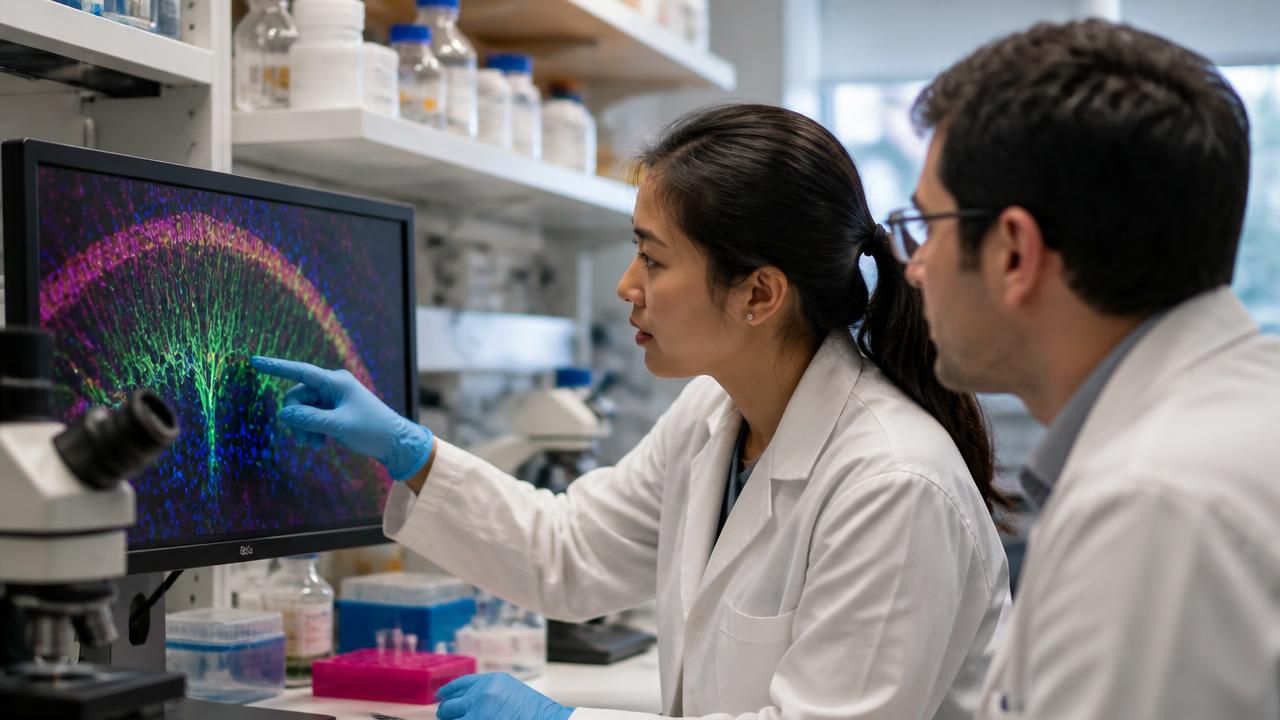
The human brain, with its billions of neurons and trillions of connections, begins as a simple tube of neural stem cells. In the first months of pregnancy, a population of cells called radial glia orchestrates the construction of the cerebral cortex, the folded outer layer responsible for higher cognition. Now, a team from the University of California, Los Angeles, has uncovered two unexpected instructions that guide this formation: the way these stem cells process glucose, and the physical contact they receive from a nearby brain region called the thalamus.
Reporting in a new study, the UCLA researchers show that radial glia alter their behavior in response to both their metabolic fuel and mechanical signaling. The findings, published this month, add a layer of complexity to the understanding of neurodevelopment and may offer clues to conditions such as autism and schizophrenia, where cortical wiring goes awry.
A Cellular Architect That Listens
Radial glia are the scaffolding of the developing brain. They extend long fibers that guide migrating neurons to their final positions and simultaneously divide to generate neurons. In particular, they are the major source of excitatory projection neurons of the cerebral cortex. These cells are organized in layers, like a sandwich; upper-layer neurons in particular have expanded dramatically through evolution and are associated with human-specific cognitive abilities.
But how do radial glia know what to build? Until recently, the dominant view was that an intrinsic genetic program dictated each stage of development, with the stem cells progressing from producing deep-layer neurons to upper-layer neurons in a fixed sequence. The new research suggests that the local environment - both metabolic and mechanical - feeds information into radial glia to fine-tune that program.
The Role of Glucose Metabolism
Glucose is more than just a source of energy. The UCLA team found that the way radial glia process glucose directly influences whether they continue to divide or begin differentiating into neurons. By altering glucose metabolism in mouse models, the scientists saw marked changes in the output of specific neuronal subtypes.
Physical Contact With the Thalamus
Perhaps even more surprising was the role of touch. The thalamus, a structure buried in the center of the brain, sends axons out to the cortex early in development. For a long time, scientists assumed that these connections were simply a later wiring event. The new work demonstrates that these outgrowing thalamic axons physically contact radial glia fibers - and those contacts generate signals that bias glucose metabolism and alter gene expression in the stem cells.
Using advanced imaging and molecular profiling, the researchers traced how these physical signals produce different neuron types, including upper-layer neurons. The contact appears to promote the production of neurons that populate the superficial cortex, a region that is particularly expanded in humans.
"These two influences act in concert, revealing a level of complexity that had not been appreciated," said a senior author of the study. "The radial glial cell is not just a passive drone; it is actively reading its environment and adjusting the blueprint."
Why This Matters for Human Brain Evolution
The cerebral cortex is, in many ways, what makes us human. Its surface area is vastly larger than in other mammals, and upper-layer neurons are disproportionately abundant. The new findings provide a mechanism by which environmental cues - both internal metabolic states and external contact from the thalamus - could modulate this expansion.
One of the most tantalizing implications is that metabolic conditions during pregnancy could affect brain development in ways previously unrecognized. For example, maternal diabetes or gestational conditions that alter glucose availability might impact radial glia behavior and therefore the final composition of the cortex.
The contact with the thalamus also suggests a much earlier dialogue between brain regions than formerly assumed. Rather than being a simple relay station that connects later, the thalamus might serve as a regulator of cortical development from the very beginning.
Implications for Neurodevelopmental Disorders
The findings could shed light on a range of conditions. Disruptions in the balance of upper-layer and deep-layer neurons have been associated with intellectual disability, epilepsy, and psychiatric disorders.
Additionally, the involvement of glucose metabolism points to a possible link between maternal metabolic health and neurodevelopmental outcomes. The authors suggest that these insights may one day lead to better strategies for identifying or mitigating risks.
- Radial glia are stem cells that generate the majority of cortical neurons.
- Glucose processing acts as a metabolic switch for neurogenesis.
- Thalamic contact sends mechanical and biochemical signals to radial glia.
- The interaction specifically impacts the generation of upper-layer neurons, which are crucial for higher cognition.
- The findings open new avenues for research into developmental disorders and brain evolution.
A New Framework for Brain Development
The UCLA discovery challenges the simple hierarchical model of cortical development. Instead of a rigid, predetermined sequence, the brain emerges from a delicate interplay of signals. The radial glial cell sits at the center of this conversation, integrating chemical, metabolic, and mechanical inputs.
"Taken together, these insights change how we think about the earliest stages of brain formation," the authors write. Future work will focus on how these pathways can be modulated, either in medical settings or in the context of regenerative medicine.
The study was supported by the National Institutes of Health and conducted in collaboration with colleagues in Europe and Asia. The researchers plan next to investigate whether the same mechanisms operate in human tissue models, including brain organoids, and how they might be harnessed to repair damaged cortical circuits.
As the most complex object in the known universe, the brain's assembly has long induced humility in those who study it. This work reminds us that even the humble radial glial cell is not simply a brick in the wall, but an active, listening builder - and we are only beginning to learn its language.