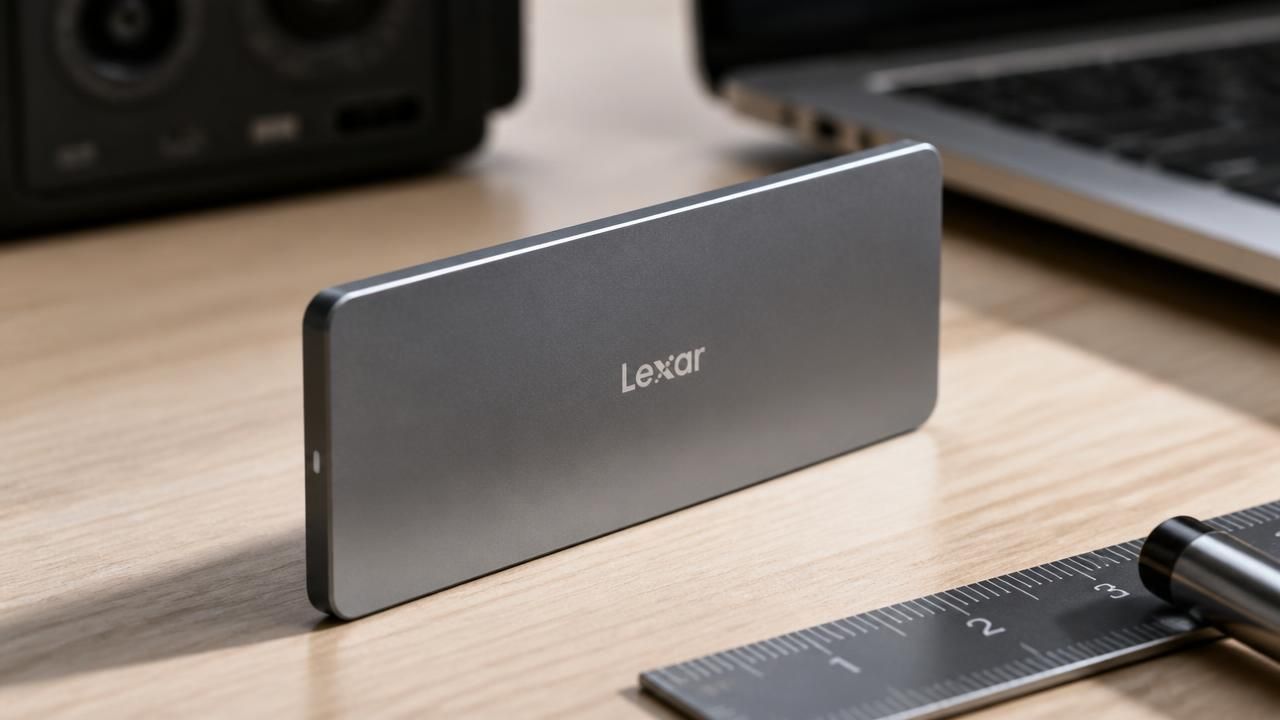
Lexar has chosen the grand stage of IFA 2026 in Berlin to celebrate its 30th anniversary with a statement product: the Lexar Muse Ultra-Slim Portable SSD. The company bills it as the world’s thinnest portable SSD, a bold claim backed by its remarkable 3.8mm profile at the center, tapering to an almost unthinkable 1mm at the edges. The drive is set to launch later this year in 512GB and 1TB capacities, offering a blend of ultra-portability and respectable performance.
An engineering marvel in thinness
To achieve such a svelte form factor, Lexar had to rethink the internal architecture of a portable SSD. The Muse uses high-density NAND stacking and what the company describes as a “custom ultra-thin PCB architecture.” This allows the drive to be thinner than a stack of a few credit cards, while still promising read speeds of up to 1,050MB/s and write speeds of up to 1,000MB/s. That puts the Muse in the realm of USB 3.2 Gen 2 performance, fast enough to handle demanding creative workflows, including recording 4K Apple ProRes video at up to 120fps when connected to a compatible camera or mobile device.
TechPowerUp, covering the IFA 2026 announcement, highlighted Lexar’s claim of the “world’s thinnest portable SSD,” framing the product as a direct response to a growing demand for media professionals who need to carry large files without bulk. The Verge similarly noted that the Muse is “one of the slimmest you can buy,” pointing out that it joins an emerging trend of ultra-thin drives that prioritize portability over traditional I/O expectations.
The USB-C compromise
The most striking — and potentially polarizing — aspect of the Muse is what Lexar had to sacrifice to reach this thickness. As PetaPixel’s headline bluntly states: “Lexar’s New SSD Is So Thin It Doesn’t Even Have a Regular USB-C Port.” Indeed, the drive’s profile leaves no room for a full-size USB-C receptacle. Instead, Lexar follows in the footsteps of niche companies like Xteink, which have also shaved off millimeters by eliminating standard connectors.
While the company hasn’t detailed the exact alternative solution — whether it’s an integrated cable, a magnetic connector, or a hybrid approach — the absence of a regular USB-C port is a notable trade-off. For users accustomed to carrying a standard USB-C cable, this could add friction. The Verge’s coverage frames this as the cost of extreme thinness: “Lexar is the latest to sacrifice a USB-C port in the pursuit of slimming down its hardware.” PetaPixel’s angle emphasizes the practical implications, questioning whether such a radical design will resonate with photographers and videographers who rely on widely available ports while in the field.
A 30th-anniversary statement
The Muse isn’t just a new product; it’s a milestone. Lexar has spent three decades building a reputation in storage, from memory cards to SSDs. Unveiling a record-breaking thin drive at IFA 2026 serves as both a celebration and a declaration of future direction. Alongside the Muse, Lexar also previewed AI-focused storage technology, hinting at its broader ambitions to support AI-driven workflows and applications. This additional announcement, covered by MSN, shows that Lexar is looking beyond conventional portable storage and into the realm of intelligent, high-capacity solutions tailored for the AI era.
The timing is also strategic. With the rise of 8K video, high-bitrate codecs, and massive machine-learning datasets, portable storage is becoming a critical bottleneck. Lexar’s new products aim to address that by combining extreme portability with the performance needed for on-location editing and real-time AI model training.
Key specifications at a glance
- Capacities: 512GB and 1TB
- Thickness: 3.8mm at the center, tapering to 1mm at the edges
- Sequential read speed: up to 1,050MB/s
- Sequential write speed: up to 1,000MB/s
- Target applications: 4K Apple ProRes video recording at up to 120fps
- Design: high-density NAND stacking, custom ultra-thin PCB, no regular USB-C port
Industry reactions and future implications
Coverage of the Muse reflects the tech community’s fascination with extreme form factors. The Verge takes a pragmatic but admiring view, praising the performance-to-thickness ratio while noting the port compromise. PetaPixel places the focus on the everyday usability for creative professionals, asking whether “thin is worth the sacrifice” when it comes to universal connector compatibility. TechPowerUp gives a straightforward report on the record-breaking claim and the specs, effectively endorsing the Muse’s engineering achievement.
Lexar’s move could signal a broader shift: as portable SSDs become smaller and thinner, manufacturers may increasingly have to choose between conventional connectivity and envelope-pushing design. The Muse will be a test case for how much compromise the market is willing to accept. If it succeeds, we may see more storage makers abandon the standard USB-C port — or develop even more creative ways to hide it altogether.
For now, the Lexar Muse stands as a bold anniversary statement. It is a device that looks like the future, performs in the high-speed present, but forces users to make peace with a past that no longer fits in a 3.8mm slot. Whether that’s a brilliant revolution or a frustrating trade-off, the market will decide when the Muse ships later this year.