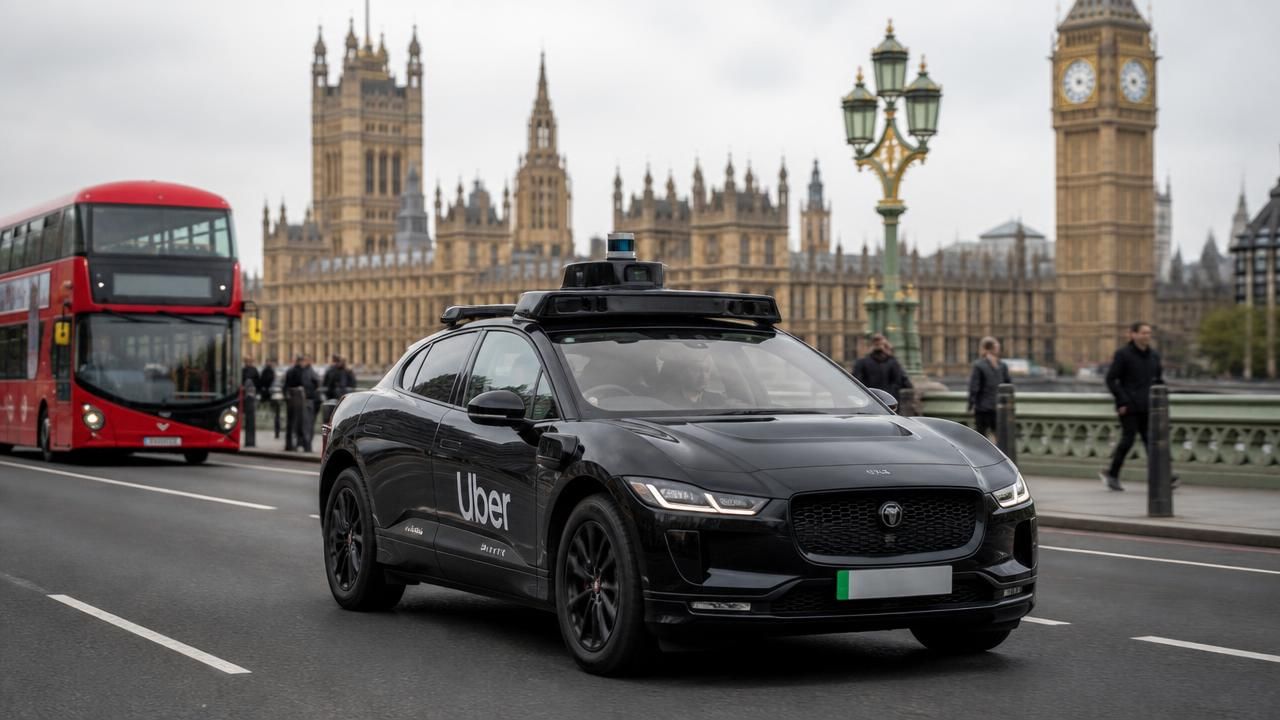
London, once the heart of a global empire, now has a new claim to fame: its first commercial robotaxi service. Uber, the ride-hailing giant, launched the city’s maiden autonomous taxi fleet this week, beating Alphabet’s Waymo to the punch and using self-driving software developed by British startup Wayve. The vehicles will initially carry safety drivers, but the technology behind them is poised to redefine urban mobility in one of the world’s most complex driving environments.
Who, What, and Where
The service, operated by Uber in partnership with Wayve, sees a small fleet of self-driving cars — reportedly based on the Jaguar I-Pace — navigate London’s notoriously narrow, winding streets. Unlike the fully driverless robotaxis that have operated in San Francisco and Phoenix, these vehicles will have a human safety engineer behind the wheel to monitor progress, a cautious first step for the city’s autonomous era. The launch is initially limited to a select group of riders, with fares structured like Uber’s standard service.
Why London Is the Ultimate Test
London presents unique challenges for autonomous vehicles. As the New York Times put it, robots are now “trying their luck” on the city’s medieval roads — ancient thoroughfares that predate the automobile, combined with aggressive traffic, double-decker buses, cyclists, and unpredictable weather. Bloomberg called the launch an attempt to “unleash supervised robotaxis on London’s winding streets.” Wayve’s AI-first approach, which relies on end-to-end deep learning rather than detailed mapping, is designed to adapt to such chaos.
The launch is a milestone for Uber, which has been plotting a UK rollout with Wayve for years. It also serves as an early test of whether there is appetite for robotaxis beyond the United States and China, where most of the world’s autonomous fleets are currently concentrated. Until now, robotaxi pilots in Europe have been largely confined to controlled demonstrations, not commercial services. Munich, for instance, is expected to be Waymo’s first EU launch, but London is the more symbolic prize.
“It’s also an early test of whether there’s appetite for driverless ride-hailing beyond the US and China, where most of the world’s robotaxis are currently clustered,” notes The Verge.
The Global Robotaxi Race
The competitive landscape is no longer a two-horse race. While Waymo has long been regarded as the leader in Western autonomous driving, Chinese firms like Baidu have aggressively expanded into the Gulf, as Rest of World reported: “China steers the Gulf’s driverless future as U.S. rivals stay home.” Baidu’s Apollo platform has already launched robotaxis in the Middle East, and the company has filed plans to bring its technology to London. A recent BBC report even suggested Uber and Lyft were partnering with Baidu to trial robotaxis in the UK, though that arrangement appears separate from the Wayve launch.
The arrival of Uber and Lyft into the robotaxi space signals a strategic shift. Rather than developing their own hardware, ride-hailing platforms are increasingly white-labeling self-driving systems from startups and tech giants. This is mirrored by Tesla’s ambitious robotaxi showcase, which Forbes described as a “deep story” in the ongoing Waymo vs. Tesla battle. Tesla’s approach relies purely on cameras and neural networks, while Waymo uses lidar and high-definition maps. Wayve, interestingly, combines elements of both: vision-based learning with a safety-net infrastructure.
Regulatory Challenges and Public Appetite
Getting to market was not easy. Reports emerged earlier this year that the London rollout had been delayed due to a lack of official guidance from Westminster. The UK’s transport regulators have been cautious, and unlike some US states, they have demanded rigorous safety testing. The eventual approval for Uber and Wayve required the vehicles to undergo extensive simulation and on-road trials. Safety drivers, who are trained to intervene, are part of the compliance package.
What Is a Robotaxi?
Robotaxis are self-driving vehicles configured for passenger transport, typically hailed through an app. As Built In explains, they are “a crucial piece of the autonomous vehicle revolution” and rely on a suite of sensors, including lidar, cameras, and radar, along with sophisticated software. While companies like Waymo have launched fully driverless services in limited US cities, most pilots around the world still operate with safety drivers—a fact that keeps regulatory approval both possible and controversial.
Framing the Story
Each news outlet has put its own spin on the launch. The Verge frames it as a strategic victory for Uber over rival Waymo, a narrative reinforced by the fact that Waymo is simultaneously preparing a launch in Munich. The BBC highlights the involvement of Chinese giant Baidu, hinting that the UK is becoming a battleground for global AI powerhouses. And the New York Times leans into the absurdity and difficulty of navigating streets that have barely changed since Dickens’ time. Together, these perspectives reveal a story larger than one city: the race to define the future of mobility is being fought on the old roads of Europe, the new highways of the Gulf, and the sprawling suburbs of China and California.
Implications and What’s Next
The launch has broader implications for jobs, safety, and urban planning. Taxi and rideshare drivers’ unions are watching closely, as autonomous services could eventually displace 100,000 workers in the UK alone. Safety advocates, meanwhile, point to the supervised nature of the initial rollout as an admission that the market isn’t ready for fully driverless operations in London. The shortage of guidance, which delayed the launch, also suggests that policymakers are still wrestling with liability and data privacy questions.
For Wayve, the London deployment is a coming-out party. The startup, which counts Microsoft-backed investors and is part of a wave of European AI companies, is betting that learning from real-world driving—rather than hand-coded rules—will outpace American and Chinese competitors. It has yet to announce a go-to-market strategy for other European cities, but a successful London trial would give it immense credibility.
For riders, the experience is likely to be underwhelming at first. Early passengers have reported cautious driving, with vehicles yielding more than necessary to pedestrians and cyclists. That could frustrate commuters used to zippy human drivers. But as the technology improves, and if regulators allow the removal of safety drivers, the economics of robotaxis could dramatically undercut traditional ride-hailing.
Conclusion
London has joined the autonomous age—not with a bang, but with a carefully supervised rollout. Uber’s victory over Waymo on this front is significant, yet the war is far from over. Waymo is heading to Munich, Baidu is circling the Gulf and British capital, and Tesla is poised to unleash its own vision. The real test in London will be whether the public embraces a robot chauffeur—even one that still needs a human lookout. If they do, the winding streets of the UK capital could become the gold standard for driverless deployment worldwide.