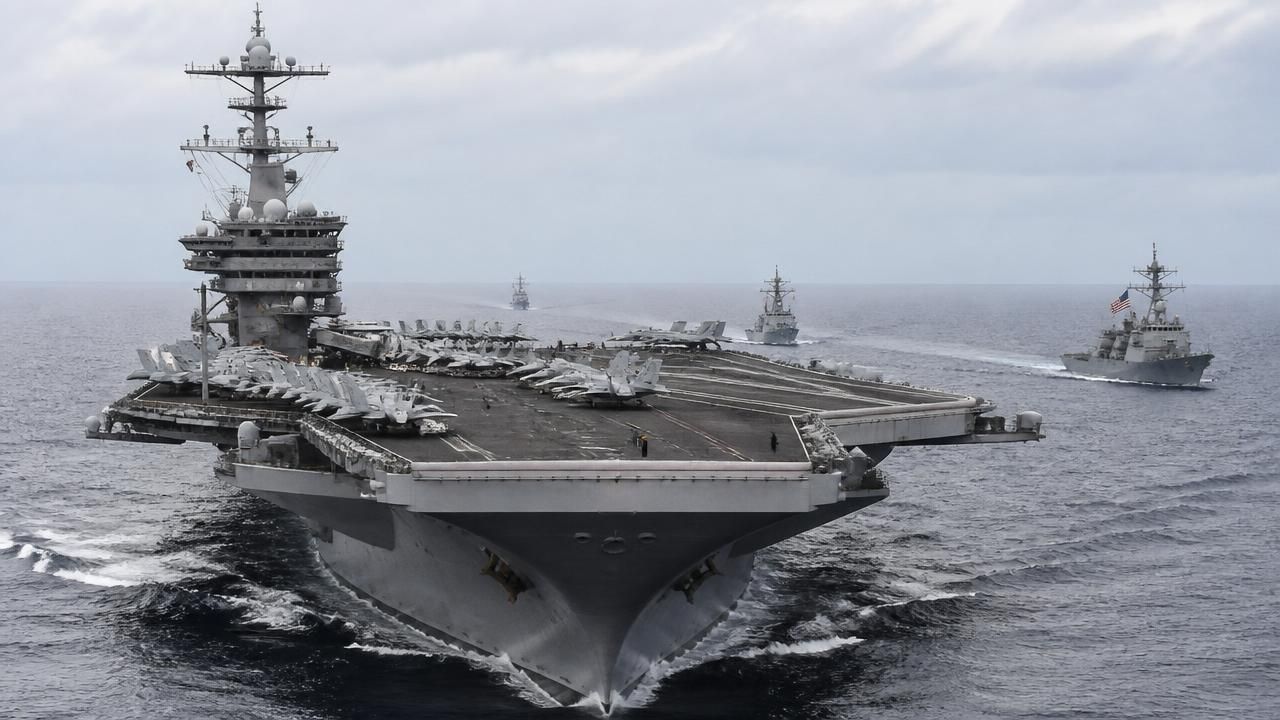
The U.S. Navy has replaced the aircraft carrier U.S.S. Abraham Lincoln in the Middle East amid a crew morale crisis and mounting logistical failures, according to a report by New York Times Pentagon correspondent John Ismay, a Navy veteran. The move comes as the Iran war enters a new, attritional phase, exposing deep cracks in the military's ability to sustain prolonged combat operations far from home.
The Lincoln, which had been deployed to the region as part of a carrier strike group, faced severe resupply problems that were directly tied to Iranian drone strikes on a key U.S. logistical hub early in the conflict. That attack, which reportedly struck a base responsible for coordinating fuel, food, and ammunition deliveries, crippled the Navy's supply chain in the region and left the carrier and its escort ships scrambling for essential materials. The resulting strain took a heavy toll on crew morale, with sailors enduring extended deployments, exhausted supplies, and the constant threat of missile and drone attacks.
A Carrier Under Strain
The decision to pull the Lincoln and substitute another flattop underscores the severity of the situation. But as Ismay explains, the new carrier will inherit the same logistical nightmare. "The challenges to supply ships in the area will most likely remain the same," he notes. The problem is not the carrier itself but the fragile network of oilers, supply vessels, and shore-based depots that keep the fleet operational.
According to MSN News, the Navy has battled "operational tempo ordeals for years," and the Iran war has laid bare those flaws. The conflict has demanded a level of sustained carrier presence that the service was never designed to support, particularly in a region as contested as the Persian Gulf and the Strait of Hormuz.
The Logistics Trap
Military analysts point to a hidden cost of Iran's drone strategy. A single strike on a logistics hub early in the war reportedly set off a chain reaction that left the Lincoln without critical supplies at a crucial moment. "It was a force multiplier for Iran," said one expert quoted by MSN. "They didn't need to sink the carrier; they just needed to break its supply line."
The episode mirrors broader concerns about the vulnerability of U.S. logistics in any major conflict with Iran. An invasion of Iran, as one military analysis from 19FortyFive puts it, would be "one of the most complex military operations in modern history," requiring an enormous logistical apparatus that currently shows signs of strain.
The View From the Fleet
The crew of the Lincoln bore the brunt of these failures. Reports describe sailors on reduced rations, awaiting critical spare parts, and facing extended deployment timelines without relief. The morale crisis became so acute that Navy leadership decided a crew rotation was necessary, even if it meant a temporary gap in carrier coverage in the region.
This is not an isolated incident. The U.S. Navy has repeatedly warned about the dangers of high operational tempo, with too few ships and too many commitments. The Iran war has magnified these problems, forcing carriers to operate for months on end without proper maintenance or crew rest.
A War of Attrition
The logistical woes come as the conflict with Iran expands beyond direct military engagements. Video reports from The New York Times illustrate a widening crisis: oil stockpiles dwindling, key shipping routes at risk, and global markets tumbling. The Strait of Hormuz, through which a fifth of the world's oil passes, has become a free-fire zone, with multiple ships struck by mines, drones, and missiles.
For the Navy, every escort mission, every strike sortie, and every resupply run is now a high-risk operation against a determined adversary armed with sophisticated anti-ship weapons. As one expert told MSN, "The Iran war has exposed the limits of U.S. naval power in a prolonged regional conflict. We're not built for a long fight here."
The Replacement Calculus
The decision to swap carriers is a tacit admission that the Lincoln is no longer combat-effective. But the replacement ship, whatever its designation, will face the same constraints. The Navy's logistics network in the region remains degraded, and Iran's ability to strike vulnerable supply nodes is undiminished.
Pentagon officials have been tight-lipped about the specific details of the resupply failures, citing operational security. However, the broader pattern is clear: without a robust and protected logistics chain, the most powerful warships in the world are little more than targets.
Broader Implications
The Lincoln's plight is a warning sign for any prolonged U.S. military engagement against a near-peer adversary. As defense analysts point out, great-power competition relies as much on depot ships and supply convoys as on aircraft carriers and destroyers. The U.S. Navy's ability to "fight tonight" is compromised when its supply lines are severed by a few well-placed drones.
For now, the focus is on keeping the carrier strike group operational in the Strait of Hormuz. But the deeper lesson may be that the Pentagon's logistics architecture — built for the counterinsurgency wars of the post-9/11 era — is ill-suited for a high-intensity conflict with a state actor like Iran. As the war grinds on, the Navy will need to rethink not just how it fights, but how it sustains the fight.
"The challenges to supply ships in the area will most likely remain the same." — John Ismay, The New York Times
In the end, the U.S.S. Abraham Lincoln's ordeal is a microcosm of a larger strategic problem. The United States can project military power anywhere in the world, but only if it can keep its ships fueled, fed, and armed. As Iran has demonstrated, taking out a single logistics hub is sometimes enough to bring a carrier to its knees. The war may be far from over, but the Navy is already learning a hard lesson about the fragility of its own supply lines.