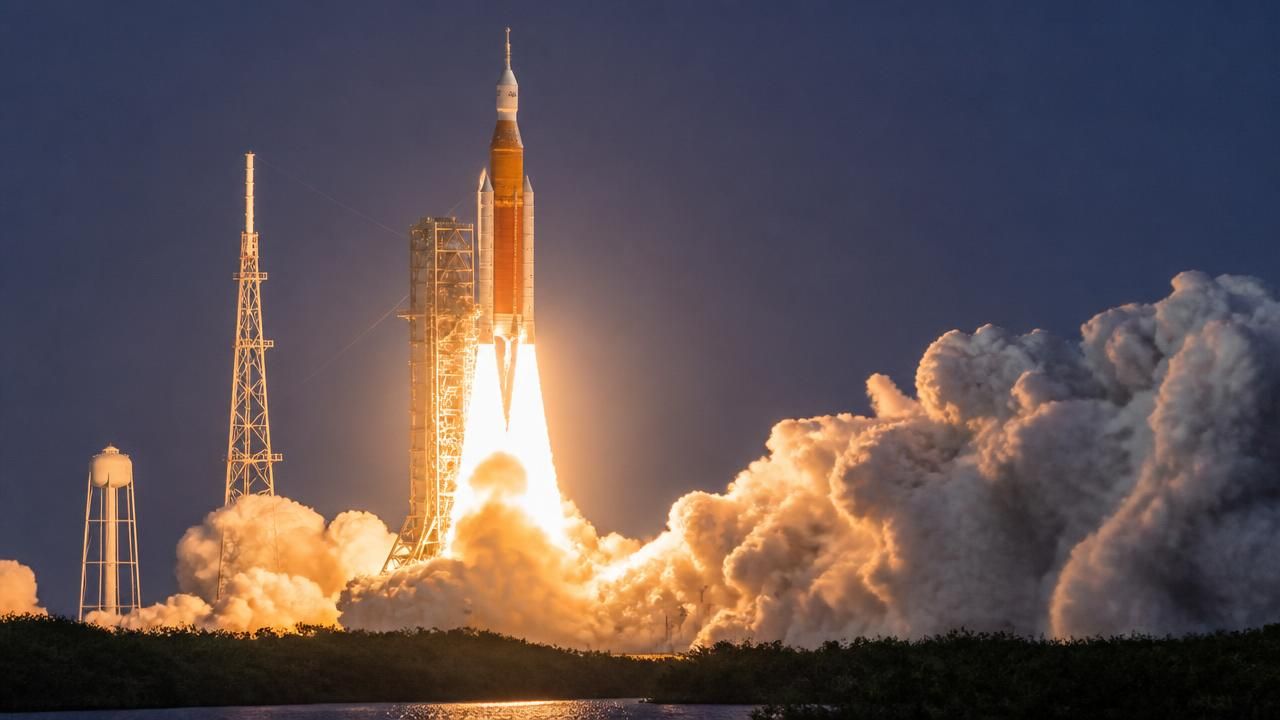
CAPE CANAVERAL, Fla. — With a thunderous roar and a pillar of flame, NASA's Artemis II mission lifted off from Launch Pad 39B at the Kennedy Space Center on April 1, 2026, at 6:25 p.m. EDT. The four-person crew — Commander Reid Wiseman, Pilot Victor Glover, and Mission Specialists Christina Koch and Canadian astronaut Jeremy Hansen — began a 10-day journey that will take them around the Moon and back to Earth. The mission marks the first time humans have traveled beyond low Earth orbit since Apollo 17 in 1972, and it serves as a critical rehearsal for the lunar landings that are soon to follow.
“On our way,” NASA announced shortly after liftoff, as the Space Launch System (SLS) rocket's core stage and twin solid rocket boosters powered the Orion spacecraft into orbit. Within hours, a crucial engine burn placed Artemis II on a free-return trajectory around the Moon, a maneuver that Mashable described as “the key engine burn” setting the crew on their historic path.
The mission is the first crewed flight of the Artemis program, building on the uncrewed Artemis I flight that tested the integrated SLS-Orion system in 2022. But this time, the astronauts are not passive passengers. As Universe Today reported, “the mission crew will periodically take control and fly the spacecraft manually during their circumlunar journey,” testing hardware and procedures that will be essential for Artemis III and future deep-space missions.
The Crew and the Voyage
Wiseman, a veteran NASA astronaut, commands the mission. Glover, a former U.S. Navy test pilot, serves as pilot and will be the first person of color to fly around the Moon. Koch, an electrical engineer and record-holder for the longest single spaceflight by a woman, brings critical systems expertise. Hansen, a Canadian Space Agency astronaut and former RCAF fighter pilot, becomes the first non-American to travel to the Moon on a NASA mission.
Over the next 10 days, the crew will travel roughly 600,000 miles round-trip, reaching a maximum distance of more than 250,000 miles from Earth. They will perform systems checks, take manual control of Orion, and capture stunning images of Earth and the far side of the Moon. The mission is designed to validate life-support systems and operational techniques before the Artemis III landing mission, slated for 2027.
As the spacecraft made its way to the Moon, NASA released striking photos of Earth rising over the lunar horizon, providing a new perspective on our planet. “The Artemis Generation begins,” wrote Universe Today, while BBC News followed the crew “from blast off to splashdown,” chronicling each major milestone.
Shuttle-Era Engines Power the Future
Even as Artemis II cruises toward the Moon, preparations for Artemis III are accelerating. On Aug. 24, 2025, technicians at NASA's Kennedy Space Center began installing the four RS-25 engines that will carry the Artemis III crew into space aboard the SLS rocket's core stage. These engines are not new; each one has a storied history from the Space Shuttle program.
Three of the four engines — E2054, E2057, and E2052 — flew on multiple shuttle missions. Engine 2048, in particular, carries a unique legacy: It helped launch the STS-95 mission in 1998, which carried U.S. Sen. John Glenn back to orbit, making him the oldest person in space at age 77. It also flew on STS-129, launching astronauts including Randy Bresnik on a mission to the International Space Station.
These engines, first built for a different era, are now being upgraded by L3Harris and others to meet the demands of Artemis. “Historic Engines Take Their Place on Artemis III,” NASA proclaimed, highlighting the reuse of proven hardware in a new chapter of exploration. The engines will be mated to the core stage built at Michoud Assembly Facility in Louisiana, with testing completed at NASA's Stennis Space Center in Mississippi.
From Coast to Coast: America's Aerospace Workforce
The Artemis program is a national effort, and state officials are eager to claim their share of the credit. California Governor Gavin Newsom highlighted the Golden State's leadership in aerospace, noting that companies from California contributed critical components to the SLS and Orion systems. In Mississippi, officials boasted that the state “powered Artemis II,” as Stennis Space Center tested the core stage that lifted the rocket off the pad. The program supports jobs across more than 40 states, a fact not lost on politicians and industry leaders as they advocate for sustained investment in lunar exploration.
Risk and Reward
While the mission is a cause for celebration, experts are also mindful of the dangers. In an exclusive interview with the New York Post, a veteran aerospace engineer delivered a blunt warning about the challenges of the journey: “Off by an inch, you're in big trouble.” The article noted that space travel is “littered with risk,” from the high-stakes launch window to the grueling reentry into Earth's atmosphere at nearly 25,000 miles per hour.
“Off by an inch, you're in big trouble.” — Aerospace expert to the New York Post
The Guardian reported that the crew must “prepare to leave Earth's orbit and head toward the Moon,” and that any deviation from the flight path could have catastrophic consequences. NASA, for its part, maintains that extensive testing and redundancies have mitigated the risks. The agency's decades of spaceflight experience, combined with modern avionics from partners like GE Aerospace, provide multiple layers of safety.
The Road Ahead: Artemis III and the Lunar Base
Artemis II is only the beginning. If the mission succeeds, NASA will proceed with Artemis III, which will use a modified Starship landing system to put two astronauts on the lunar surface near the Moon's south pole. The program aims to establish a sustainable human presence on the Moon, including a base camp, as a stepping stone for eventual crewed missions to Mars.
But first, Artemis II must complete its voyage. The crew is expected to make a critical engine burn to leave lunar orbit — or more precisely, use the Moon's gravity as a slingshot — to head home, as The Times described. Splashdown is scheduled for April 11 in the Pacific Ocean off the coast of California. Until then, the world watches with bated breath as the Artemis Generation takes its first giant leap.