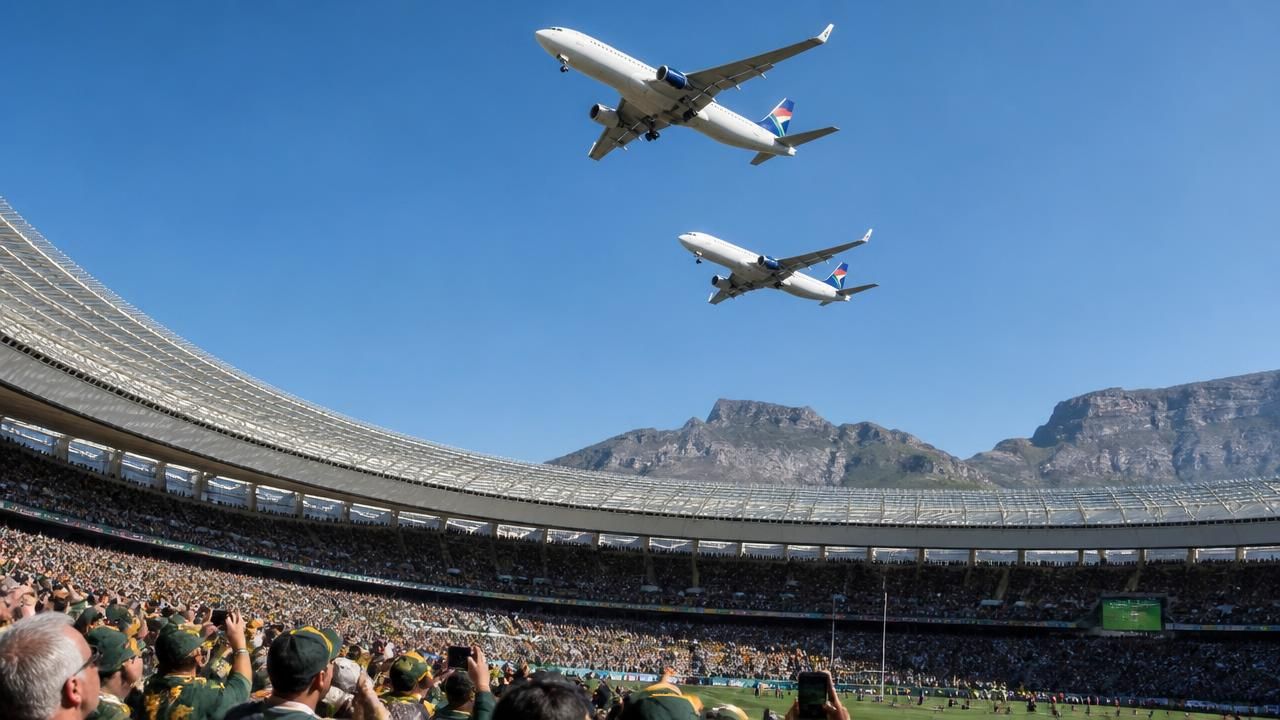
CAPE TOWN — The roar of two Embraer jets sweeping just meters above Cape Town Stadium on Saturday was meant to ignite the crowd before the Springboks took on the All Blacks. It did — but it also ignited a fierce debate about aviation safety, regulatory oversight, and the fine line between spectacle and recklessness.
The flyby, staged by South African regional airline Airlink before the second rugby union Test between South Africa and New Zealand, drew loud cheers from the estimated 56,000 spectators packed into the stadium. Videos posted on social media showed the two aircraft appearing to skim the roofline of the arena before banking sharply away. Yet almost immediately, aviation experts and concerned observers began questioning whether the stunt had been too close for comfort.
A Stunt That Divided Opinion
The flyby was intended as a tribute to the sporting occasion, but it quickly became the story itself. The Guardian reported that the stunt sparked a “major debate over safety risks,” while the African Insider headline declared it “Too close for comfort.” The BBC and MSN carried similar accounts, noting that Airlink was forced to defend the operation. The reaction was split: many fans celebrated the spectacle as a memorable pre-match moment, while others, including pilots and safety analysts, expressed alarm at the proximity of the aircraft to a densely populated venue.
“It was absolutely breathtaking,” said one spectator on social media. “You could feel the wind from the engines.” Another responded, “That was way too low for a packed stadium. One mistake and you have a catastrophe.”
“The flyby was conducted according to all relevant regulations and safety protocols,” an Airlink spokesperson insisted in a statement to multiple outlets.
Airlink’s Defense
Airlink, a private airline based in Johannesburg, defended the operation, stating that it had obtained the necessary permissions from South African civil aviation authorities and followed standard procedures for such display flights. The company emphasized that the pilots were highly experienced, the aircraft were in perfect condition, and the flight path was carefully planned to avoid any direct overflight of crowded areas.
“This was a coordinated event with the appropriate regulatory bodies,” the spokesperson said. “We pride ourselves on safety, and we would never compromise it for a spectacle.” The airline also noted that the flyby was a tribute to the long-standing tradition of aviation displays at major sporting events in South Africa.
Historical Echoes: The 1995 Iconic Flyby
This is not the first time a flyby has stirred emotions at a rugby match in South Africa. Many commentators immediately drew comparisons to the legendary flyby before the 1995 Rugby World Cup final at Ellis Park in Johannesburg, when a South African aircraft thundered low over the stadium, capturing the spirit of a nation celebrating its first major post-apartheid sporting triumph. That moment remains etched in rugby lore, and Saturday’s flyby was clearly intended to evoke similar national pride.
However, experts note that times have changed. Airport security and airspace regulations have become far stricter since 1995, and the increased density of urban development around stadiums like Cape Town Stadium adds new layers of risk. “What was acceptable 30 years ago may not be acceptable today,” said an aviation safety consultant who asked not to be named. “The key is whether the operators adhered to current rules, not whether it looked cool.”
Safety Concerns Raised
Despite Airlink’s assurances, the incident has reignited concerns about the adequacy of oversight for such display flights. Some aviation experts pointed out that even a minor technical failure at that altitude would leave pilots with virtually no time to react. Others questioned the psychological impact on the players and the crowd, with some fans reporting that the noise was deafening.
“The margin for error is zero,” said a retired commercial pilot in an interview with a local radio station. “If one bird hit a windshield or a gust of wind pushed the aircraft off course, we could be talking about a different story altogether.” The pilot also noted that the presence of 56,000 people below amplified the potential consequences, making the risk-to-benefit ratio questionable.
Regulatory authorities have not yet issued a public statement, but it is understood that they are reviewing the flight logs and communication records. The Civil Aviation Authority of South Africa typically requires special permission for low-altitude overflights of populated areas, and strict conditions are imposed. Whether those conditions were fully met remains a matter of scrutiny.
Different Media Framings
The story has been framed in markedly different ways across outlets. British media, including The Guardian and the BBC, focused on the safety debate and the airline’s defensive response. The Irish Examiner led with the dramatic nature of the flyby, describing it as “dramatic” and “low-level.” Meanwhile, rugby-focused media like Rugby365 attempted to place it in the context of historic flybys, though that article was marred by a technical error. The African Insider took a more critical tone, highlighting the phrase “too close for comfort.”
One notable omission from most reports is any comment from the players or coaches. Neither the South African nor New Zealand teams publicly commented, though the All Blacks have a history of experiencing unusual events during their visits to South Africa.
What Happens Now?
The immediate aftermath saw no official complaints filed, and no injuries were reported. However, the South African Civil Aviation Authority is expected to release a statement in the coming days. Should any irregularities be found, Airlink could face fines or restrictions on future display flights. For now, the airline appears to have weathered the immediate storm, with many fans defending the spectacle as a memorable part of the match-day experience.
The broader question remains: how much spectacle is too much? As stadium events increasingly incorporate drone shows, pyrotechnics, and aerial displays, regulators and organizers must balance entertainment against public safety. Saturday’s flyby may have thrilled those 56,000 fans, but it has also ensured that this particular pre-match moment will be remembered for more than just the rugby.
For now, the Springboks’ victory on the field — the team went on to win the Test — has been somewhat overshadowed by the drama in the sky. As one headline put it, it was truly an “insane” flyover, but whether it was a proud tradition or a dangerous gamble remains a matter of perspective.