In what is being hailed as one of the largest and most historically significant video game data leaks ever, a massive 12-terabyte archive of Valve's Steam content has surfaced online. Dubbed the “teraleak,” the dump appears to contain an “as-complete-as-possible” snapshot of Valve's defunct Steam2 content delivery server architecture, spanning roughly a decade of PC gaming from 2003 to 2013. The collection is already circulating via BitTorrent, and experts say it is unlikely Valve will ever be able to purge it completely from the internet.
What Is the 'Teraleak'?
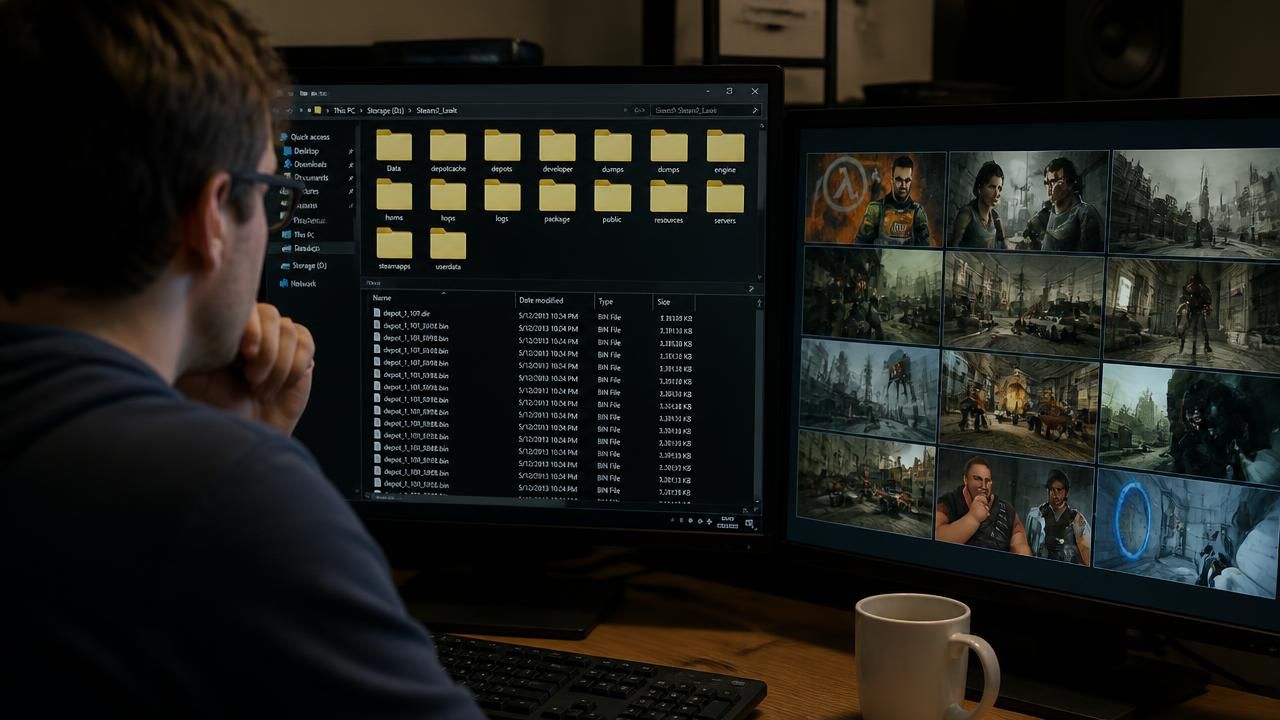
The leaked data consists of thousands of “depots” — Valve's term for the file repositories that power Steam downloads. These depots represent what seems to be every version of every game uploaded to Steam's old Steam2 servers during that ten-year window. That includes public release builds, but also a trove of previously unseen pre-release, prototype, and playtest versions of popular titles published by both Valve and third-party developers. According to Ars Technica, the collection is being distributed as a BitTorrent bundle that is “seemingly every title available on Steam between 2003 to 2013.”
“As-complete-as-possible ... content server dump” of Steam's defunct “Steam2” server architecture.
The leak is notable not just for its sheer size, but for the type of content it exposes. While many depots contain publicly available builds, a significant portion includes internal development files, debug versions, and content that was never meant to see the light of day. This makes the archive a goldmine for game historians, data miners, and fans of lost media.
Why Did the Leak Cut Off in 2013?
The 2013 cutoff is no accident. That was the year Valve transitioned its content distribution system from Steam2 to the current SteamPipe system. SteamPipe replaced Valve's proprietary file distribution format with standard HTTP file trees, removing various update approval bottlenecks and streamlining patch downloads by only transferring file differentials. This architectural change likely meant that the old Steam2 servers were decommissioned at that point, leaving the pre-2013 data frozen in time until it was eventually exfiltrated and shared.
The transition to SteamPipe also explains why the leaked content includes such a broad range of builds. In the Steam2 era, developers often uploaded entire new file sets for each update, rather than incremental patches. As a result, the servers retained a near-complete history of every iteration of every game — a side effect that now provides an unprecedented look at game development processes from that era.
Lost Valve Titles Resurface
Perhaps the most tantalizing aspect of the teraleak is the reported inclusion of long-rumored Valve projects. According to 4Gamers, a Taiwanese gaming outlet, the archive contains content related to F-Stop — the canceled Portal prequel that Valve famously shelved — as well as early builds of Half-Life 2: Episode Three, the fabled and never-released conclusion to the episodic trilogy. Also mentioned are various prototype and playtest versions of other Valve classics, including Left 4 Dead, Counter-Strike, and Team Fortress 2.
While the presence of these specific titles has not been independently verified by this publication, the sheer scale of the leak makes it plausible. Ars Technica notes that the archive includes “pre-release, prototype, and playtest versions of popular titles published by Valve and third-party Steam publishers.” The discovery of such artifacts could rewrite the history of Valve's most beloved franchises, which have always been shrouded in secrecy.
Different Framing, Same Story
Outlets are covering the leak from markedly different angles. Ars Technica frames it primarily as a matter of gaming history and preservation, calling it “a decade of lost PC gaming history.” TechMyMoney focuses on the scale of the dump, describing it as “Steam 12TB leak dumps 2003-2013 game files.” Meanwhile, MyBroadband, a South African technology site, packages the story alongside broader cybersecurity anxieties, headlining it “Cybersecurity apocalypse closer than expected, and 12TB Steam leak spills lost PC gaming history.” This juxtaposition highlights how a single event can be repurposed to fit different editorial narratives — from archival milestone to cautionary tale about data security.
The varied framing also reflects the dual nature of the leak. On one hand, it is a treasure trove for preservationists and modders, who argue that preserving game history is crucial for cultural memory. On the other, it represents a massive breach of Valve's internal infrastructure and raises legal questions about intellectual property, trade secrets, and the right of developers to control unfinished work.
Community Reaction and Implications
Initial reactions within the gaming community have been a mix of excitement, nostalgia, and legal caution. Data miners have already begun sifting through the archive, hoping to uncover cut content, hidden maps, and unused dialog. For fans of the Half-Life universe, the prospect of finally seeing what Episode Three might have been is almost overwhelming. Yet, many are also wary of the legal risks involved in downloading or distributing Valve's proprietary files.
Game preservationists, however, see the leak as a windfall. A spokesperson for the Video Game History Foundation noted in a comment to Ars Technica that “this kind of accidental preservation is becoming increasingly common,” and while the method is dubious, the historical value is undeniable. Still, the archive is incomplete — it cuts off in 2013 and may have gaps, and the massive file size makes it difficult to review comprehensively.
What Happens Next?
Valve has not yet issued an official statement about the leak. Historically, the company has been tolerant of fan-led preservation efforts, but a leak of this magnitude — involving unreleased intellectual property — may prompt legal action. The company could attempt to issue DMCA takedowns against torrent trackers, but given the decentralized nature of BitTorrent and the number of mirrors already springing up, any purge would likely be futile.
For now, the teraleak stands as a fascinating, if legally fraught, window into a pivotal era of PC gaming. Whether it becomes a permanent fixture of internet archives or a cautionary tale about server security, it has already made history. As one commentator put it, “This is the kind of leak that doesn't just reveal secrets; it preserves a digital ecosystem that would otherwise be lost forever.”