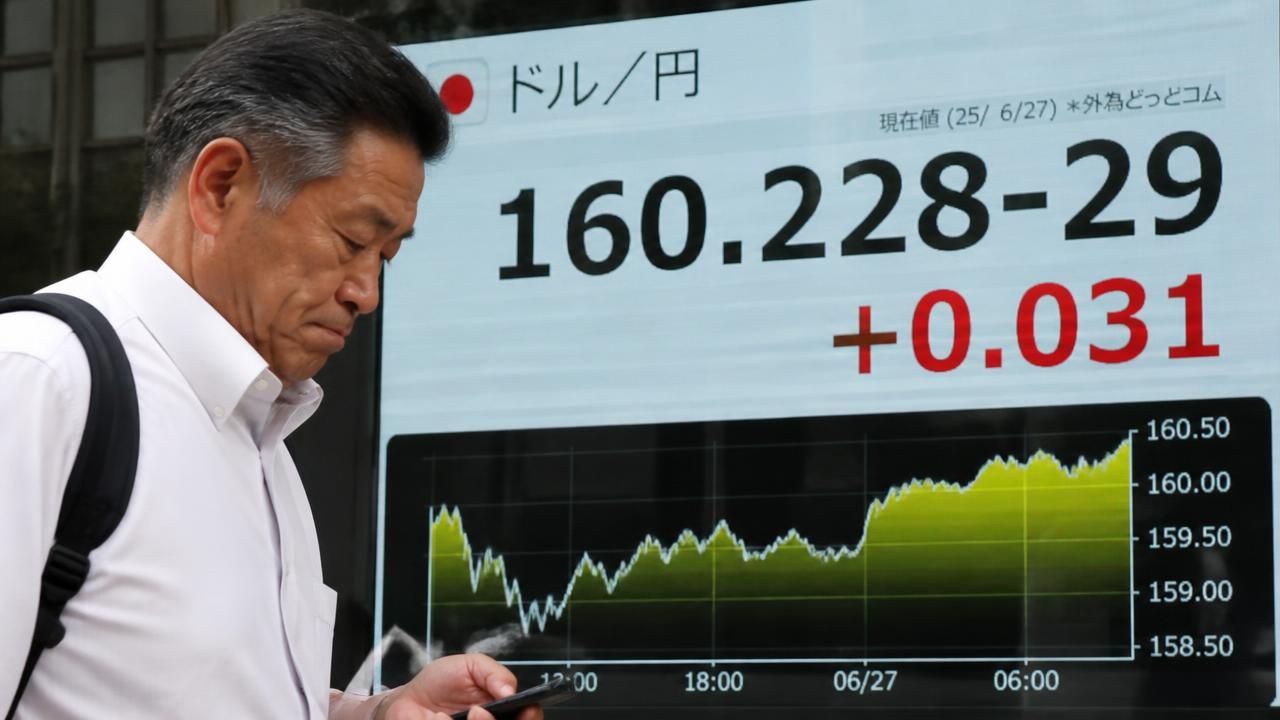
The Japanese yen has breached the psychological 160-per-dollar level, plunging to its weakest point in nearly four decades and igniting fresh speculation that Tokyo will step into currency markets to stem the slide. The move, which comes despite a historic coordinated intervention with the United States earlier this year, has left traders on edge, with thin holiday liquidity raising the specter of sudden, stealthy official action.
According to Bloomberg, the yen’s breach of 160 underscores “the Japanese currency’s vulnerability to further weakness and the heightened risk of authorities entering the market again to slow its decline.” Reuters similarly described the yen as plunging to a 38-year low, while other sources put the decline at a 40-year low, with the dollar-yen rate touching 161.7 and even 162 in some sessions.
The 160 Breach: A Line in the Sand
For months, the 160 level has been viewed as a “line in the sand” for Japanese policymakers. When the yen crossed that threshold in April 2024, the Ministry of Finance (MOF) intervened for the first time since 2022, spending billions of dollars to support the currency. That intervention, however, proved short-lived. By mid-2026, the yen is again hovering near or beyond that mark, and market participants are watching for a repeat.
“The fact that we are back at these levels despite official action shows how powerful the dollar-yield differential remains,” said a senior currency strategist at a Tokyo-based bank, speaking on condition of anonymity. “Intervention can slow the move, but it doesn’t change the fundamental drivers.”
Indeed, the core driver of the yen’s weakness is the wide interest rate gap between the U.S. Federal Reserve and the Bank of Japan (BOJ). While the Fed has kept rates relatively high to combat inflation, the BOJ has only begun a slow, cautious normalization, leaving Japanese yields far below those in the U.S. This makes the dollar more attractive to yield-seeking investors, putting persistent downward pressure on the yen.
Why the Yen Keeps Falling
The latest leg of the decline has been exacerbated by several factors. A spike in global oil prices, for example, has widened Japan’s import bill, weighing on the country’s terms of trade. As the Japan Times noted, “yen, Japanese government bonds and Tokyo stocks decline as oil prices spike” – a sign of how external shocks ripple through Japan’s economy.
Another factor is the divergence in policy expectations. In the United States, some prominent figures—such as Kevin Warsh, known for his hawkish views on inflation—have clashed with more dovish voices like Scott Bessent. According to an investinglive.com report, the yen initially popped after Warsh’s hawkish tone clashed with Bessent’s comments, but the relief was temporary as USD/JPY weakened earlier past 160. This highlights how sensitive the currency is to any hint of U.S. policy shifts.
Meanwhile, the BOJ is signaling a more cautious approach. Sources indicate that “BOJ hawk Himino” (likely a reference to Deputy Governor Ryozo Himino) is expected to speak soon ahead of a key September meeting. Markets are parsing every remark for clues on how fast the central bank will raise rates, but few expect a sharp tightening that would decisively reverse the yen’s slide.
Intervention Watch: The Game of Cat and Mouse
Traders are now glued to intervention alerts. The yen’s closeness to 160 has prompted the MOF to issue verbal warnings, and Japan’s top currency diplomat has said authorities are watching “with a strong sense of urgency.” The investinglive sources suggest that “Japan intervenes to defend yen and warns of further action over Golden Week,” a reference to a period of Japanese holidays when market liquidity is notoriously thin.
Thin liquidity is a double-edged sword. It makes it easier for the MOF to move the market with a relatively modest intervention, but it also amplifies volatility. As one trading desk put it, “Tokyo holiday thins liquidity, a recipe the Ministry of Finance likes!” The logic: with fewer participants, any intervention can have a larger impact per dollar spent, but it also risks triggering disorderly moves if not carefully timed.
The recent holiday-period intervention was reportedly coordinated with U.S. officials, a rare show of cooperation. However, according to CNBC, that “historic U.S.-Japan intervention has failed to halt the yen's slide.” The failure underscores the limitations of currency intervention in a world of massive capital flows and deep financial markets.
What the Analysts Are Saying
Opinions differ on what happens next. Some see the 162 level as a critical resistance point. A tradingnews.com forecast notes that “Dollar-Yen Near 161.7 at 40-Year High as Fed-BoJ Gap Stays Wide” and warns that “162 Resistance, Intervention Risk Builds.” Another forecast suggests that if U.S. yields break above 4.5%, the yen could slide further to 160 and beyond. These technical levels align with broader market sentiment.
“The market is testing Japan’s resolve,” said a foreign exchange analyst at a global bank. “Every push toward 160 invites the risk of intervention, but if authorities don’t act, the yen could fall to 170 or even higher. The longer they wait, the more dramatic the response might be.”
Not everyone is convinced intervention is the answer. “We saw in 2022 and 2024 that intervention alone doesn’t reverse a trend,” another analyst argued. “Without a real change in monetary policy—specifically, a meaningful BOJ rate hike—the yen will remain under pressure.”
Impact on Japan’s Economy and Everyday Life
For ordinary Japanese citizens, the weak yen is a mixed blessing. It boosts profits for exporters like Toyota and Sony, and it makes Japanese stocks more attractive to foreign investors. But it also raises the cost of imported fuel, food, and raw materials, squeezing households that are already facing inflation. According to Tokyo Weekender, the yen hitting ¥162 has “a 39-year low” and has significant consequences for travelers and residents alike: overseas trips become more expensive, while Japan becomes a bargain destination for tourists.
The government is caught in a dilemma. A weaker yen helps support the export-driven economy, but it also fuels inflation and erodes living standards. That tension explains why officials have been hesitant to intervene too aggressively, even as they warn of “excessive” moves.
Looking Ahead
The next catalyst is the BOJ’s September meeting, where policymakers will decide on the future path of interest rates. If the BOJ delivers a hawkish surprise, the yen could rebound. If not, traders expect further depreciation and more intervention drama.
“We are in a state of high alert,” said a currency trader in Singapore. “The 160 level is not just a number—it’s a battleground. Both the MOF and the market know that once it breaks decisively, the rules of the game change.”
Until then, investors are parsing every data point, every official comment, and every technical level for clues. The yen’s fate is tethered to forces beyond Japan’s control—from U.S. interest rates to oil prices to the mood of global markets. For now, the world watches, and Japan treads carefully.