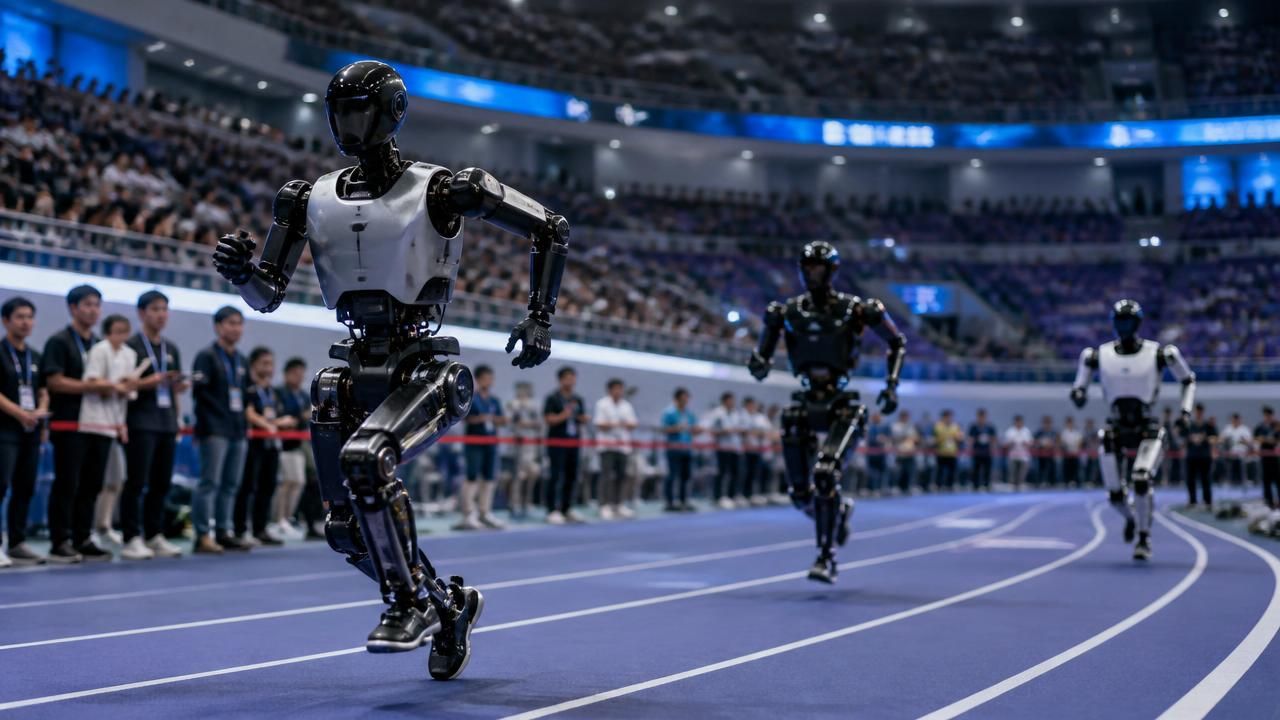
Beijing’s National Speed Skating Oval, built for the 2022 Winter Olympics, became an unlikely proving ground this week as the second World Humanoid Robot Games drew to a close. For five days, humanoid machines sprinted, jumped, boxed, and stumbled before crowds that cheered every fall as much as any finish line. The event offered a dazzling showcase of China’s ambitions in embodied artificial intelligence — and a stark reminder of how far the technology still has to go.
The Spectacle in Beijing
The games featured robots from leading Chinese companies and research institutions, including Tiangong, Unitree, and even smartphone maker Honor. The highlight reel was equal parts impressive and absurd. A Tiangong Ultra robot reportedly broke the event’s 100-meter and high-jump records, while another Tiangong machine smashed its own 400-meter record, outpacing a South African rival. Unitree, meanwhile, unveiled a robot that the company claims can run faster than Usain Bolt’s top speed, drawing headlines ahead of its planned IPO.
But the spectacle also delivered the kind of viral failures that robotics enthusiasts have come to love. One Honor-built robot lost a leg mid-sprint, collapsing in a shower of sparks. Another crashed into a wall during a training session, with onlookers describing sparks flying everywhere. As The Verge noted, the games did not disappoint in the drama department.
These theatrics are part of a broader narrative. China is positioning humanoid robots as a flagship technology in its race against the United States. The country is already testing a humanoid robot half marathon, with a full-scale event planned for 2026. According to Global Times, a test run was recently held to validate safety and logistics. The message is clear: Beijing wants to lead the world in embodied AI.
Breaking Human Records, or Just Headlines?
Several outlets reported that Chinese robots outperformed human benchmarks at the games. MSN proclaimed that a humanoid robot outran Usain Bolt’s 100m world record, while Yahoo News reported that Chinese robots “smashed human records” in the sprint and high jump. However, these claims deserve scrutiny. The robots were competing in an optional boxing routine, not a standard 100m dash against humans. In reality, Tiangong Ultra's times may have exceeded Bolt’s average speed over a short distance, but not in a comparable, wind-legal sprint. The headlines reflect a marketing-savvy industry more than an actual athletic breakthrough.
Even so, the progress is undeniable. The robots at this year’s games were faster, more stable, and more autonomous than last year’s. Some completed courses without external control, a key hurdle for real-world deployment. As Bloomberg put it in a video segment, humanoid robots are putting China ahead in the tech race.
The Reality Check: Factory Floors vs. Flashy Demos
Yet the biggest question looming over the celebration is simpler: can these robots do useful work? A Reuters headline captured the paradox: “China can build kung fu-fighting robots. But it can't get them to do factory work.” Analysts at CNBC echoed that sentiment, tempering hopes for near-term commercial use. While the athletic feats are impressive, humanoid robots remain far too slow, fragile, and expensive to replace humans in most industrial settings.
“The gap between what you see in a stadium and what you need on a factory floor is enormous,” said one industry analyst cited by CNBC. “These robots are still novelty acts.” A report from Devdiscourse went further, framing the racetrack as a test of industrial readiness: robots may win sprints, but they struggle with complex manipulation tasks like assembly or logistics.
The US-China Robotics Race
The geopolitical stakes are high. The games unfolded against a backdrop of escalating US-China rivalry over technology. The New York Times reported on U.S. fears of becoming dependent on Chinese technology. The Economist analyzed how China is running a different AI race, one focused on physical, embodied systems rather than purely digital models. Meanwhile, venture capital firm Andreessen Horowitz published an impassioned essay titled “America Cannot Lose the Robotics Race,” warning that China’s state-backed industrial policy gives it a crucial edge.
Others pushed back. A piece in The Wire China argues that Beijing is actually falling behind at the “sharp end” of the global robot race, particularly in high-end components and software. The BBC took a balanced view, suggesting China and the U.S. each lead in distinct AI domains — China in physical robotics, the U.S. in foundational models and chips — and that either could still pull ahead.
The Pentagon’s Robotics Push
The race extends beyond civilian use. Fox News reported that the U.S. Army is developing an onboard AI “brain” for autonomous battlefield robots, while the Times of India noted that robot dogs — originally a U.S. innovation — are now being built at scale in China. This has fueled concerns in Washington about a new arms race in which software and hardware converge.
Industry and Investment: From Alibaba to Unitree
The commercial landscape is shifting rapidly. Unitree, one of China’s most prominent humanoid robot makers, is preparing for an IPO, according to MSN. Alibaba has released its most powerful AI models for robots to date, challenging Nvidia’s dominance in the agentic AI space. Huawei is promoting a 5G-A, AI, and robotics ecosystem that it says will power the next wave of industrial automation. Even Tesla is accelerating mass production of its Optimus robot, prompting analysts to ask whether the “EV moment” for humanoid robots is finally arriving.
Yet the economics remain stubborn. The Christian Science Monitor highlighted China’s “embodied” push for AI dominance, but also noted that consumer robots are still far from becoming reliable home helpers. One viral video showed a Sophia robot’s Instagram plea falling flat as rivals race ahead — a symbolic reminder that hype does not equal utility.
The Road Ahead
China has made no secret of its ambitions. State media via Xinhua framed the push as part of a “people-centered digital future,” while an op-ed in China Daily declared that the country is “pushing ahead in humanoid robotics lead.” The government has funded research institutes, subsidized robot startups, and built test facilities like the World Humanoid Robot Games. The result is a pipeline of prototypes that are becoming more capable each year.
But the chasm between demo and deployment is still the defining feature of this industry. For every robot that breaks a record, another loses a leg or slams into a wall. The robots that triumph in Beijing are not yet ready to clean your home, let alone staff a warehouse.
As the global race accelerates, the real competition is not about who can run the fastest 100 meters — it’s about who can make these machines reliable, affordable, and useful enough to transform the economy. On that front, neither China nor the United States has yet won. But if the games in Beijing are any indication, China is sprinting hard.