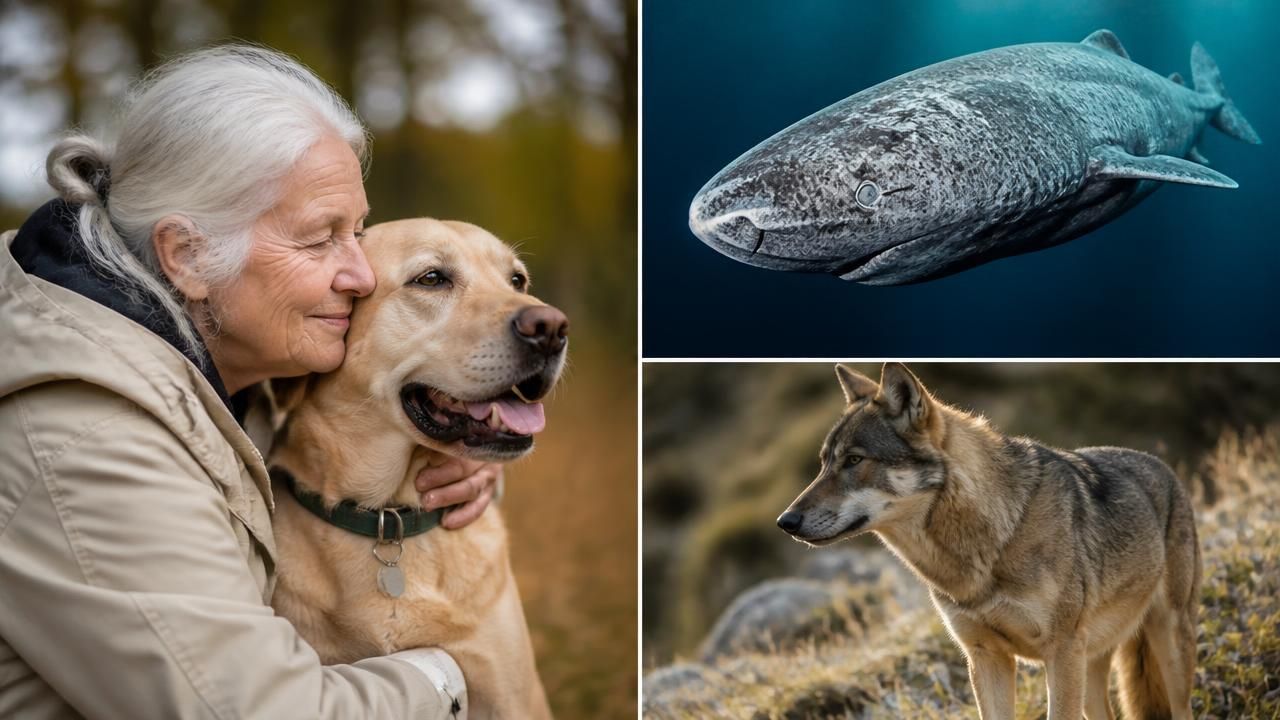
What can a 400-year-old shark, a labrador retriever, and an ancient wolf ancestor tell us about why we age? More than you might think. In a wave of new scientific research, animals are emerging as powerful witnesses to the biological mechanisms of aging—and, surprisingly, to the deep connections we share with them.
Dogs as Metabolic Mirrors
The Dog Aging Project, a large-scale longitudinal study, has identified metabolic "fingerprints" in dog blood that are linked to longer or shorter lifespans. According to ScienceDaily, these patterns are "remarkably similar" to those seen in humans. The findings suggest that dogs, which share our environments and often our diets, may be ideal models for studying aging. The researchers point to key processes: metabolism, inflammation, and cellular stress.
"These metabolic fingerprints could offer clues about the biological processes that drive aging," the study notes.
Because dogs live shorter lives than we do, they allow scientists to observe aging in real time, compressing decades of human health into a few years.
Ancient Companions, Shared Fates
But the link between dogs and humans is not just physiological—it's ancient. A new analysis of ancient canid DNA, covered by Inverse, reveals that early dogs and humans "shared a surprising bond." The research suggests that domestication may have shaped not only canine behavior but also the way both species co-evolved in response to changing environments. This bond may have even influenced patterns of disease and longevity.
The analysis highlights how our shared history with dogs goes back thousands of years, and that the intimacy of that relationship could have biological consequences for both species.
The Human Effect on Animal Aging
In a separate large-scale study, scientists tracked 4,500 animals and found a surprising human effect, as reported by ScienceDaily. While the full details remain under wraps, the tracking data hints that human activity—ranging from urbanization to domestication—may be altering the natural aging processes of animals. This could have implications for conservation and public health, revealing how human-induced environmental changes ripple through the animal kingdom.
The sheer scale of the study, involving thousands of animals across multiple species, offers a rare global view of ecological and physiological change.
Sharks That Barely Age
At the other end of the spectrum, the Greenland shark can live up to 400 years, and its eyes "barely seem to age," according to ScienceDaily. Scientists studying these deep-sea animals are looking at the eye lenses to uncover genetic and metabolic adaptations that enable extreme longevity. The shark's slow growth and remarkable tissue resilience suggest that cellular repair processes can be fine-tuned over centuries.
Understanding how these sharks escape the typical wear-and-tear of aging could inspire new therapeutic approaches for age-related diseases in humans.
Implications for Human Longevity
Together, these studies paint a profound picture: aging is not a fixed, inevitable process, but a biological program that varies dramatically across species. Dogs give us a close companion model that mirrors our own metabolic aging; ancient DNA shows that our bond with them is embedded in our evolutionary history; tracking thousands of animals reveals the impact of our presence on their lifespans; and sharks prove that nature can slow aging to an almost negligible crawl.
As scientists integrate these perspectives, one message is clear: to understand human longevity, we must look beyond our own species. Whether it's a dog's blood, a shark's eye, or a wolf's genome, the animal world is holding up a mirror to our own biological fate.