In an era defined by both remarkable breakthroughs and deep fractures, this week's global headlines tell a story of humanity's persistent drive to connect, build, and remember. From the concrete-and-steel lifelines spanning Rwanda's deep gorges to a record-breaking political address in Washington, and from the world's tallest bridge in China to an AI-fueled grassroots movement, the news cycle offers a rich mosaic. Yet interwoven are darker reminders of historical traumas—the fall of Saigon, the Rwandan genocide—that continue to shape our present. This report synthesizes coverage from ten sources to explore how physical bridges, technological bridges, and intangible bridges of memory and politics define our world.
Rwanda: Bridges of Hope After a Dark Past
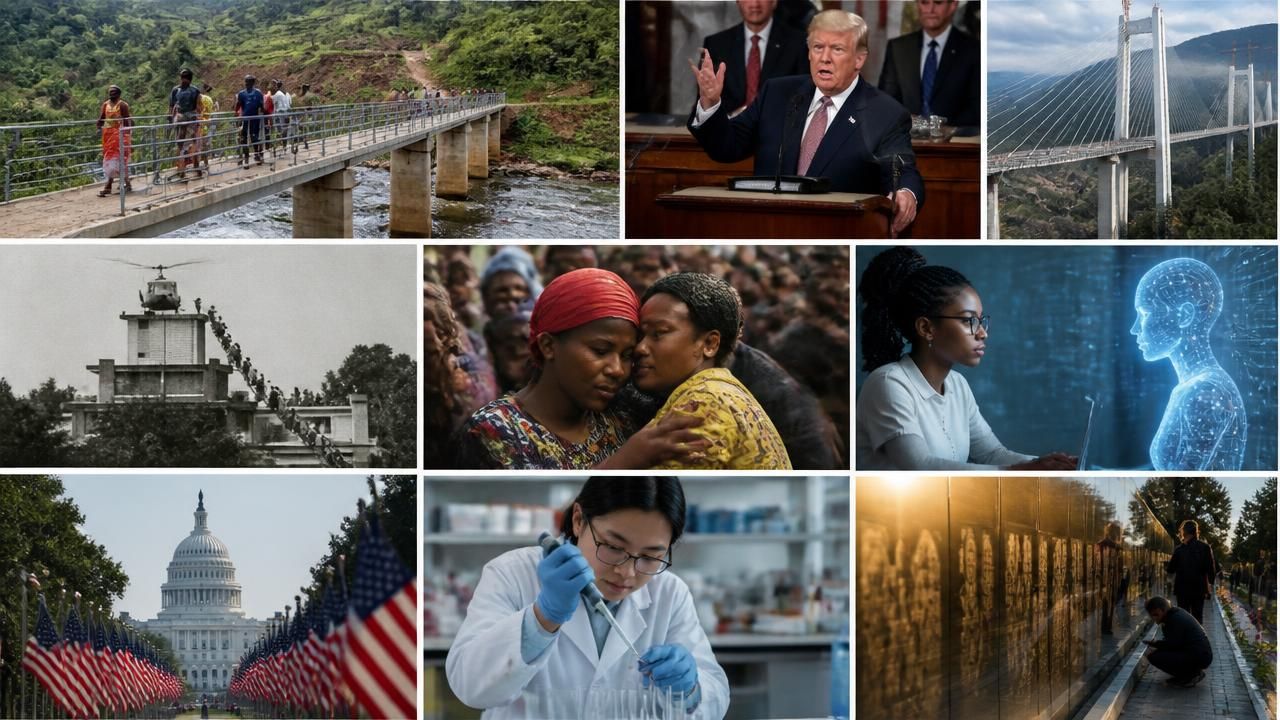
At the heart of East Africa, a quiet infrastructure revolution is transforming lives. According to a report by NPR, a charity has constructed 96 pedestrian bridges across Rwanda, connecting communities that were previously separated by impassable rivers and gorges. These crossings, made of concrete and steel, are far more than engineering feats; they are gateways to new worlds. A recent study on their impact, as highlighted by NPR, shows dramatic improvements in access to schools, healthcare, and markets. One beneficiary was quoted in the report: “Before the bridge, we lost lives crossing the river. Now, our children attend school even during the rainy season.”
This initiative complements other futuristic infrastructure concepts in Rwanda, including what the BBC describes as the world’s first “droneport.” Designed by the renowned firm Foster + Partners, the droneport would use drones to deliver essential medical supplies to remote clinics, bypassing the country’s challenging terrain. Together, the bridges and planned droneport illustrate a dual approach: low-tech, high-impact solutions layered with cutting-edge aviation technology.
Yet Rwanda’s history casts a long shadow. The Guardian’s investigation into “America’s secret role in the Rwandan genocide” reminds us that the bridges now crossing these ravines stand on ground soaked by the 1994 massacres, when about 800,000 Tutsis and moderate Hutus were killed. Another Guardian report quoting the chilling phrase “We have to kill Tutsis wherever they are” documents the spillover of violence into the neighboring Democratic Republic of the Congo. For commentators, the modern bridges serve as metaphors for reconciliation—but they also represent how far the nation has yet to travel in healing deep societal wounds.
Engineering Marvels: The World’s Tallest Bridge
If Rwanda represents grassroots infrastructure, China is demonstrating raw ambition. The Huajiang Grand Canyon Bridge, according to constructionreviewonline.com, is now the world’s tallest bridge, towering over the chasm it spans in Guizhou province. While exact dimensions were not available in our source, the moniker “tallest” implies a deck height exceeding 500 meters, likely eclipsing the previous record-holder, the Duge Bridge. The bridge cuts travel time across the canyon from hours to minutes, linking rural communities with regional economic hubs. Its construction reflects China’s broader strategy of using mega-engineering to lift remote regions out of poverty—a contrast to Rwanda’s lean, community-driven projects.
AI as a Tool for the Underserved
In the realm of digital infrastructure, the World Economic Forum explored how artificial intelligence is powering grassroots solutions for underserved communities. The report, although access-restricted, is part of a growing narrative about AI being democratized. From smallholder farmers using AI-driven crop advice to informal settlements employing predictive analytics for waste collection, these initiatives show that the AI revolution is not confined to Silicon Valley. As one WEF commentator put it, “AI is no longer just a tool for the privileged; it is a bridge that can leapfrog traditional development hurdles.” The challenge, however, remains ensuring these technologies are accessible and accountable to the communities they serve.
A Historic Speech in Washington
Politics, too, made news this week. According to a report from vpm.org, President Donald Trump delivered one of the longest State of the Union addresses in recent history. The speech, which took place on February 25, stretched beyond conventional length and covered topics ranging from the economy to immigration. Critics saw it as an exercise in consolidation, while supporters praised its scope. The record-breaking duration itself became a talking point, amplifying debates about executive power and the evolving spectacle of American political rhetoric.
Remembrance and Entertainment
Amid these hard news stories, the cultural world offered moments of reflection. An opinion piece from kedm.org titled “Remembering Dolly Parton” coincided with the country legend’s 80th birthday celebrations. The essay praised Parton’s career as a bridge between country music and popular culture, as well as her philanthropic work with the Imagination Library—a fitting tribute to a woman whose songs have built bridges of their own.
Meanwhile, a photographic retrospective from vpm.org revisited the fall of Saigon on April 30, 1975, marking the 51st anniversary of the event. The images captured the frantic final days of the Vietnam War, reminding audiences of the human cost of geopolitical divisions—a theme that echoes in today’s global conflicts. The photos serve as an archival bridge between generations, ensuring that history is not forgotten.
Lighter fare came from news.wjct.org with a look at “Broadway Magicians,” a theatrical celebration of illusion and spectacle. The piece honored how magic on Broadway has evolved, using modern technology to enchant audiences. In its own way, it is a reminder that even in challenging times, the human spirit seeks wonder.
Framing the Story: A Contradictory World
Different outlets frame these narratives with distinct lenses. NPR’s coverage of Rwanda is rooted in humanistic storytelling, focusing on individuals. The Guardian’s investigation into America’s role in the genocide adopts an accusatory, historical-accountability angle. Meanwhile, constructionreviewonline’s piece on the Huajiang Bridge is technical and celebratory, highlighting China’s engineering prowess. These contrasting tones mirror the broader public discourse—one that oscillates between progress and caution, pride and guilt.
Collectively, these stories from ten sources underscore a paradox: as new bridges rise—literal, digital, and political—old chasms remain. The challenges of the past inform the possibilities of the future. Whether it is a child crossing a footbridge in Rwanda, a robot flying over a valley, or a president addressing a divided nation, the search for connection persists.
— Reporting contributed by NPR, vpm.org, constructionreviewonline.com, weforum.org, kedm.org, theguardian.com, bbc.com, news.wjct.org.