In a series of moves that span the country’s legal past and its disputed present, the Trump administration is pushing the boundaries of presidential authority with a striking blend of legal innovation and historical revisionism. From a Civil War–era maritime court being quietly revived to seize Iranian oil, to a Supreme Court ruling that bolsters Republican-drawn voting maps in Texas, to a contentious ceremony at Arlington National Cemetery that sparked debate over the meaning of American history, the actions form a coherent pattern: an executive branch intent on expanding its own power and remaking the national narrative to suit its ends.
A Dormant Court Awakens
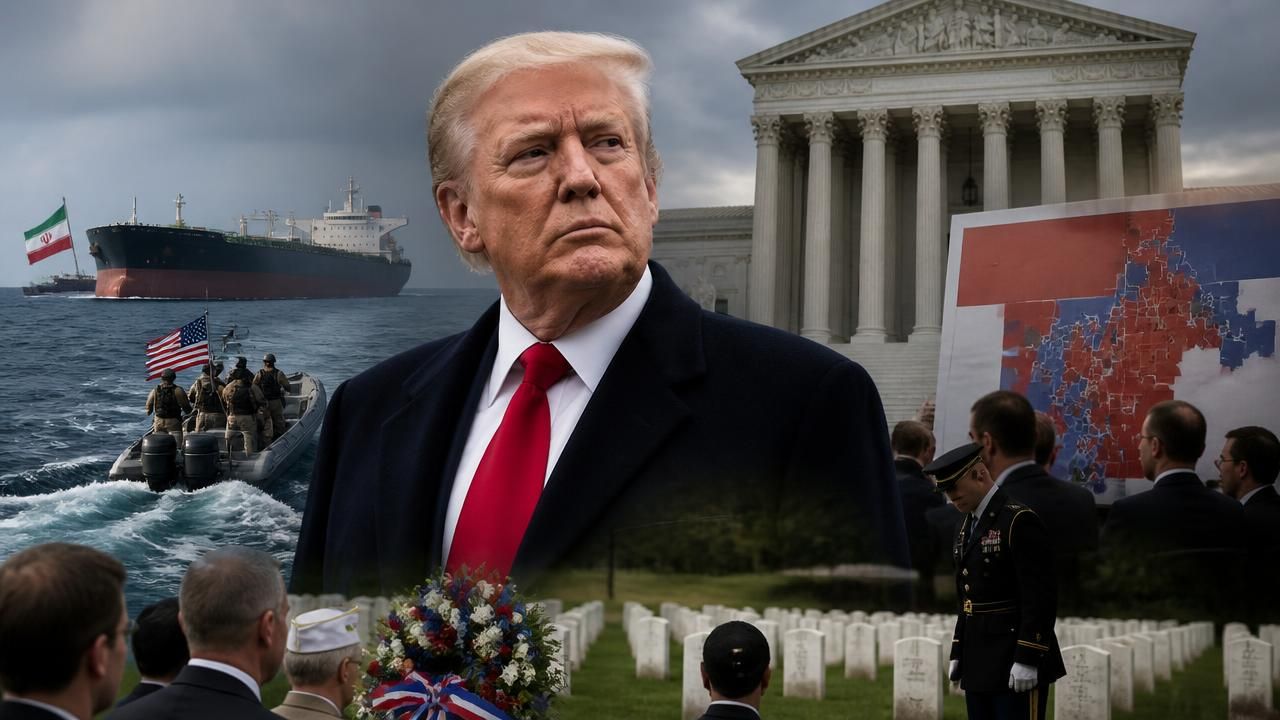
Bloomberg Markets reported that the Justice Department is preparing to activate a long-dormant maritime war court—specifically, the traditional Admiralty prize court—to streamline the military capture of Iranian oil tankers. The move, described by three people familiar with the plans, would allow the U.S. Navy to seize cargos under a legal framework that dates to the 19th century, when such courts were used to adjudicate captures of enemy ships during wartime. The revival of this mechanism is a deep historical reach by an administration that has repeatedly shown its willingness to dust off obscure legal authorities to achieve its foreign policy and economic goals.
Prize courts were a mainstay of the Civil War era, when the Union used them to confiscate Confederate vessels and their cargo. The dormant status of such courts in modern times means their activation would likely face untested legal challenges, but proponents argue it provides a more streamlined route than conventional sanctions or piracy statutes. Critics, however, see it as an end-run around due process and a further concentration of power in the executive—both themes that resonate across the other developments this week.
Supreme Court Reinforces the President’s Agenda
In a separate but equally consequential legal victory for the administration, the Supreme Court revived a pro-Republican Texas voting map that was sought by President Donald Trump. The ruling, reported by Reuters, overturns lower court decisions that had struck down the map as discriminatory. The court’s decision effectively shields the Texas congressional districts from further pre-election challenges, a win that could help solidify Republican control of the House of Representatives in the upcoming cycle.
Voting rights advocates decried the ruling as another setback for racial minority voters, while conservative legal scholars framed it as a vindication of legislative prerogative. The case is one of several in which the president’s influence—through judicial appointments and amicus briefs—has shifted the nation’s legal landscape toward his policy preferences. Together with the prize court revival, it suggests an administration that is winning legal battles not just through conventional means, but by reshaping the very forums in which the law is interpreted.
The Battle Over Memory and Arlington
While these court rulings unfold in Washington, a different kind of conflict is being waged over American history itself. In his Guardian opinion piece, Sidney Blumenthal bluntly argues that “Trump wants to rewrite American history. Maybe he should learn it first.” The essay contends that the president’s attempts to control the remembrance of events like the Civil War and Reconstruction are not mere nostalgia but deliberate political weapons designed to justify a more autocratic and exclusionary vision of the country.
Blumenthal’s critique finds a legal mirror in a recent analysis by law professor Steve Vladeck, titled “Arlington, the Lees, and the ‘Officer Fiction.’” The article, published on his substack, examines the historical legal fiction underlying the government’s original seizure of Arlington National Cemetery from the family of Robert E. Lee. Vladeck argues that this fiction—which treated Lee’s absence as a legal waiver of property rights—presaged a pattern of executive overreach that has resurfaced in modern controversies over presidential authority. By reaching back to the 19th century, both Blumenthal and Vladeck highlight a thread: the White House is actively curating a selective memory of American history to normalize power grabs that might otherwise be unthinkable.
The Arlington controversy itself, which erupted over a wreath-laying ceremony and allegations of political activity, became a proxy for broader disputes about how the nation honors its past and who gets to define it. The administration’s critics charge that such gestures are part of a coordinated effort to elevate Confederate heritage and diminish the legacy of civil rights, while supporters insist they are simply paying respect to all American soldiers. The starkly different frames—one sees a sacred site desecrated, the other a culture war victory—illustrate how deeply the nation is divided over the very facts of its history.
Can Anyone Stop Him?
CNN’s analysis cuts to the heart of the matter with the question: “As Trump aims to expand presidential authority, can anyone stop him?” The piece examines the institutional checks—Congress, the courts, the bureaucracy, and public opinion—that have so far proven porous in the face of executive assertions of power. The revival of prize courts and the Supreme Court’s voting map decision both demonstrate that the judiciary, once thought to be a bulwark against overreach, has at times become a partner in consolidation. Meanwhile, Congress has shown little appetite for exercising its oversight powers, and the civil service has been increasingly hollowed out by political appointees loyal to the president.
The convergence of these stories is not coincidental. They reflect a coordinated strategy to use the most arcane legal tools and the most resonant historical symbols to cement a new model of the presidency—one that is less constrained by precedent, less accountable to the other branches, and more reliant on the force of will and narrative control. Whether this strategy succeeds may depend on the resilience of a legal system that was itself forged in earlier crises of executive ambition.
“Trump wants to rewrite American history. Maybe he should learn it first.” — Sidney Blumenthal, The Guardian
For now, the administration’s opponents are left to mount a piecemeal resistance, challenging each maneuver as it arises. But the pace of change is staggering: a Civil War court, a Supreme Court ruling, and a historian’s reckoning all arriving in the same fortnight suggests a presidency that is accelerating its own mythology faster than the country can process its meaning.
What the Different Frames Reveal
The five sources that informed this article each bring a distinct perspective. Bloomberg emphasizes the legal novelty and strategic calculation behind the prize court plan. Reuters focuses on the immediate political impact of the Texas voting map decision. Steve Vladeck’s substack digs into the doctrinal roots of executive authority. Sidney Blumenthal’s Guardian op-ed is a call to remember history accurately. And CNN’s analysis situates these events in the larger question of institutional resistance. Together, they paint a picture of an administration that treats the law as an instrument, history as a weapon, and power as an end in itself.
- Legal maneuvering: The revival of prize courts and the Supreme Court’s voting map ruling are clear attempts to bend existing structures to presidential will.
- Historical manipulation: The Arlington controversy and the broader reframing of Civil War history serve to legitimize a more centralised, aggressive executive.
- Institutional fragility: Congress and the judiciary have, so far, largely failed to serve as effective checks on this expansion.
- Public narrative: The battle over history is not academic; it shapes how Americans perceive the legitimacy of presidential actions.
As the Trump administration continues to wield these tools, the stakes extend beyond any single policy victory. The question posed by CNN—and echoed by scholars and critics alike—is whether the Republic’s ancient safeguards can adapt to a president who is as willing to use a 150-year-old court as he is to refight the Civil War in the court of public opinion. The answer, still unresolved, will define the future of American governance for decades to come.