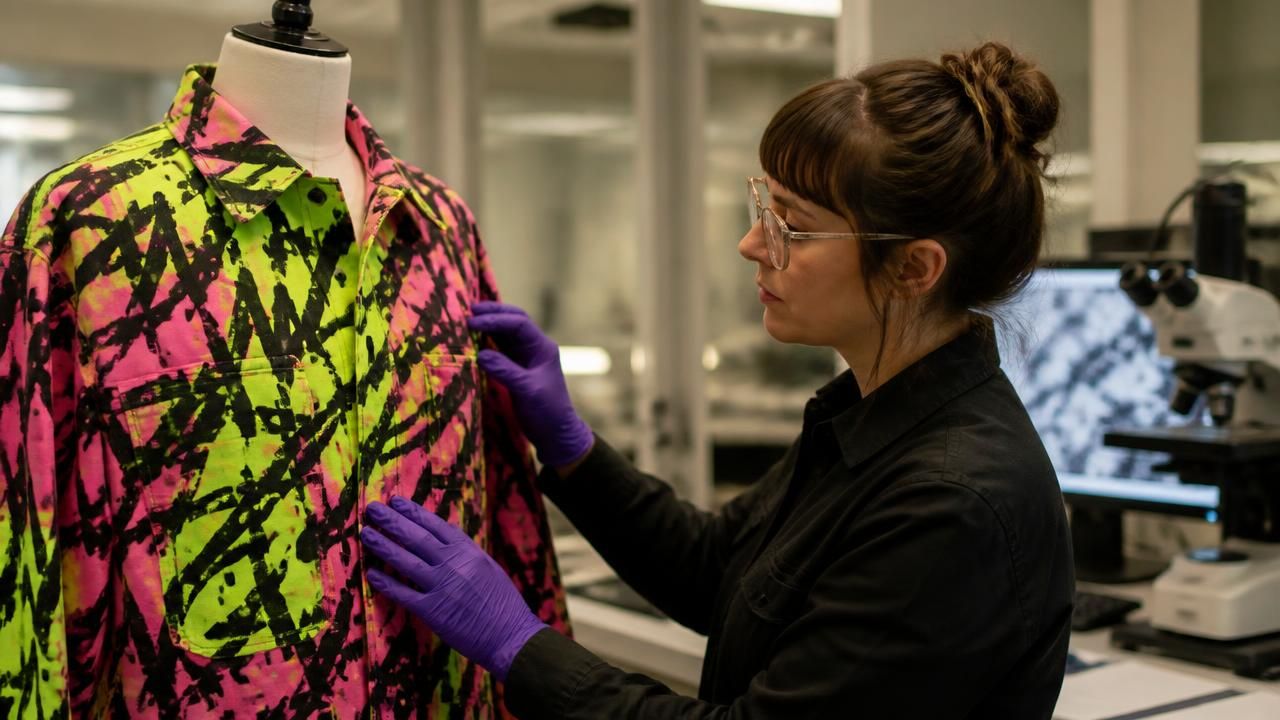
In the pantheon of fashion designers who blurred the lines between street art and high style, Stephen Sprouse stands out as a true visionary. His graffiti-splashed creations, worn by icons like Debbie Harry and celebrated by Andy Warhol, were unmistakable for their electric Day-Glo palette. But these radiant colors are under threat—not from changing tastes, but from the relentless passage of time. At this week's American Chemical Society (ACS) meeting in Chicago, researchers from the Indianapolis Museum of Art at Newfields presented new findings on the chemical behavior of the pigments that made Sprouse's work so vivid, and what can be done to preserve them for future generations.
Stephen Sprouse: A Punk Palette
Stephen Sprouse's rise in the mid-1980s was meteoric. His collections mixed 1960s-inspired silhouettes with raw graffiti prints and neon-bright colors, earning him a devoted following that included some of the era's biggest cultural figures. The Indianapolis Museum of Art's textiles collection holds several examples of his work, each one a time capsule of an exhilarating creative moment.
Yet those same garments are now physical evidence of a chemical puzzle. The phosphorescent and fluorescent pigments Sprouse used were cutting-edge at the time, but they are not permanent. Exposure to light and environmental factors gradually alters their molecular structure, causing the colors to dull.
The Science of Glowing Materials
Glow-in-the-dark chemistry has a storied history. Medieval alchemists called such materials "phosphors," meaning "light bringers." These substances work by absorbing light energy and slowly emitting it over time. The phenomenon is closely related to fluorescence, which is what gives Day-Glo paints their signature intensity. In fluorescence, ultraviolet light is absorbed and almost instantly re-emitted as visible light, creating a brilliant optical effect.
The link to nuclear physics is a footnote to history: Henri Becquerel's discovery of radioactivity in 1896 came from his studies of phosphorescent uranium salts. That chance observation opened an entirely new field of science. Today, understanding how these materials age is the focus of a new generation of researchers.
Conservation at a Crossroads
For conservators, preserving Sprouse's work is a race against decay. The goal is to understand exactly which pigments were used, how they interact with their fabric substrate, and what environmental factors accelerate their breakdown. Equipped with that knowledge, conservationists can create storage and display conditions that significantly slow the aging process, and potentially develop treatments to revive faded colors.
The project is a model of interdisciplinary collaboration, bringing together expertise from analytical chemistry, art history, and textile conservation. By analyzing microscopic samples of Sprouse's garments, researchers are beginning to map the pigment compositions and their degradation pathways.
An Ecosystem of Care
Sprouse's designs are not the only light-based artworks facing such challenges. At the Art Institute of Chicago, for example, conservators have been investigating the "ecosystem of care" around neon artworks—pieces that rely on gas discharge tubes to glow. These works pose unique preservation questions, from the stability of the glass and electrodes to the color temperatures of the gases. The ACS presentation in Chicago appeared amid a broader conversation about the sustainability of media that use light as a primary material.
The convergence of these efforts signals a growing awareness: as contemporary art increasingly embraces ephemeral materials, collection care must evolve accordingly. Museums are no longer just preserving objects; they are preserving experiences and the sensory impact of light in real time.
Implications Beyond the Museum
This research is not confined to display cases. Fluorescent pigments are ubiquitous in consumer products, from sportswear to safety gear, as well as in neon signage and digital displays. A deeper understanding of their molecular behavior could lead to more durable formulations, reducing waste and improving sustainability across these industries.
The findings presented at ACS represent a stepping stone toward predictive models. If a conservator knows how a particular pigment reacts to light, temperature, and humidity, they can simulate aging and test interventions. The team at Newfields is now building a spectral database of historical pigments, a resource that could become a standard reference for art conservation worldwide.
What’s Next
The immediate next step is to expand the study to more pieces in the collection and to collaborate with institutions that hold similar works. Sharing data across museums will accelerate the learning curve and ensure that the preservation of these fragile treasures is not left to chance.
In the long run, the goal is to develop reversible treatments—methods that can restore the glow without damaging the original fibers. That would be a game-changer for the field, turning conservation from a holding action into a restorative practice.
A Future That Glows
Stephen Sprouse's art was never meant to be dim. It was an explosion of color and energy, a rebellion against the monochrome. Thanks to the meticulous work of chemists and conservators, that vibrancy may yet shine on. The hidden chemistry behind glow-in-the-dark art is stepping into the light, and with it, a legacy that refuses to fade.