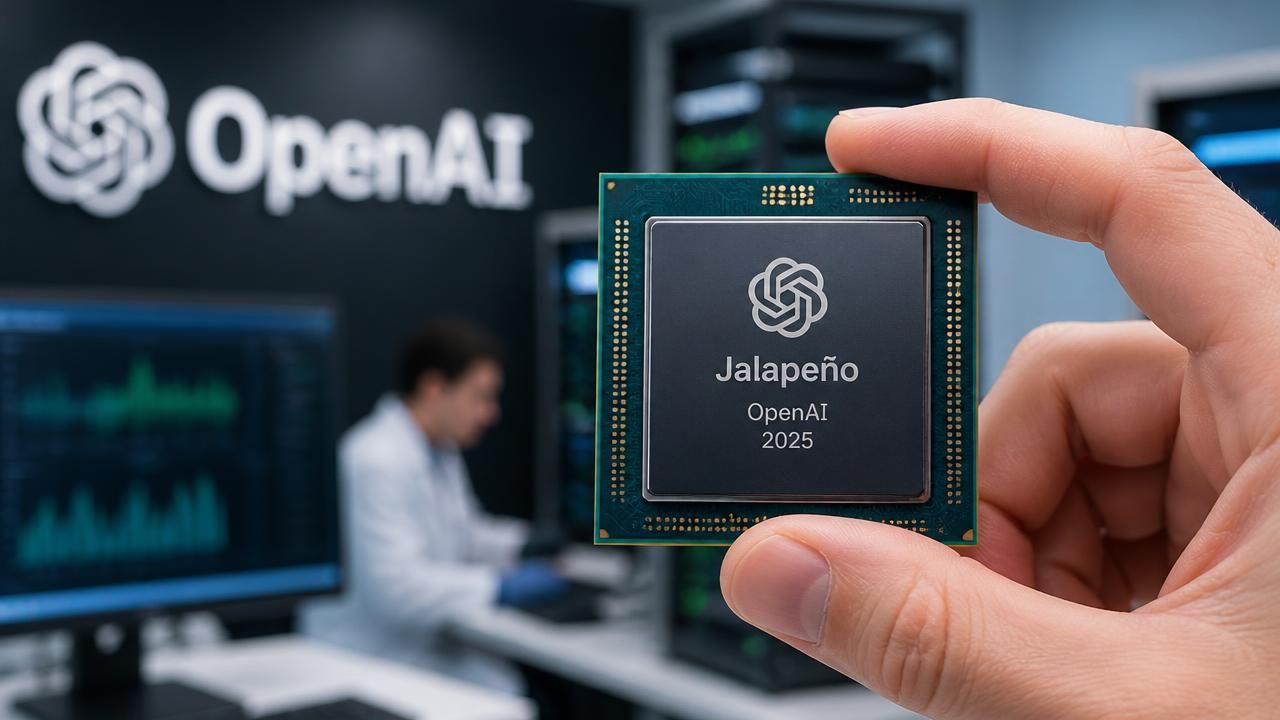
OpenAI has fired a bold salvo in the AI hardware wars. On Tuesday, the company unveiled its first custom AI processor, Jalapeño, a chip designed specifically for AI inference—the process of running trained models to generate responses, power agents, and execute tasks. Developed in partnership with Broadcom, Jalapeño is an Application-Specific Integrated Circuit (ASIC) that OpenAI claims outperforms Nvidia's latest systems on both speed and efficiency, marking a direct challenge to the GPU giant's dominance in the AI compute market.
A New Kind of Chip for a New Phase of AI
Jalapeño was first introduced in June, but the new results—published in a blog post and briefed to reporters—represent the first public benchmark data. According to OpenAI, the chip offers "the best of both worlds" by avoiding the traditional trade-off between latency and throughput. OpenAI's hardware vice president, Richard Ho, told reporters that Jalapeño delivers lower latency (faster individual responses) and higher throughput (more total work completed) simultaneously, a feat that typical AI accelerators struggle to achieve.
“We’re seeing industry-leading speed and efficiency in AI inference,” Ho said during the briefing. “This is a pivotal milestone for scaling next-generation large language models.”
The chip is an ASIC, meaning it is custom-built for a narrow but crucial task: running AI models after they have been trained. Unlike Nvidia's general-purpose GPUs, which handle both training and inference, Jalapeño is optimized for the growing volume of real-time AI queries, chatbot interactions, and autonomous agent deployments. This specialization is what allows it to claim such dramatic gains.
Benchmark Claims: Outperforming Nvidia's Blackwell
While OpenAI has not released raw benchmark numbers, the company says Jalapeño outperformed Nvidia's GB300 (a member of the Blackwell family) on power efficiency and response speed in internal tests. Several headlines from outlets including Bloomberg, The Verge, and NewsBytes captured the essence: “OpenAI Claims Its New Chips Can Outperform Nvidia Processors in Tests.”
The claims have resonated across the tech world. Some industry watchers, like the Chinese outlet 36Kr, framed the chip as a “spicy” response to Nvidia’s dominance, questioning whether AI-designed silicon could rival Blackwell in just nine months of development. Others, such as The Street, noted that OpenAI has effectively “built a chip to cut Nvidia out of one job” — specifically the inference workload, which is becoming the most expensive and critical part of AI deployment.
Why This Matters: The Battle for AI's Infrastructure
Nvidia currently controls an estimated 80–95% of the AI accelerator market, and its GPUs have become the industry standard for training and inference. But as AI models grow larger and inference costs balloon, major players are looking to reduce their dependence on Nvidia by designing custom silicon. OpenAI joins a growing list—including Google (TPU), Amazon (Trainium/Inferentia), Microsoft (Maia), and Meta (MTIA)—that are investing heavily in in-house chips.
Jalapeño’s significance extends beyond technical specifications. It is a strategic move to cut costs, secure supply chains, and gain leverage in negotiations with Nvidia. OpenAI, which reportedly spends enormous sums on cloud compute, faces mounting pressure to make AI economically sustainable. A chip that delivers more compute per watt and per dollar could be a game-changer.
The partnership with Broadcom is also telling. Broadcom is a major player in custom silicon design, and working with OpenAI signals a broader trend: AI companies are no longer content to be mere customers of chipmakers; they are becoming co-architects of their own hardware.
Different Perspectives: Bullish, Cautious, and Skeptical
The reaction from the media has been multifaceted, reflecting the stakes involved.
- The Verge emphasized the engineering breakthrough, highlighting Richard Ho's “best of both worlds” quote and the technical efficiency gains.
- Bloomberg and Yahoo Finance framed the story as a direct competitive threat to Nvidia, using the headline “Outperform Nvidia Processors in Tests.”
- TechRepublic sought to distill the news into five key takeaways, aiming for a practical audience looking to understand the chip's impact.
- Memeburn called it a “full-stack AI ambition,” noting that OpenAI is moving beyond software into hardware and potentially even devices (a separate rumor about an AI phone surfaced on the same day).
- 36Kr, a Chinese publication, focused on the speed of development, asking whether AI-designed chips can truly rival Blackwell in under a year—a nod to the fact that Jalapeño may have been co-designed with AI assistance.
However, some analysts urge caution. The benchmarks so far come exclusively from OpenAI, and no independent third-party verification has been released. Historically, custom ASIC claims have often proven optimistic once deployed in real-world environments. Nvidia, for its part, has not responded publicly, but its roadmap includes next-generation architectures that could raise the bar again.
Contextualizing the Race
Jalapeño is not just a chip; it is a statement about the future of AI infrastructure. As models like GPT-5 and beyond emerge, the demand for inference compute will explode. Traditional GPUs, while versatile, may not be the most efficient tools for every workload. Custom ASICs like Jalapeño can be fine-tuned to the specific mathematics of transformers and large language models, yielding 2–3x better performance per watt in theory.
Moreover, OpenAI's vertical integration strategy — from silicon to software to services — positions it to control its own destiny. The company has also partnered with Cerebras, another AI chipmaker, to expand its capacity, according to a separate announcement. This diversification suggests OpenAI is not putting all its eggs in one basket, but rather building a resilient ecosystem of hardware partners.
What’s Next?
OpenAI has not provided a timeline for when Jalapeño will be deployed at scale in its data centers. The company says it is already running production workloads on the chip, but broader availability is likely slated for 2026. The chip's development team is reportedly accelerating the next iteration, possibly using AI-driven design tools to reduce the traditional 18–24 month chip development cycle.
For the industry, the implications are profound. If OpenAI’s claims hold up, the cost of serving AI models could drop dramatically, making AI features more accessible to businesses and consumers. It could also force Nvidia to innovate faster, potentially lowering prices across the entire AI hardware market.
At the same time, the spotlight on inference efficiency reflects a maturing AI industry. Training the giant models remains a one-time cost, but inference is recurring, and it will ultimately determine whether AI can be profitable. Jalapeño is OpenAI’s bet that the company best positioned to optimize that equation will win the AI race.
As the battle lines are drawn, one thing is clear: the era of Nvidia’s unquestioned supremacy is over. The question now is who will lead the next phase of AI computing.