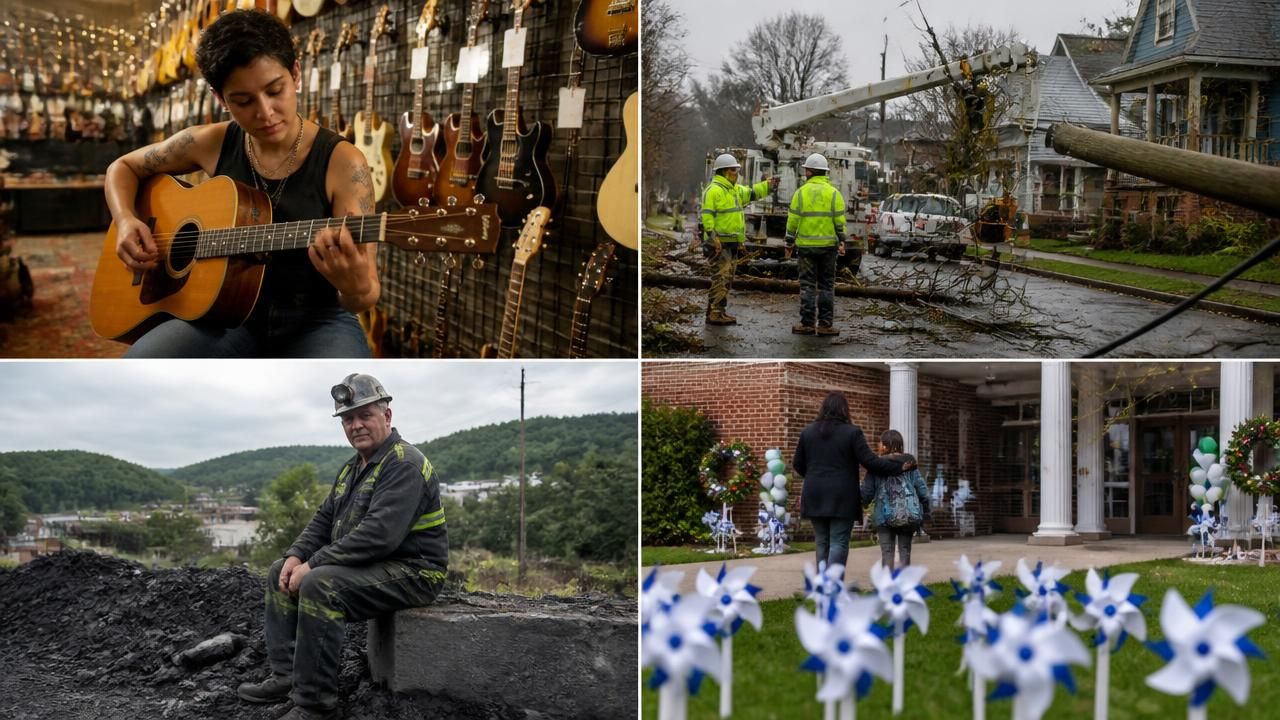
This week, a patchwork of stories from across the country highlights the many faces of community resilience—from a Texas nonprofit extending health coverage to gig workers, to storm-weary residents in the Midwest, to a Kentucky coal town facing an uncertain future, and a Connecticut community marking a painful anniversary with a symbol of hope.
A Lifeline for Musicians—and Soon, Food Workers
In Austin, Texas, a pioneering program is helping ensure that the city's musicians don't have to choose between their art and their health. The Health Alliance for Austin Musicians (HAAM), in partnership with local public health agency Central Health, subsidizes marketplace health insurance plans for working musicians. According to NPR, the program has become a model for other cities, even as rising healthcare costs make it increasingly expensive to maintain.
KUT reports that the nonprofit is now looking to expand its reach to food workers, a similarly vulnerable population in the gig economy. For years, the service industry has grappled with low wages, irregular hours, and limited access to employer-sponsored benefits. By broadening eligibility, HAAM aims to cover even more of Austin's creative and service workers.
Why this matters
The initiative reflects a growing recognition that traditional employer-based health insurance doesn't fit the modern labor force. Musicians, servers, and other gig workers often fall through the cracks. As one advocate explained:
"For many workers, health insurance is the difference between a minor setback and a financial catastrophe. This program is a lifeline."
The need is clear: KNAU notes that thousands of musicians have been helped by the program, and KVUE highlights the importance of the HAAM-Central Health partnership. But with healthcare costs climbing, organizers warn that sustaining the effort will require continued community support and creative policy solutions.
- HAAM and Central Health have worked together to provide marketplace insurance subsidies.
- Musicians and increasingly food workers are eligible for assistance.
- The program has inspired similar efforts in other cities, according to NPR.
- Rising premiums pose a challenge to the program's long-term viability.
Northwest Indiana: Still in the Dark
Meanwhile, in northwest Indiana, thousands of residents are still without power nearly two weeks after a severe storm swept through the region. The prolonged outages have disrupted daily life, from heating and cooling to refrigeration and medical equipment. Local officials and utility crews are working around the clock, but many are growing frustrated with the slow pace of restoration. The situation underscores the vulnerability of aging infrastructure in the face of increasingly extreme weather events.
Pike County Coal Workers in Limbo
In eastern Kentucky, a judge's decision to dismiss a coal operator's bankruptcy case has left workers in limbo. The ruling means that employees of the Pike County operation face uncertainty over back pay, benefits, and even their future employment. The case is another blow to a region already hard hit by the decline of the coal industry. For the workers and their families, the lack of clarity is deeply unsettling, as they await word on what comes next.
A New Beginning in Newtown
Four years after the tragic shooting at Sandy Hook Elementary School, a new school building is preparing to open its doors in Newtown, Connecticut. The state-of-the-art facility replaces the old school, which was demolished after the 2012 attack that claimed the lives of 20 children and six educators. The new building is designed not only to meet modern educational standards but also to create a warm and welcoming environment for students and staff. Community leaders describe it as a powerful symbol of healing and hope.
Common Threads of Resilience
Though separated by geography and circumstance, these stories share underlying themes. In Austin, a public-private partnership fills a critical gap in the social safety net. In Indiana, the focus is on infrastructure and disaster response. In Kentucky, a community grapples with economic transition. And in Newtown, a community transforms grief into renewal. Together, they illustrate the many ways Americans support one another in times of challenge—and the enduring strength of community bonds.