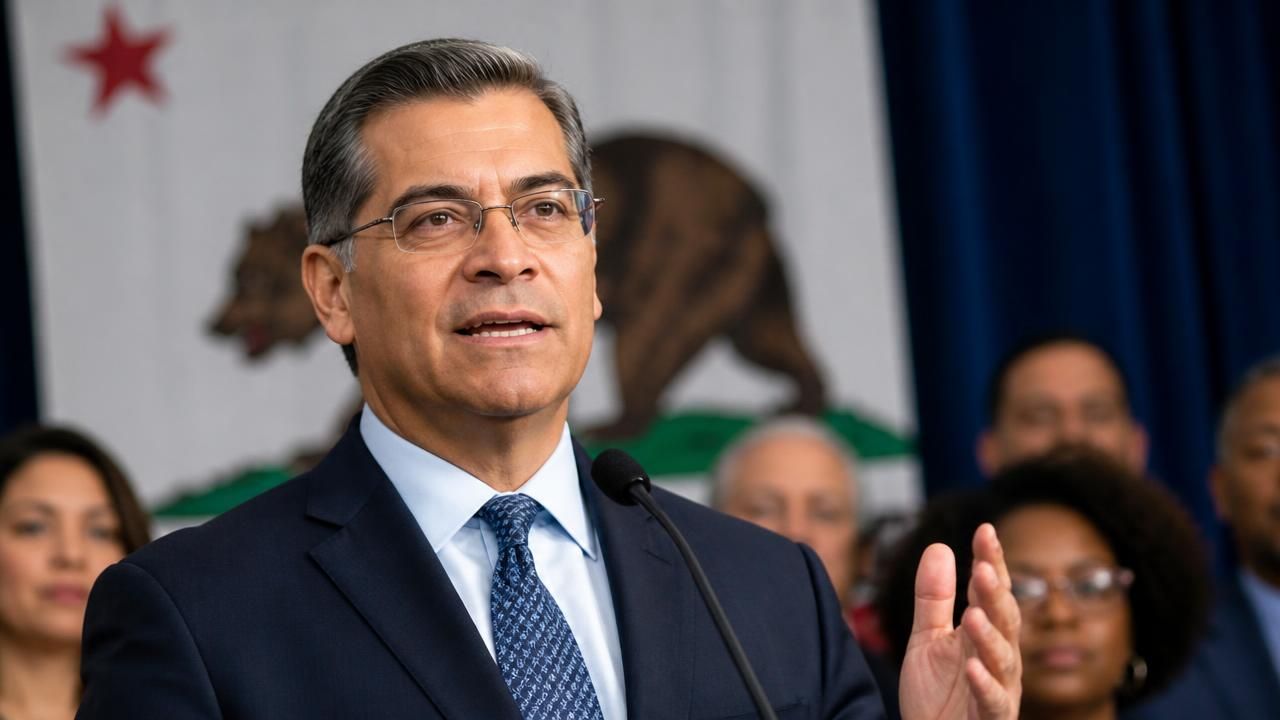
Xavier Becerra, the former U.S. Secretary of Health and Human Services (HHS), is once again in the political spotlight as he campaigns to become California's next governor. With a commanding lead in recent polls over Republican challenger Steve Hilton, Becerra is the front-runner in a race that has quickly become a referendum on his national record, his policy platform, and his willingness to engage directly with voters. But as the campaign heats up, a series of controversies—ranging from stolen campaign funds to whistleblower allegations about missing migrant children—has put the Democrat on the defensive.
Becerra, who served as California's attorney general before leading the nation's health agency under President Joe Biden, entered the race with a familiar name and a deep resume. Yet his path to Sacramento is not without obstacles. The race pits him against Hilton, a former Trump administration official and staunch conservative, setting up a stark ideological contrast in a state that has not elected a Republican governor in nearly two decades.
Healthcare Record Under Fire
At the heart of Becerra's campaign is his tenure at HHS, where he oversaw a historic expansion of health coverage. During his time in office, the nation's uninsured rate hit an all-time low, a fact that Becerra frequently cites on the trail. However, as NPR reports, that achievement is now under threat. President Donald Trump's actions have driven millions of Americans off health insurance, and Becerra has pledged to reverse this trend if elected governor.
We know how to cover people. We did it before, and we will do it again.
In a recent policy roll-out, Becerra laid out ambitious plans to protect and expand healthcare access in California, including proposals to bolster the state's insurance marketplace, invest in mental health services, and address the social determinants of health. He has also promised to safeguard coverage for undocumented immigrants, a key constituency in the state. Yet critics argue that his plans lack specificity. The New York Post has characterized his platform as "shocking" in its vagueness, noting that Becerra has offered few details on how he would fund these initiatives or tackle the state's broader affordability crisis.
Becerra's cautious approach extends beyond healthcare. According to a report from NPR-affiliated station IJPR, Becerra is "getting to play it safe" in the race, avoiding bold promises that could be used against him. Supporters see this as a sign of pragmatism and experience, pointing to his tenure as California's attorney general, where he filed hundreds of lawsuits against the Trump administration and established himself as a legal bulwark against conservative policies.
Whistleblower Claims Over Migrant Children
The campaign has also been dogged by allegations surrounding Becerra's oversight of unaccompanied migrant children during his time at HHS. The New York Post has published a series of exclusive reports, citing whistleblower claims that more than 130,000 migrant children remain missing after being placed with sponsors. The allegations, which have been fiercely denied by Becerra's camp, allege that his department failed to track these children adequately, leaving them vulnerable to trafficking and exploitation.
The controversy has become a rallying cry for Hilton, who has sought to paint Becerra as culpable in what he calls "a humanitarian catastrophe." In a statement, Hilton said, "The people of California deserve to know the truth about Xavier Becerra's role in this scandal. He cannot hide from it." Becerra's campaign has dismissed the reports as "politically motivated" and "misleading," pointing to federal oversight reports that have largely exonerated HHS policies.
The issue has also created friction with some of Becerra's former colleagues in Washington. NBC News reports that several Biden-era officials have privately expressed unease with Becerra's handling of the migrant children issue, though most have refrained from public criticism. An anonymous former HHS official told NBC, "There were systemic problems, and Xavier was the boss. It's fair to ask what he knew and what he did about it."
Platform and Debate Strategy
Beyond the controversies, Becerra's campaign is defined by a strategic decision to limit media exposure. Hilton has repeatedly challenged Becerra to a series of debates across California, but Becerra has so far declined to commit. This has led to accusations that he is trying to "run out the clock" and avoid tough questions, as the New York Post has framed it.
In contrast, Becerra's team argues that he is being deliberate about his appearances, focusing on targeted outreach rather than spectacle. A spokesperson said, "Xavier is meeting with voters across the state, listening to their concerns, and laying out a vision for California's future. He looks forward to debates at the appropriate time."
When Becerra has appeared, he has emphasized a broad agenda that includes housing affordability, healthcare access, and artificial intelligence. In a recent address, he proposed new regulations for AI development, drawing on his experience as a former attorney general. He also pledged to streamline housing construction by cutting red tape, a key issue in a state plagued by a severe housing shortage. However, as the Los Angeles Times noted in a recent commentary, "From here to November, Becerra will need to do more than offer a laundry list of priorities. He will need to convince voters that he has the vision and the grit to lead."
The Race Ahead
Despite the challenges, the numbers are in Becerra's favor. A recent PPIC poll shows Becerra leading Hilton by a wide margin of 61% to 36%, reflecting California's Democratic lean and Becerra's strong name recognition. Hilton, a former Brexit strategist and Fox News personality, has struggled to gain traction, though he has used the migrant children scandal and debate challenges to energize his base.
- Becerra leads in all major demographic groups, but particularly among Latino and Asian American voters.
- The race has also become a proxy battle over Trump-era policies, with Hilton embracing the former president's border security agenda and Becerra countersuing with his health and immigration records.
- California's primary election is scheduled for June 2026, with the general election to follow in November.
Political observers say Becerra's cautious strategy carries risks. If he continues to avoid direct engagement, he may appear evasive, especially as Hilton amplifies the migrant children allegations. Conversely, a commanding lead allows Becerra to set the terms of the debate, and his team is betting that California voters will ultimately trust a seasoned public servant over a controversial newcomer.
"Becerra's challenge is to translate his national profile into a compelling local story," said Jessica Levinson, a professor of constitutional law at Loyola Marymount University. "He needs to show that he understands the concerns of everyday Californians, from the cost of living to public safety. If he can do that, the math is on his side."
As the campaign moves toward the primary, all eyes will be on Becerra's next moves—whether he will agree to debate, how he addresses the whistleblower claims, and whether his cautiously crafted platform can withstand the scrutiny of a high-stakes statewide race. For now, he remains the candidate to beat, but the road to Sacramento is never a safe one.