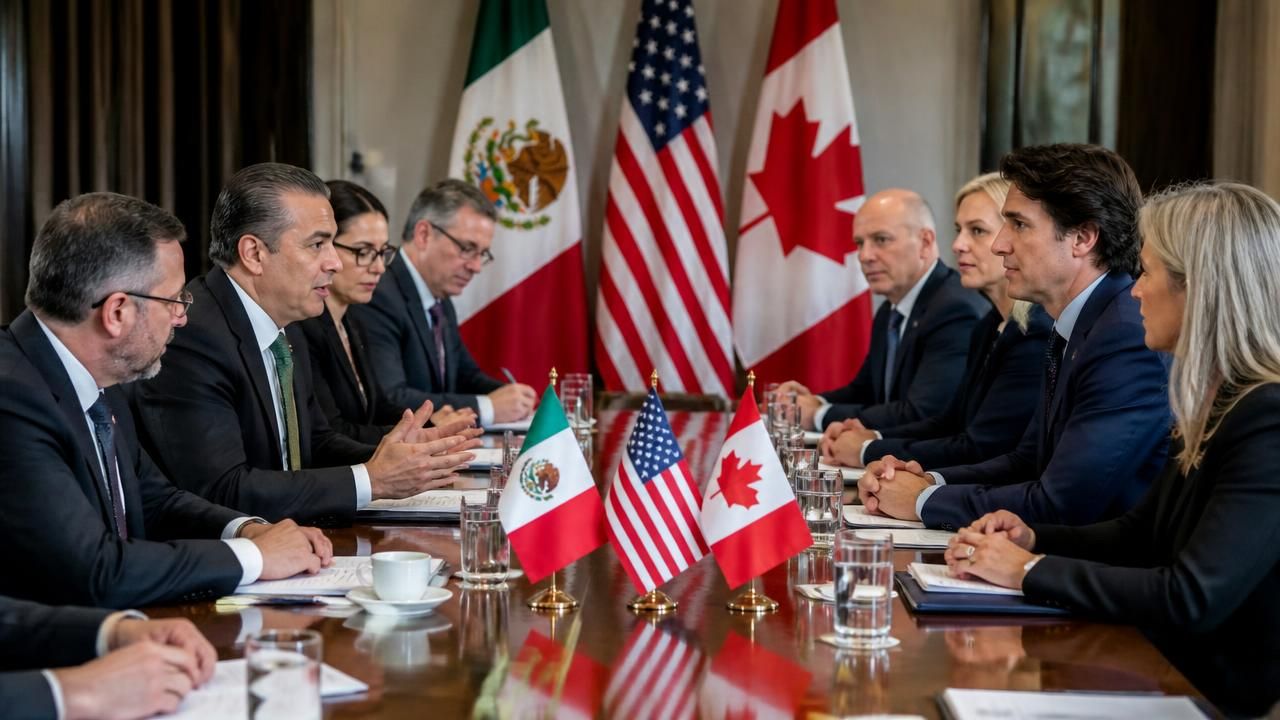
Trade negotiators from the United States, Mexico, and Canada have returned to the table this week amid a fast-moving and increasingly contentious tariff landscape. With President Donald Trump imposing fresh tariffs on Canada and pressing Mexico to align with Washington's tariff wall against Chinese steel, the talks—centered on the US-Mexico-Canada Agreement (USMCA)—have taken on renewed urgency.
Mexico's top trade negotiator expressed optimism that the country can secure less burdensome tariff terms on automobile and steel exports, similar to revised measures the US is discussing with Canada. Canada's chief negotiator also voiced hope after a round of talks, even as Trump's latest tariff actions complicated the atmosphere.
Tariff Talks and the Auto and Steel Front
At the heart of the negotiations are two politically sensitive industries: automobiles and steel. Mexico and Canada both rely heavily on exports of these goods to the US market. According to Bloomberg, Mexico's trade minister believes a deal can be reached that would lower US tariffs on Mexican cars and steel, mirroring the approach being considered for Canada.
However, the US is also pressing Mexico to adopt a harder line on Chinese steel imports, effectively asking Mexico to erect the same tariff barriers Washington has placed on Chinese steel. This demand reflects the broader US strategy of preventing transshipment through third countries. Justin Trudeau's government, meanwhile, is seeking to exempt Canada from tariffs that have already been imposed on Canadian steel and aluminum.
“We are confident we can find a formula that works for all three countries,” a senior Mexican official said, speaking on condition of anonymity. “The spirit of cooperation is still intact.”
Automakers Face Billions in Potential Costs
Behind the diplomatic optimism, however, lies deep anxiety in the auto industry. Detroit's three major automakers—General Motors, Ford, and Stellantis—fear that a revamp of the North American trade deal could cost them billions of dollars. Internal industry analyses warn that stricter rules of origin, increased tariffs, or new quotas on vehicles and components could significantly raise production costs and disrupt the carefully integrated supply chains built over decades.
In a separate development, a New York Times report noted that car companies are increasingly absorbing tariff costs rather than passing them on to consumers, in an effort to preserve market share. This squeeze on profit margins comes at a time when the industry is already grappling with the transition to electric vehicles and rising raw material costs.
Canada's Broader Trade Concerns
As trade talks continue, Canadian officials are also seeking relief on non-tariff issues. British Columbia's premier revealed that Prime Minister Mark Carney has asked US officials to lift an American alcohol ban that has hurt Canadian exports. The request surfaced as negotiators moved closer to a partial deal, though alcohol remains a contentious side issue.
According to the Financial Times, Canada is now exploring sectoral trade agreements with the US, rather than a comprehensive rewrite of the USMCA. This approach—negotiating on a sector-by-sector basis—reflects a pragmatic shift as Trump seeks pre-election wins that can be announced without a full-scale treaty renegotiation.
Alcohol Bans and Sectoral Deals
The alcohol ban, which has drawn particular ire in Canadian provinces, may be one of the first issues resolved in a limited agreement. Provincial leaders have made clear that any broader trade pact must include provisions for cross-border alcohol sales. Sectoral deals on aerospace, agriculture, and digital services are also being floated as quick wins.
The Broader Mexican Business Landscape
The trade talks occur against a backdrop of significant business developments in Mexico. The country's central bank gave approval to Nubank, a Brazilian digital bank, to launch banking operations in Mexico—a sign that fintech investment continues to flow in despite trade uncertainties. Walmart Mexico shares suffered their steepest decline since 2018 after the company reported weaker-than-expected earnings, highlighting the vulnerability of consumer-facing businesses to inflation and tariff-related cost pressures.
Meanwhile, Mexican billionaire Ricardo Salinas announced that he will take his retail chain Elektra private, a move he says will "set him free" from market scrutiny. In political news, President Claudia Sheinbaum unveiled an electoral reform proposal despite pushback from some allies, drawing attention away from trade for a moment.
Peso Slump and Economic Signals
Former President Andrés Manuel López Obrador, who still commands significant influence, declared that the recent slump in the peso "helps" the Mexican economy after the currency had become "too strong." The peso's depreciation has been driven in part by tariff fears, but AMLO's comments suggest a nuanced view—one that sees a weaker currency as beneficial for exporters.
Commodity markets have also been jittery, with fastmarkets reporting low activity in the Mexican primary aluminium market as buyers adopt a wait-and-see stance amid tariff uncertainty.
What This Means for North America
The outcome of these talks will shape the future of North American trade. If Mexico can secure tariff reductions on autos and steel, it may strengthen the case for a broader agreement. But the US demand for a unified anti-China steel tariff wall complicates matters, as does Canada's insistence on resolving issues like the alcohol ban.
For the automakers, the stakes are existential. As one industry analyst put it: "Every week of uncertainty costs time and money. The longer the talks drag on, the more difficult it becomes to plan investments across the region."
With the Trump administration eager to showcase wins, and both Mexico and Canada hoping to avoid a full-blown trade war, the next few weeks will be critical. The pragmatic shift toward sectoral deals may offer a temporary solution, but it risks leaving the broader structural issues—such as rules of origin and dispute resolution—unresolved.
For now, the mood is cautiously optimistic, but the road ahead remains fraught. As one Canadian official summarized: "We are closer than we were, but still far from where we need to be."