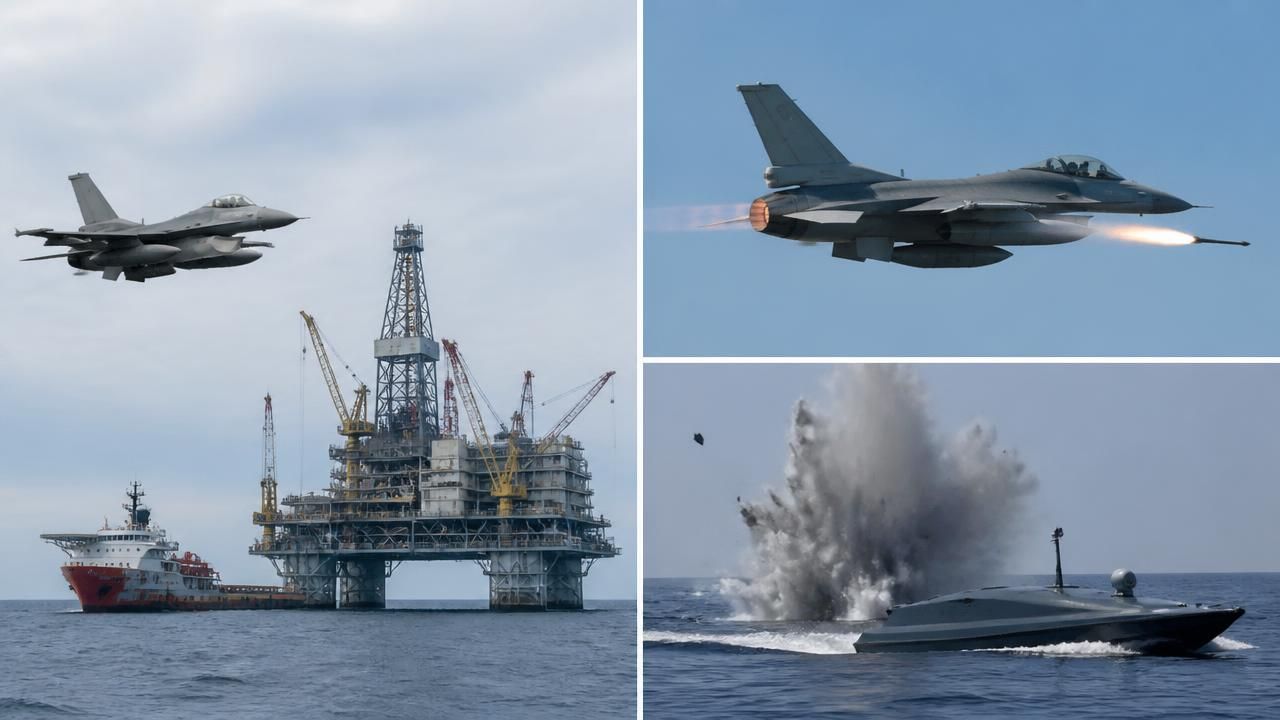
The Black Sea has become a crucible for a new kind of warfare, where unmanned surface and aerial vehicles are challenging traditional military power. In a 72-hour period, NATO member Romania scrambled F-16 fighter jets to destroy a Russian maritime drone near a critical offshore gas platform, while Ukraine claimed a world first: naval drones shooting down Russian fighter jets. These incidents, reported across multiple outlets, underscore how drone technology is rapidly transforming the region's security landscape.
Romania's F-16s Intercept Russian Drone Near Neptun Deep
On August 20, the Romanian Coast Guard spotted an explosive-laden unmanned surface vessel (USV) a few hundred meters from the main drilling platform of the Neptun Deep project in the Black Sea. Defense Minister Radu Miruță announced on Facebook that two F-16 fighter jets were scrambled and used their cannons to disable the drone, after which explosive ordnance experts carried out a controlled detonation. A video shared by the minister showed the operation. According to Ars Technica, the platform, once fully operational in 2027, will make Romania the largest gas producer in the European Union. The quick response protected hundreds of workers and vital energy infrastructure.
“To protect the lives of the workers and the offshore gas infrastructure, the Romanian military scrambled two F-16 fighter jets to stop the drone with cannon fire,” Miruță said.
The incident marks the third such Russian drone interception near Romanian territory in three days, according to news10.com, highlighting Moscow's increased use of naval drones to probe NATO's eastern flank and disrupt energy security. Reuters noted that Romania has repeatedly reported Russian drone fragments washing ashore, a sign of the escalating threat.
Ukraine's Historic Drone Boat Kill of Russian Fighter Jets
While Romania was dealing with the drone boat, Ukraine announced a significant milestone in drone warfare. On the same day and the day before, Ukrainian naval drones, specifically the Magura V5 USV, reportedly shot down two Russian warplanes over the Black Sea. KyivPost reported this as a first-ever unmanned surface vessel kill of a fighter jet. The Ukrainian Defense Intelligence (HUR) claimed that a Magura drone equipped with surface-to-air missiles downed a MiG-29 and a Su-30SM near the Crimean coast. The New York Post and The Telegraph both carried the claim, noting it would be a historic first. Military Watch Magazine reported that two Su-30SM jets were claimed shot down, while other sources mention a MiG-29 at Belbek airfield in Crimea.
“Ukraine demonstrates a completely different technological level,” an expert told RBC-Ukraine, commenting on the Su-30 downing. The claim is part of a broader pattern of Ukrainian drone attacks targeting Russian air assets and naval vessels in and around Crimea. In the same 24-hour period, Ukraine said it struck Russian radar domes, a Pantsir air defense system, and two military boats in Crimea. CNN reported that Ukraine previously used a seaborne drone to destroy a Russian fighter jet on the ground, but the air-to-air success is unprecedented.
Russia's Counterclaims and Escalation
Moscow has pushed back, claiming its own jets destroyed Ukrainian drone boats. The Moscow Times reported that a Russian fighter jet destroyed a Ukrainian boat in the Black Sea, and separately, Russia said it destroyed four Ukrainian military boats carrying troops. These competing narratives are typical of the information war accompanying open combat. Russia also announced it had scrambled jets to intercept two drones over the Black Sea, a sign that both sides are deploying unmanned systems aggressively.
Magura V5: The Drone Reshaping Naval Warfare
The Magura V5, a compact, high-speed naval drone developed by Ukraine, has become a symbol of asymmetric warfare. UNITED24 Media detailed how these drones have already sunk a Russian warship and are now being exported to the Indo-Pacific, where they made a debut during a 17,000-troop military exercise by sinking a target ship. Ukraine's drone fleet has inflicted an estimated $350 million in losses on Russian warships and aircraft, forcing Moscow to revive the Soviet-era “Katran” program for counter-drone systems, according to UNITED24.
In recent weeks, Ukraine has also claimed to have sunk the submarine Rostov-on-Don in Crimea and destroyed a Russian patrol ship, reports BBC and The Moscow Times. These strikes, along with the downing of jets, suggest drones are now a decisive factor in the war, allowing Ukraine to project power far beyond its coastline.
Framing the Future of War
Western media has largely framed Ukraine’s drone successes as a technological triumph that exposes the vulnerability of conventional platforms. An opinion piece from KyivPost, titled “Operation Spiderweb Is the Future of War – and America Isn’t Ready,” argues that the integration of AI, autonomous swarms, and low-cost drones is replacing expensive hardware. The piece warns that the US military, still built around carrier groups and stealth fighters, may struggle to adapt to this new paradigm.
Conversely, Russian media, as reported by The Moscow Times, emphasizes Moscow's ability to counter drone threats, highlighting interceptions and destruction of Ukrainian boats. The truth likely lies somewhere between the propaganda, but the trend is undeniable: the Black Sea has become a laboratory for drone warfare, with implications for global military strategy, energy security, and NATO’s eastern defenses.
Analysts point out that Romania’s interception of a Russian drone near a gas platform is a stark reminder that undersea and surface infrastructure are vulnerable to sabotage. The Neptun Deep project, which Europe has eyed to reduce dependence on Russian gas, is a strategic asset. The incident may push NATO to reconsider how it protects offshore installations, possibly with more permanent drone and fighter patrols.
The events of this week mark a turning point: naval drones are no longer just cheap weapons of harassment; they are lethal platforms capable of engaging aircraft and warships. As Ukraine’s Magura drones continue to evolve, and as Russia adapts with countermeasures, the world is watching the future of combat unfold on the Black Sea.