The artificial intelligence industry has long feared a public reckoning. But the reckoning that has arrived looks nothing like the one tech executives and researchers spent years worrying about. It is not about rogue AI systems or mass unemployment. Instead, it is about something far more mundane and physical: the sprawling data centers being built to power the AI boom, and the growing sense among ordinary people that they are being asked to bear the costs without seeing the benefits.
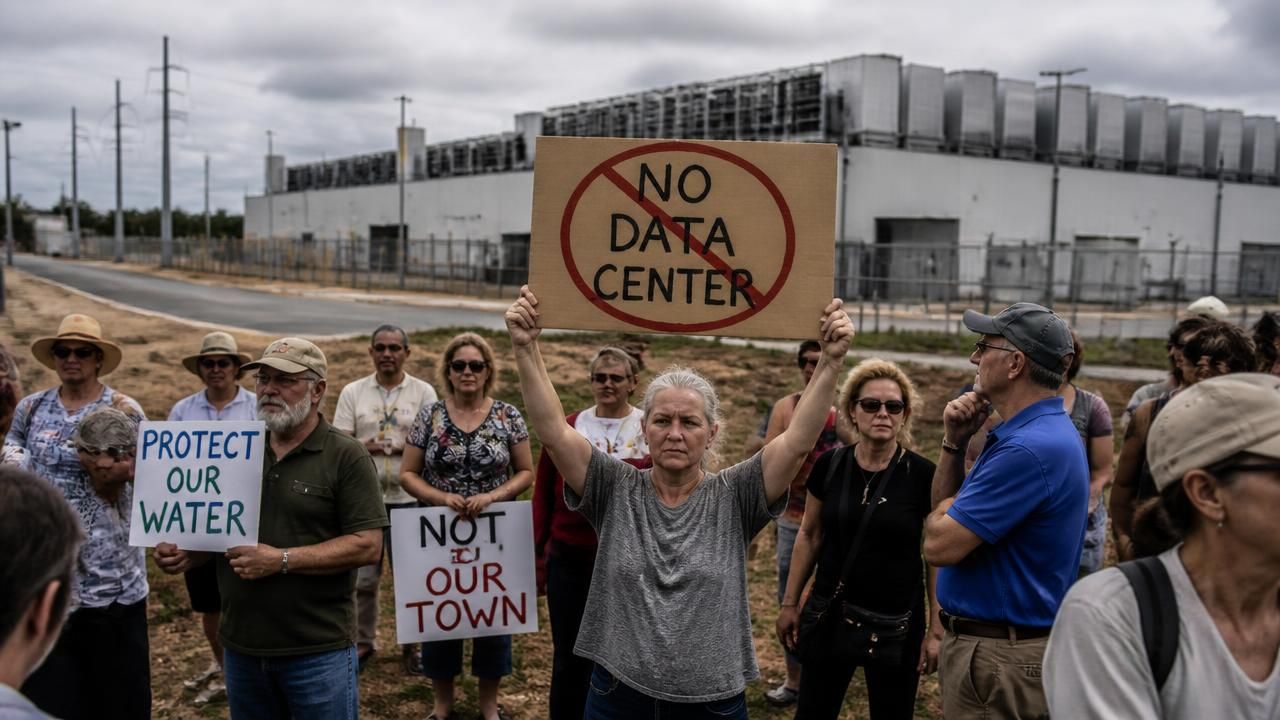
Across the United States and beyond, communities are fighting data center projects over concerns about water, electricity, noise, and land use. At the same time, a broader cultural backlash against AI-generated content known as 'slop' is eroding consumer patience, and some major brands are quietly pulling back from AI experiments. The message is becoming clear: the public is not as enthusiastic about AI's expansion as the tech industry hoped, and the resistance is taking unexpected forms.
The Physical Backlash: Data Centers Under Siege
Nate Silver, the statistician and writer, recently asked a question that captures the mood: 'Why does everyone hate data centers?' It is a good question, because data centers are not inherently controversial. They have been around for decades. But the scale of construction required for AI is unprecedented, and it is colliding with local residents who feel blindsided.
Vox's analysis offers a blunt explanation: 'Americans don't know how to fight AI, so they're fighting data centers.' AI is abstract, diffuse, and hard to target. Data centers are concrete, visible, and often dropped into communities with little warning. They consume massive amounts of electricity and water, and they generate noise and traffic. For many, they are the most tangible symbol of an industry that seems to operate above democratic oversight.
'The AI industry missed the thing that's become the most publicly salient: how upset people would be about building data centers.' — Bloomberg Odd Lots podcast
According to an investigation by NBC News, a web of little-known companies—data center developers, electrical contractors, and utilities—are driving this boom. Many of these firms operate behind the scenes, answering to a handful of hyperscale cloud providers. This has made it harder for communities to know who to hold accountable, and easier for developers to navigate around local opposition.
The Washington Examiner, however, argues that the backlash is 'aimed at the wrong target.' Data centers, it contends, are a necessary part of the digital economy, and their resource use is often exaggerated compared to other industries. But that framing has done little to soothe residents of places like Northern Virginia, where data centers now consume an enormous share of the area's power grid, or in drought-prone regions where water used for cooling is a flashpoint.
The Economics and Politics: Unprepared for the Fallout
One of the most striking aspects of the backlash is that it has escaped the predictive models of both economists and technologists. As a recent New York Times article put it, 'This is something that traditional economics isn't prepared to deal with.' The costs of data centers are often negative externalities—pollution, resource depletion, and community disruption—that don't show up in market prices. Meanwhile, the benefits, like improved AI capabilities, are concentrated in a few large corporations.
This dynamic has led to strange political alliances. Left-leaning environmentalists and right-leaning rural property rights advocates have found common cause in opposing data centers. The Big Newsletter's 'Monopoly Round-Up' draws parallels between the market power of AI giants and the gilded age monopolies, suggesting that the backlash is not just about local grievances but about a broader concern over corporate consolidation.
The Slop Backlash: AI's Cultural Revolt
The physical resistance is matched by a cultural one. The BBC reports that AI 'slop'—low-quality, AI-generated content flooding social media—is transforming online spaces and triggering widespread revulsion. Users are tired of seeing obviously synthetic images, generic headlines, and spammy commentary. This has created a sense of pollution in the information ecosystem, one that brands are beginning to notice.
Rolling Stone notes that 'brands are beginning to turn against AI,' as public ridicule outweighs the cost savings of automated content. Apple's upcoming iOS 27 is expected to incorporate more AI features, but Macworld warns that consumers may hate it, reflecting a broader fatigue with AI-driven changes to familiar products. The message is that AI adoption is hitting a wall of public skepticism.
Accountability and Democratic Oversight
The policy response is lagging. Tech Policy Press argues that 'shifting responsibility for AI harms undermines democratic accountability.' When damage occurs—whether from an algorithm or a data center—responsibility is diffused across a chain of developers, operators, and users. This makes it nearly impossible for citizens to seek redress or for regulators to enforce standards.
Some commentators have framed the backlash as a modern version of Luddism, but as Blood in the Machine's analysis points out, the original Luddites were not against technology per se; they were against the concentration of power that technology enabled. Today's anti-data-center activists, similarly, are often not anti-AI. They are simply demanding that the costs and benefits be distributed more fairly.
What Comes Next
The AI industry is at a crossroads. It can continue to build first and ask questions later, deepening the resentments that have already formed. Or it can take the backlash seriously, engaging with local communities, investing in cleaner and more efficient infrastructure, and being more transparent about its resource footprint. The latter is harder, but the alternative may be a regulatory crackdown that no one in the industry wants.
In the meantime, the lessons of the past year are clear. The public is no longer willing to accept AI's advances as an unqualified good. They want a seat at the table, and they will fight for it—whether the target is a data center, a feed full of slop, or a tech giant's bottom line.